

Football may not seem like the most obvious vehicle for Holocaust education, but two international visitors to Vancouver recently believe the world’s most popular sport is precisely the place to tackle the issue, as well as to confront the realities of racism on the field and in the stands.
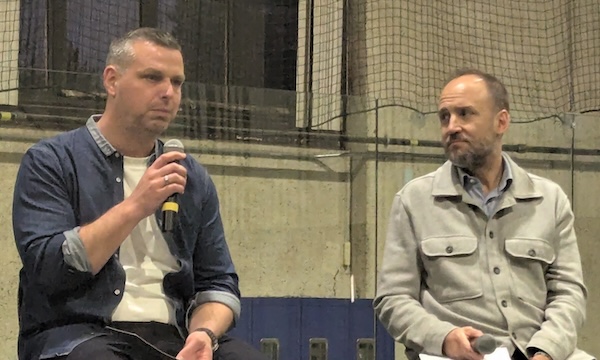
Daniel Lörcher, vice-president of the German team Borussia Dortmund and co-founder of the educational organization what matters, spoke Oct. 27 at an event hosted by the Vancouver Holocaust Education Centre (VHEC). The event, Holocaust Education in the Modern Stadium, also featured Mexican human rights expert José Antonio Guevara Bermúdez to discuss how football – soccer as it usually known around here – can both perpetuate discrimination and help combat it.
Lörcher said his involvement in Holocaust education began about 15 years ago when he and a fellow Borussia Dortmund supporter visited Auschwitz. What began as a personal initiative has grown into a program that has taken thousands of football supporters, club employees and others to the former Nazi extermination site. Lörcher himself has visited Auschwitz more than 50 times.
Holocaust education today, he said, is embedded throughout Borussia Dortmund, one of Europe’s largest football clubs, which has supporters around the world and approximately 248,000 registered members.
“In each and every department of the club and every fan group, everywhere, are people that have been part of our educational programs in Auschwitz,” he said.
Football provides an unusual opportunity to bring together people who might otherwise never meet, let alone discuss difficult historical subjects, said Lörcher. An 18-year-old supporter, for example, might find it easier to ask a 60-year-old fellow supporter about how his family dealt with the Nazi era than to raise the subject with his own parents.
Rather than treating football supporters as a potential source of antisemitism and other prejudices, Lörcher said his organization works to make them part of the solution. His educational initiatives examine Holocaust history through connections to football itself. One example is Árpád Weisz, a Hungarian Jewish coach who led major Italian clubs before fleeing Nazi persecution. He was ultimately murdered at Auschwitz.
Lörcher said the objective is not to simplify Holocaust education for sports enthusiasts, but to use their existing interests as a way into broader historical understanding.

He also challenged one of the questions frequently raised during Holocaust education programs: How would I have behaved during the Nazi era?
“This is the wrong question, because we are looking at the history from the end,” he said.
Instead, he argues, educators should ask how people behave today, what they can learn from the ideologies and mechanisms of the past, and how they can apply those lessons in their own communities.
The German Football League has participated for more than a decade in the World Jewish Congress’s annual #WeRemember campaign, in which football teams display Holocaust remembrance messages. Lörcher said clubs supplement the public campaign by sharing biographies of Holocaust victims connected to their home communities. He cautioned, however, against relying on symbolic gestures without meaningful education.
“You need to deal with the topic, and then it needs to become a value, and then you can start and hold up a banner,” he said.
Lörcher addressed the increasingly difficult environment for confronting antisemitism in European football since the Hamas attacks of Oct. 7, 2023.
He noted that the German Football League held a minute of silence following the attacks and that clubs subsequently participated in activities supporting bereaved families and raising awareness of Israeli hostages. While German stadiums did not experience the scale of anti-Israel demonstrations he had anticipated, he said, antisemitism and racism have become significant concerns on social media.
He described growing uncertainty within football organizations about how to approach Holocaust remembrance and antisemitism education in the aftermath of Oct. 7.
One practical initiative at Borussia Dortmund allows people experiencing harassment or discrimination inside the stadium to approach a staff member and use a designated code word. Employees, including ushers and merchandise staff, are trained to respond and assist the person in reaching a safe space. Lörcher said the club has seen an increase in reported incidents since establishing the system, something he interprets as evidence that people trust the process.
Guevara Bermúdez, academic director of Mexico City’s Museum of Memory and Tolerance, discussed his institution’s exhibition Fair Play: The Field That Unites Us, developed in conjunction with the 2026 FIFA World Cup, which was hosted by Mexico, Canada and the United States. The exhibition explores football as a global cultural phenomenon while examining racism, homophobia, gender inequality and the exploitation of migrant workers.
Guevara Bermúdez said international human rights principles developed after the Holocaust have increasingly influenced the obligations and expectations placed on sporting organizations. He cited discrimination against women, homophobic chants and the treatment of migrant workers during preparations for the 2022 World Cup in Qatar as examples of issues that international football has been forced to confront.
Major sporting events can create opportunities for activists to draw attention to human rights abuses, he said. During the 1978 World Cup in Argentina, for example, families of people disappeared under the military dictatorship drew international attention to state repression. At the 2018 tournament in Russia, members of the activist group Pussy Riot protested political persecution. During this year’s World Cup, Mexican families of disappeared people used the international spotlight to highlight their country’s continuing crisis.
Guevara Bermúdez said football has the capacity to bring people together even amid profound political disagreements, while offering opportunities to challenge the discrimination that exists within the sport. He urged individuals, sporting organizations and corporations to uphold the principles of the Universal Declaration of Human Rights.
Another theme of the evening was the importance of allowing people to ask difficult questions without feeling obliged to take immediate political positions. Lörcher described how, following Oct. 7, his organization began offering online discussions for football officials, supporters, musicians and employees who wanted to better understand events in Israel and the wider Middle East.
“Everybody is asked to have an opinion on Oct. 7 and on the situation in Israel and in Gaza and in Lebanon,” he said, “but nobody creates a space where people can go and say, ‘I don’t have a clue and I want to understand.’”
He acknowledged the challenges of working with groups that may share commitments to combating racism while holding views his organization considers antisemitic. His approach, he said, is to look for areas of agreement that can provide a foundation for discussing disagreements.
“Looking into what is unifying us gives us the chance to talk about what is dividing us,” he said.
The Oct. 27 event was moderated by VHEC education and engagement manager Ellie Lawson.
In opening remarks, VHEC executive director Hannah Marazzi explained why a Holocaust education institution would focus on football.
During the Holocaust, she said, Jewish athletes were excluded from sporting institutions, while sport itself was exploited to advance Nazi policies. Yet sports can also create moments of solidarity, dignity and belonging, she said.
Jennifer Scott, vice-president of community and social impact at the Vancouver Whitecaps, described the club’s efforts to make football accessible to communities that have historically faced barriers to participation. She said the Whitecaps deliver free soccer programming to more than 50,000 children annually, reaching communities across British Columbia, including Indigenous communities, newcomers, women and girls, and people living in underserved areas.