
It’s campy, it’s sexy, it’s hilarious – it’s Dracula: A Comedy of Terrors, playing at the Arts Club’s Granville Island stage. Gordon Greenberg and Steven Rosen wrote this irreverent Gothic spoof of the Bram Stoker story, and local Jewish community member Josh Epstein helms this fast-moving production.
The farce stays true to the original story in many ways but with the twist that Dracula is played by a woman: Synthia Yusuf, resplendent in black leather dominatrix attire, is one scary person. There are also lots of pop culture and local references to contemporize the narrative.
Vincent Tong plays the germophobic realtor Harker whose fiancée, Lucy (Kate Besworth), becomes Dracula’s love interest and victim as he lusts for her blood. Tong’s metamorphosis from nerd to dirty (and I do mean dirty) dancing vampire hunk is one of the highlights of the show, along with Steffanie Davis’s ability to transition seamlessly from any of her three characters with just a turn of her head or change of accent (her depiction of the weird bug-eating servant is priceless). Jeff Meadows doubles as the ugly, sexually repressed spinster sister Mina and the German frau doktor.
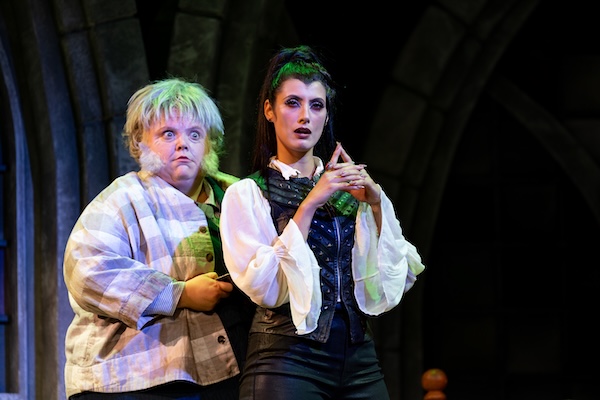
The set (Alaia Hamer’s design), with its arches and stained-glass windows, provides the backdrop for both the Count’s Transylvanian castle and a London mansion. The action moves from the Carpathian Mountains to the fog-shrouded streets of London, as the vampire hunters, armed with stakes, crosses and garlic cloves search for the elusive count to stop his diabolical agenda. Donnie Tejani’s costumes, Gerald King’s eerie lighting and MJ Coomber’s spooky music add the finishing touches to this romp.
There are some X-rated moments and simulated sex scenes in the show, so I would recommend it for audiences 13+ with parental guidance.
The Independent interviewed Epstein prior to opening night.
JI: You are coming off of a great show with The Play That Goes Wrong and going straight into another farce. Do you feel any pressure?
JE: Some, for sure, but mostly it’s excitement. Play That Goes Wrong worked because we bought into the material completely and had a killer team who grounded it. That’s the same approach here. The difference is Dracula is a different kind of farce. There’s real story under it, and the scares have to land, too. I also can’t lean on what worked last time. Every show exists online now and, when a production copies the original staging, it feels flat to me. So, we’ve been inventing in the room, which keeps it alive for us.

JI: What influenced your decision to do a gender reversal on the lead character?
JE: It didn’t start as a concept. Synthia walked in to audition and nailed it. Dracula is still “he” and we’re not playing it as a bit. We went toward a feminine masculinity, dangerous and magnetic, a little androgynous, in the way the glam rock icons were. The script already plays with gender in a lot of places (Steff playing Westfeldt/Renfield, Jeff playing Mina/Van Helsing) and most of it pokes at old ideas about who gets to be dangerous, who’s weak and who gets saved. Having Dracula played by a woman fits that without pointing at it. If anything, it makes him more seductive.
JI: Five actors play 16 characters. How difficult is that to direct?
JE: The hard part is precision. Every quick change, door and light cue has to hit or the joke is gone. We have a lot of tech for a five-person show, but it’s the best group to do it with. They’re veterans who can be silly and still play it truthfully, and I don’t have to explain the comedy to them.
JI: How would you characterize the production in terms of genre?
JE: Farce on the surface, but it’s more than that. There’s Gothic horror in the lighting and shadow-play, a bit of romance and some meta-theatre, because the audience sees the tricks happening. I want people to be scared a little and then laugh at being scared. That’s the “Comedy of Terrors” part of the title.
JI: Dracula was written by two Jewish playwrights. Do you see any Jewish humour or sensitivities in the script?
JE: Definitely. There’s vaudeville and Borscht Belt all through it, the quick one-liners, the pompous authority figure getting punctured (Dr. Westfeldt), the underestimated expert nobody believes until she’s right. Van Helsing is written “German dialect à la Mel Brooks,” so Greenberg and Rosen are knowingly working in that tradition. I grew up watching the Marx Brothers, so it’s a rhythm I love. It’s irreverent about status and loves its characters at the same time.
JI: What would you like audiences to take away from the production?
JE: I want them to come expecting to laugh and leave a little seduced, a little moved and a bit scared. Come because it’s a night out that feels like an event. The design is gorgeous, the cast is the best in the city, and you’ll see the stage magic happening in front of you and still not be able to explain it.
For tickets to the show, go to artsclub.com.
Tova Kornfeld is a Vancouver freelance writer and lawyer.
A side note:
Some historians believe that Dracula embodies the antisemitic tropes prevalent in Victorian England. The Count, with his “aquiline nose,” is portrayed as a blood-sucking, avaricious foreigner intent on invading “white” Britain (he buys five London properties in prestigious locations). The portrayal is based on the classic blood libel myth and the stereotypical image of the money-hungry Jew (Shakespeare’s Shylock and Dickens’ Fagin) or Jack the Ripper (suspected by some to have been Aaron Kosminski, a Polish-Jewish barber in London’s Whitechapel area). There are two direct references to Jews in Bram Stoker’s 400-page opus, both negative. Other scholars say this is all a coincidence.
– TK