
Michael Seelig’s solo show, Intimate Horizons, which includes his photo collages and paintings, opened at the Zack Gallery on Oct 15. The exhibit comprises several distinct threads, outlining the artist’s multifaceted personality.
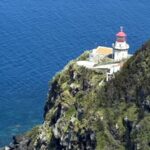
The distant horizons, emphasized by the collage “Horizons,” reflect Seelig’s career as an urban planning professor. The work consists of five different images flowing into one another. The photos of sea and land, a sunset and a foggy morning, were taken in different countries during different times and seasons, but the perspective is universal. “I see the world horizontally,” he told the Independent.
The second thread of the show is intimate – his home garden, in Vancouver. The photos are bright and meticulously detailed. Leaves and flowers of various shapes and sizes intertwine like luminous green mosaics. He obviously finds delight in his garden, and the only photo of people in the show is a photograph of his gardeners – a tribute to the people who maintain his private, verdant horizon.
And then, there are paintings. “All the paintings are of my garden, what I see from my window,” said Seelig. Unlike the photos, bursting with colours, the paintings are quiet, the tones muted, reminiscent of Claude Monet’s impressionistic landscapes. Again, the artist’s love for his garden is unmistakable in every pastel brushstroke.
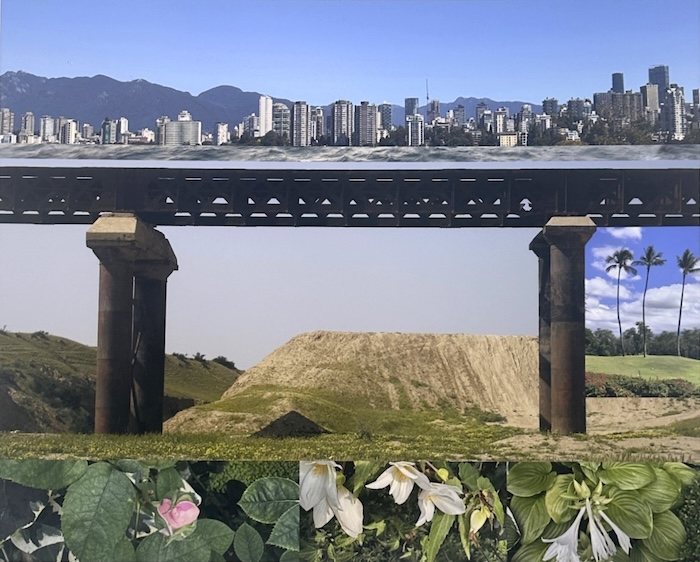
Another aspect of Seelig’s complex artistic profile comes out in his urban photocollages. “Cityscape” is one of them.
“I photographed the bridge in Israel,” said Seelig. “But I wanted more, so I put the photo of the Vancouver skyline across the top and a selection from my garden photos across the bottom. It still needed something else. On the right, under one of the bridge supports, is a photo of palms in Hawaii. Now it looks complete.”
Intimate Horizons is Seelig’s third exhibit at the Zack Gallery. He had shows there in 2014 and 2019, but hasn’t exhibited anywhere else.
“I don’t consider myself an artist,” he said, “but I wanted to contribute to the JCC and the Zack Gallery. That’s why the proceeds of all three shows are for the gallery’s benefit.”
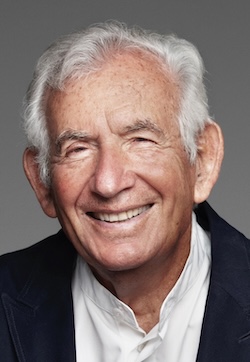
The richness and originality of Seelig’s creativity, reflected in his show, come to the fore in his recent memoir, Just Happened.
“This book is for my grandchildren,” said Seelig. Half text and half photos, the book documents the long and fruitful life of a fascinating man. The focus is on people: the author’s family and friends, colleagues and mentors, casual pals and kindergarten connections that lasted for decades.
It starts with Seelig’s childhood in Israel. Born in Tel Aviv 10 years before Israel became an independent state, Seelig matured together with his beloved birthplace. The chapters about his early years are full of affection for people and places around him: his schoolmates, his family, his city of Haifa. “I lived in a city of sea and hills and sunsets,” he told the Independent. “I thought every city in the world is like that.”
Even as a child, he liked to draw. “I was an average student, but my report cards often mentioned that I drew very well,” he said. In high school, his favourite lessons were handicrafts and jewelry making. It was clear that he was headed towards an artistic career. Not surprising really, as his father, Heinz, was one of the first interior designers in Israel.
“He designed interiors for restaurants, cafés, hotels, private homes,” Seelig said. “His family was from Berlin, but he saw what was happening in Germany, and he sailed for Palestine in 1933.” The memoir notes that, a couple years later, Heinz brought all his family over, saving them from the Nazis’ rampage.
With a designer father and his own propensity for making and creating, Seelig sought higher education in an artistic field. “I wanted to enrol in an architectural school,” he said. “I was considering the Technion, but its architectural program was more science and less art than I wanted. After my military service in the Israeli army, I decided to travel to London as a tourist. I fell in love with it. The city opened the world for me. I started looking at the architectural programs in London and found one – a five-year program – that was exactly what I wanted. And they accepted me after one interview.”
Seelig graduated and found a job with one of London’s architectural firms, but, after a few years, his dissatisfaction grew. “I liked developing ideas and creating designs, but the bulk of time of a practising architect is spent in management, permit applications, building specifications, etc.,” he said.
One of his friends suggested he should continue his education, and Seelig moved to Philadelphia, where he received his PhD in urban planning from the University of Pennsylvania. He also got married.
“I was talking with the Technion people, and they wanted to hire me, but they had no budget for that year,” said Seelig. “They recommended I find a temporary position for one year, and another friend pointed me towards UBC in Vancouver.
“We didn’t know anything about Vancouver or Canada,” he said.
Seelig and his wife, Julie, drove to Vancouver in the summer of 1971, planning to stay for one year. They still live here.
From his point of view as a city planner, Vancouver at that time was “a direct contrast to the older cities of North America – those cities were in the process of repairing past mistakes; Vancouver was in the process of taking off to make its own,” he said.
In addition to teaching urban planning at the University of British Columbia, Seelig tried new directions, explored new horizons. At various times, he owned, singly and jointly, a few consulting businesses related to city planning. Plus, he and several partners opened the restaurant Bridges on Granville Island and operated it for almost 40 years, from 1980 until about 2019, when they sold it, shortly before COVID.
“None of the partners knew anything about running a restaurant,” he recalled. “We hired a wonderful general manager.”
Over the years, Seelig’s participation in running the restaurant increased, notably, in its esthetic aspects. By the end, “… Bridges felt like a family, a happy place,” he writes in his memoir. “My association with Bridges became an important part of my identity.”
As are his photos and paintings, and the people who surround him. Intimate Horizons is at the Zack Gallery until Nov. 9.
Olga Livshin is a Vancouver freelance writer. She can be reached at olgagodim@gmail.com.