

Chavura: A small group of like-minded individuals who meet regularly for prayer, Torah study, socializing or celebrating Jewish life, often serving as an extended family or an autonomous alternative to formal institutional structures. (dictai.org)
We don’t have a name, and can’t agree on the spelling. We’ve bounced around between chavurah, chavura and havura, and this year we’re celebrating our 40th anniversary. We all agree that being in the chavura has been among the most intensely meaningful and extraordinarily significant facets of our lives.
We began as five young married couples, added a couple plus another single adult, and have weathered a death, four divorces (three of the divorcé left the chavura), a wedding between two of the divorcé, two new partners, and not only a second generation we call the Gen 2s, but now grandchildren, the Gen 3s.
The main driver for initiating our chavura was a shared desire among us to live more deeply Jewish lives supported by an intentional community of friends. We were already involved and active in one of three Vancouver synagogues, but were missing the home rituals and family events that make Jewish observance a more all-encompassing experience.
Some of us were estranged from our birth families, while others had good relations with our families of origin but had no local family. There were those of us with a light Jewish background who were seeking something deeper, and Jews by choice who were looking to expand their Jewish community. Many of us were starting our own families, a moment in life’s trajectory that often leads to an entry or a return to religious participation.
We formed at a time when chavurot had become a significant movement to revive and diversify Jewish practice. The movement grew out of a general dissatisfaction with institutional Judaism consistent with other social and political counter-culture movements of the 1960s and 1970s. Chavurot trended towards being egalitarian, lay-led and non-denominational, with participation ranging from groupings of a few families to larger communities offering Shabbat and holiday services.
We quickly evolved a pattern for Friday night dinners that has been our bedrock activity for these 40 years. We rotate meeting monthly in one another’s homes, and sign up the week before in a group chat for whatever potluck dish we’d like to bring. Friday nights begin with chatting over the appetizers, move to singing three Shabbat songs, Kiddush and Motzi, and then we eat.
We’ve also added in holiday and vacation activities, with a lunch the second day of Rosh Hashanah, break-the-fast for Yom Kippur, a Friday night in a sukkah, and epic Pesach seders with upwards of 35 or 40 attendees and our own wacky traditions. For many years, we held a weekend camp retreat towards the end of August at local Camp Sasamat.

In addition, we get together in all sorts of combinations for myriad activities. Two guys meet for breakfast once a month, two couples attend symphonies together, and many of the adults went on a weeklong cruise to Alaska a few years ago. There have been numerous weddings, baby namings and brises, b’nai mitzvot, graduation ceremonies from high school and university, and shiva minyans.
We have grown remarkably close after 40 years of sharing so much of one another’s lives, exhibiting the best aspects of both family and community, with few conflicts. It’s notable that the Gen 2s, and the 3s, are very much in contact with one another. By coincidence, three Gen 2 families now live in Seattle, two of them (not coincidentally) around the corner from each other. Five Gen 2s and their various partners and children still live in Vancouver, one is on Vancouver Island, one is in New York and two are in Toronto. The kids frequently meet up as they travel and reconnect with one another and with the Gen 1s when visiting Vancouver.
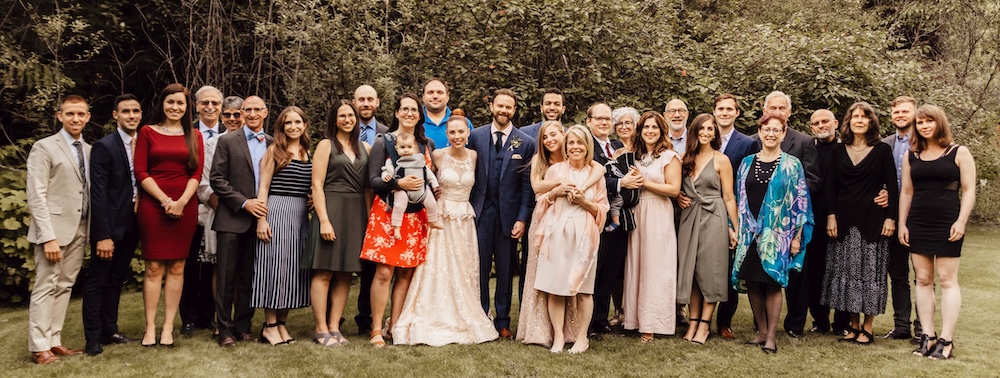
Perhaps “non-biological cousins” or “each other’s close friends” would be good descriptors for the kids, but they also exhibit unusual rapport with the Gen 1 chavuraniks. The chavurah kids often came and continue to come to the non-parental adults for advice, for guidance making connections as they move through the world, and to share challenges and experiences that they may be reluctant to discuss with their parents.
Why have we persisted? Some of the reasons are logistical: first and foremost, we meet every August to block out dates and hosts for the coming year, assuring that chavura events are locked in before calendars fill. Also, none of the Gen 1s have moved away from the city, providing a stable continuity of relationships.
But good logistics aren’t enough to stay connected and genuinely involved with one another for four decades. The chavura has more than provided what we were seeking, a deeper Jewish life and stronger family and community connections, offering an unequivocal system to celebrate the good times and support us when life becomes challenging.
Our personalities are quite diverse, but our individual quirks and behaviours have not become sources of irritation. In our chavura universe, we suspend judgment and accept one another’s oddities as a source of enjoyment rather than conflict, laughter rather than argument. I wish I knew the magic sauce by which we came to accept one another as we are, as it would be quite a boon to the world if that attitude would spread, but the how and why remain a mystery, albeit one that’s much appreciated.
Our chavura experience also attests to the power of ritual and repetition in maintaining robust communities. It is a very human characteristic to be comforted by predictability, and we’ve merged traditional Jewish rituals for Shabbat and holidays with chavura rituals we’ve evolved over time that repeat each Shabbat and holiday, year after year. We know that every seder Mark is going to pull out and read a postcard from an Israelite slave, and every Hanukkah there’s going to be a mass candlelighting at Richard and Cathie’s that goes very much against the fire code.
When we get together to sing from the songbook curated with our favourite songs, created for someone’s special birthday and used frequently when we gather, we’ll end with “Morningtown Ride” by the Limeliters. This became a chavura tradition during the Saturday nights around the weekend retreat campfire, when we’d sing the lullaby as our last song before putting the then-young Gen 2s to bed. It evokes the sweetness of a day spent together with the sadness that the end-of-day brings as the train moves along to sleepy-time.
Perhaps that’s the core reason we’ve stayed together so long, and why the chavura is so precious to each of us. The song encapsulates all the joy and laughter, and all the sadness and tragedy, that populate every life. It’s been the most profound of experiences to inhabit our journeys together, with the best of friends, recreating and redefining our Jewish life, as each generation has done for thousands of years.
Mark L. Winston is an internationally recognized bee researcher, teacher and writer. He directed Simon Fraser University’s Centre for Dialogue for 12 years, where he currently is a professor emeritus and senior fellow.