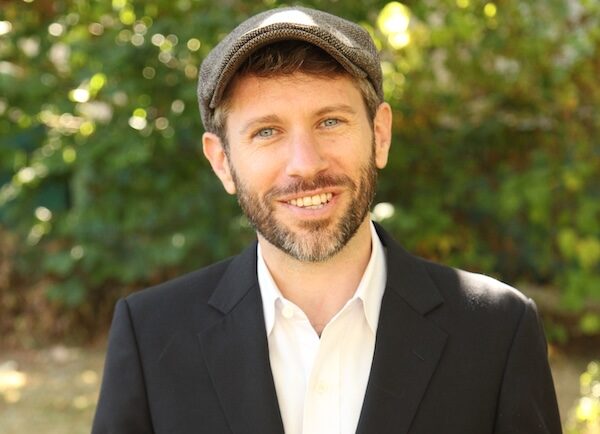

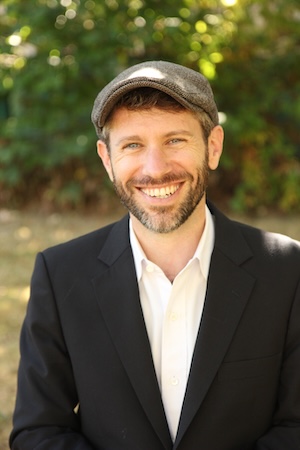
Rabbi Matthew Ponak helped launch Lech Lecha: Journeys of the Soul, the 2026/27 six-part Kolot Mayim lecture series, on Nov. 1. He spoke on the topic The Jewish Spiritual Seeker: Journeying Away and Coming Home, before both in-person and Zoom audiences.
A teacher of Jewish mysticism, a spiritual counselor and an author living in Victoria, Ponak talked about why many Jewish seekers leave the Jewish community – at least for a time – to find wisdom through meditation, yoga, psychology or other contemplative traditions. He considered how emerging forms of Jewish mysticism and practice can offer an embracing home that welcomes, rather than rejects, the insights discovered outside of Judaism.
The Victoria congregation’s lecture series, Lech Lecha, is named after the section in the Torah when Abraham receives a call to leave behind the place where he’s from, his family, and, as Ponak noted, maybe his culture, to go find the place to where he’s being called.
“The Zohar translates ‘lech lecha’ not as ‘get thee going’ or ‘get going,’ but as ‘go to yourself’ – ‘go to yourself,’” Ponak said. “And a question many of us today have faced, or at least we know people who face this in the Jewish community, is what happens when going to yourself, to find yourself, requires you to leave the Jewish community for awhile.”
Ponak addressed how various practices, including Shabbat dinner or Havdalah, which, in our age, appear rooted in tradition, were once innovations – the rituals are not written down in the Hebrew Bible.
Weaving this history of innovation and the exploration of new ideas to the present, Ponak said, “Today, we live in an era of religious freedom, for most Jews. We have the capacity, if we choose, to try new things, and there’s no Jewish or other religious beliefs around to tell us that that’s not OK. And, in times like this, there’s actually a great opportunity.”
A distinguishing feature of Judaism, Ponak emphasized, is that there is no monastic class, which means that its wisest, most spiritual teachers have to contend with the real world. People and circumstances may pressure us and we have to decide how to act.
“A tzaddik, a holy person, a righteous person, is not judged on how many stories they can tell you about the astral plane or about transcending suffering. A tzaddik is judged based on being a mensch, a good person. At the end of the day, that’s what matters,” he said.

Ponak shared his view that we are in another talmudic age, or transitional phase, now that there is a Jewish state.
“One could make the argument that the whole goal of diaspora Judaism, of the rabbi’s talmudic project, was to return to the land,” he said.
There’s a cycle that’s occurred, he explained, and, in this new age, inspired by the tradition of how earlier generations have dealt with this, we ought to be asking questions – of one another, of ourselves, of our communities, of our family across the globe – and also be engaging with tradition and studying Torah.
“We should be trying out practices we’ve never done before, that we can find, whether they’re approved halachic practices or just practices mentioned in these older books,” Ponak said. “And, somewhere – I don’t think it’ll happen right away, I think it’ll take multiple generations, like it always has – we are going to be transforming, we’re going to be changing and growing and moving forward. And that is the way we’re going to take the new, we’re going to take the old, and we’re going to weave them together and allow a gift for future generations to find wholeness and meaning here.”
Ponak’s books include The Path of the Sephirot: A 49-Day Omer Counter for Spiritual Growth and Inner Balance and Embodied Kabbalah: Jewish Mysticism for All People. He has recently printed The Hebrew Letters, which brings ancient tradition into a 22-card contemplative deck with a 32-page companion guidebook. To learn more about his teachings and books, visit his website, matthewponak.com.
Next up in the Kolot Mayim series is Adam Kirsch, a senior editor at The Atlantic and the author of several books on Jewish literature and ideas, on Dec. 13. Kirsch will speak about reclaiming Zionism after Oct. 7. He will examine the history and meaning of Zionism and consider why it remains crucial to a better Jewish future, both in Israel and throughout the diaspora.
This season’s speakers series offers a new direction for the talks. For the past six years, they have been held on Zoom. Now, three of the talks – including Ponak’s – are hybrid events, allowing attendees to attend the lecture in person, watch it on Zoom as it happens or on YouTube later. For the 2026/27 schedule, visit kolotmayimreformtemple.com.
Sam Margolis has written for the Globe and Mail, the National Post, UPI and MSNBC.