
Sisters Dr. Gloria Gutman and Dr. Carol Herbert at a Simon Fraser University convocation this past June. (photo from Carol Herbert)
Carol Herbert started university at age 16 and she’s still there at 80.
A primary care medical doctor who became a top university administrator, Herbert just celebrated her landmark birthday and – perhaps partly because her sister is the groundbreaking gerontologist Gloria Gutman – has reflected deeply on ideas of aging and continuing contributions to the community and the world.
Herbert recently added to her responsibilities. She is halfway through her term as chair of Simon Fraser University’s board of governors at one of the most consequential moments in the institution’s history – as SFU launches Western Canada’s first new medical school in six decades.
Chronicling Herbert’s career trajectory is challenging. Curricula vitae, she says, make lives look linear, as though people started with a destination in mind and marched deliberately toward it.
“It sure wasn’t like that for me,” she told the Independent.
She entered university at 16 and medical school at 19. After initially imagining a specialist career, marriage, motherhood and circumstance steered her toward a position at REACH Community Health Centre on Commercial Drive, one of Vancouver’s earliest community health centres.
She discovered she loved primary care. More than that, she discovered something fundamental about herself: she was a generalist.

“I love knowing a little bit about a lot,” Herbert said – understanding how things connect, transferring knowledge from one field to another and being comfortable making decisions without complete information.
That instinct would define her career.
Herbert became head of family practice at the University of British Columbia, held major leadership positions in medical education, and served as dean of the Schulich School of Medicine and Dentistry at the University of Western Ontario (now Western University) in London, Ont., from 1999 to 2010. She helped establish a new medical campus and became a prominent advocate for family medicine, primary care and a model of medical education that values community practice as much as specialized academic medicine.
Her experience eventually brought her into SFU’s orbit.
When the provincial government announced plans for a new medical school at Simon Fraser, Herbert was asked for advice. Someone initially suggested she might help write a curriculum. Her response, essentially, was: you are nowhere near ready for a curriculum. There were governance structures to create, relationships to establish and a host of foundational questions to answer first.
Herbert was appointed to SFU’s board of governors in 2022. She became chair, a two-year appointment, in November 2025.
SFU’s new medical school has now welcomed its first class – 48 students. Its particular emphasis on primary care and community-based medicine reflects much of what Herbert has spent her career advocating. Rather than driving students into specializations, SFU’s med school will help address Canada’s shortage of family doctors.
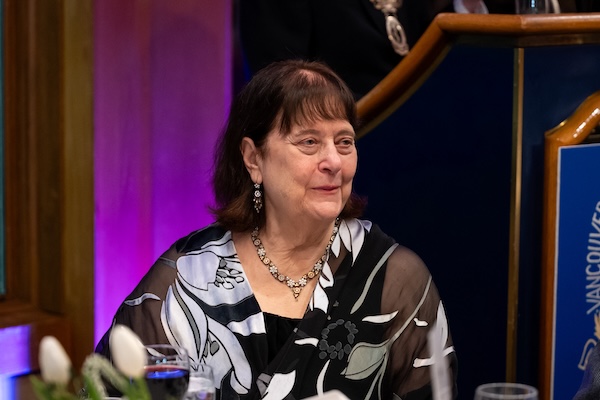
She is careful not to oversell what one new medical school can accomplish. “It’s not going to be the salvation of the healthcare system,” she said.
Herbert believes that general practitioners do not always get due credit. Some of the smartest, most capable and committed physicians she has encountered have been generalists working in communities large and small. The skill, she argues, lies precisely in dealing with uncertainty: seeing patients before their conditions are neatly diagnosed, recognizing who is seriously ill and who is not, asking the right questions, knowing when to investigate and when to wait.
It turns out that those same abilities are useful in leadership, she said. “You’ve got to be able to function with partial information.”
Herbert brings that philosophy to university governance. No matter the discipline, academia is facing difficult tensions between protecting free expression and academic freedom, fostering diversity, equity and inclusion, and ensuring that students and faculty feel safe, respected and able to participate fully in campus life.
She describes herself as a strong believer in free speech, academic freedom and university as a place where people learn not what to think, but how to think. Universities, in her view, should be places where knowledge is built and challenged, where students are encouraged to question received wisdom and where people can express uncomfortable ideas so long as they are not infringing on the rights of others.
She is equally emphatic that universities must respond when students feel unsafe or excluded. Values, she says, mean little unless they apply to everyone.
The combination of intellectual openness, institutional responsibility and a preference for evidence over slogans reflects Herbert’s broader approach to leadership.
“I like to be with people who know what they know and also know what they don’t,” she said, “and are prepared to defer to people who might know more, and who look for fact rather than coming out with their opinion first.”
Her responsibilities at SFU recently expanded again. With the university preparing to choose a new president, Herbert is chairing the presidential search committee – a process she expects will require extensive consultation throughout the university community.
The goal, she said, is to find a leader capable of guiding SFU through profound changes in higher education and society, including the rise of artificial intelligence, while remaining grounded in institutional values without being trapped by convention.
Being chair of this committee is an ambitious assignment for somebody who, technically, is retired.
Herbert appears amused by the concept. She seems to put the emphasis on “re” rather than “tired.” (In addition to everything else, she swims, walks, mentors, speaks her mind and remains deeply involved in public life.)
You don’t stop doing what you do “because you get old,” she said.
Aging is an academic matter in her family. As the (younger, she notes) sister of Gloria, the internationally recognized gerontologist recently profiled in the Independent, the topic is frequent fodder in sibling conversations that take place constantly.
Carol Herbert and Gloria Gutman are not the only notable names in the family. There are four sisters altogether, including retired social worker Patsy Policar and former opera singer and cantorial soloist Judith Levy. Herbert jokes that, at one point, the sisters thought they should open a clinic together: Patsy could provide social work, Carol medicine, Gloria psychology – “and Judy could sing.”
It’s a throwaway line, but it says something about an extraordinary family, who Herbert credits for the sisters’ collective successes.
Their parents, Rachelle and David Chertkow, raised four daughters in Vancouver with an expectation that achievement was normal and service was obligatory. Their father, a lawyer, was active in both the Jewish and broader communities. Their mother was deeply involved as a volunteer.
“We were raised to believe that we could do anything we wanted to do,” Herbert recalled.
But there was another message just as important: privilege came with responsibility.
“We were lucky to be in Canada, we were lucky to be who we were,” she said. “It was a question of how we’d give back, not whether. Tikkun olam was kind of baked in.”
That sense of obligation and commitment – not kudos – was what led to achievements. The plaudits have come nonetheless.
Herbert was named to the Order of Canada and inducted into the Canadian Medical Hall of Fame, among other honours.
These recognitions are “markers of responsibility,” she said – reminders to mentor others, bring people along and continue contributing.
One of her favourite recent photographs captures sisters Herbert and Gutman together at an SFU convocation. Herbert, as chair of the board of governors, is in a blue academic robe trimmed in red. Gloria, receiving an honorary degree, is in red trimmed in blue.
“We look like kids that got into the costume box,” she said.
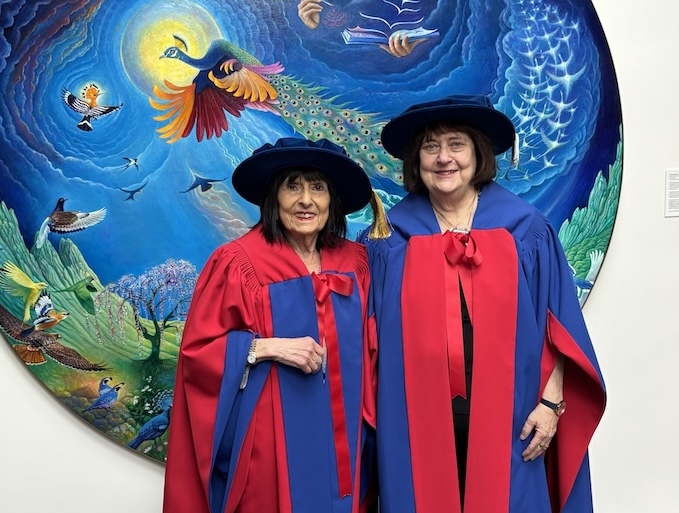
The joke disguises something deeper. The sisters are very different people, Herbert said, but they share the same core.
“That comes from our parents,” said Herbert. “I cannot talk about myself without saying I absorbed who I am from my mother and my father.”
All four sisters remain close. Since the pandemic, they have maintained a weekly Zoom call despite being spread between Metro Vancouver, Phoenix and San Diego. “We’re very fortunate we have the four of us,” Herbert said.
While she has no qualms telling everyone she just turned 80, Herbert jokes that Gutman prefers to admit only to being “over 65.”
Eighty once sounded ancient to Herbert. Now, she finds the notion almost funny.
“I just swam this morning,” she said. “We’ll be walking later.”
Between Herbert and her husband Fred Swartz, there are six children, 10 grandchildren and “nearly” seven great-grandchildren. Her life is crowded with family, friends, colleagues and causes.
“I’ve got a million people in my life,” she said.
Luck, she emphasized repeatedly, has played an enormous part: good health, good genes, being born in Canada, loving her work and, perhaps most of all, being born into the family she was.
But, as previously noted, the Chertkow daughters were also taught that luck creates an obligation.
“You’ve got to leave the world better than you found it,” said Herbert.