
A Yemeni who grew up praying for the destruction of Israel, a Bahraini who was taught in school that Jews deserved the Holocaust, and a Bedouin Israeli who encountered hostility elsewhere for his identity have all become vocal defenders of the Jewish state – and they brought their experiences and messages of coexistence to British Columbia last month.
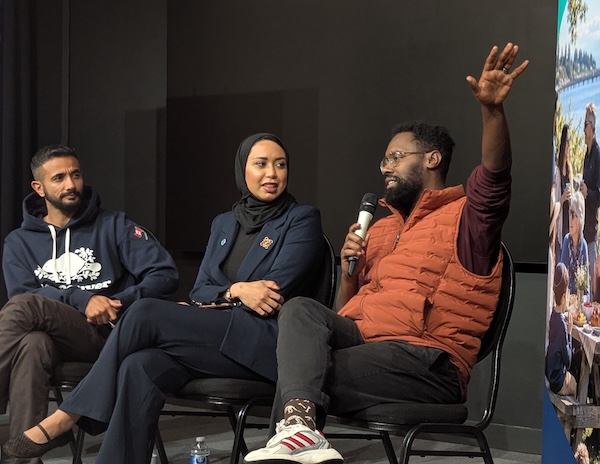
Luai Ahmed, Fatema Al-Harbi and Tamer Masudin spoke at Congregation Beth Israel Oct. 21 as part of United We Stand: Voices for Peace in the Middle East, a national tour organized by Allied Voices for Israel (AVI) and Sharaka, an organization dedicated to advancing the Abraham Accords and building relationships between Israelis and people across the Arab and Muslim world. The trio spoke in Langley the next evening.
The tour also visited Montreal, Toronto and Calgary, with the speakers participating in university programs, school visits, interfaith gatherings and community events.
For Ahmed, a Yemeni-Swedish journalist, the journey from childhood antisemitism to outspoken advocacy for Israel began with a friendship that challenged everything he had been taught.
Growing up in Sana’a, Yemen, he recalled attending Friday prayers where the imam would call for God to kill the Jews and destroy Israel. “And I’d respond, ‘Amen,’” he told the Vancouver audience.
The hatred extended into school, where students were taught antisemitic conspiracy theories, burned Israeli flags and received lists of supposedly Jewish-owned products to boycott. He believed it all.
Ahmed’s mother, a pioneering Yemeni women’s rights activist, encouraged him to challenge conventional thinking. In 2014, he moved to Sweden, partly because, as a gay man, he feared for his future in Yemen.
While at university in Sweden, Ahmed met an Israeli exchange student named Tal. He described his initial reaction as physical panic, but Tal greeted him warmly, enthusiastically discussing Yemeni food and offering to prepare traditional dishes. Ahmed initially assumed the friendliness concealed some sinister motive. Instead, the Israeli became one of his closest friends. Other Jewish friendships followed, including with an editor who became a mentor and father figure.

These relationships transformed how Ahmed responded to the Hamas attacks of Oct. 7, 2023. He saw images of the atrocities and realized that the victims could have been people he knew and loved.
“This is the violent resistance that I have cheered for my entire life,” he recalled thinking.
He began posting videos denouncing the attacks and the celebrations he witnessed among some acquaintances. The reaction to his posts included denunciations and threats from family and friends. Nevertheless, Ahmed continued speaking out and eventually accepted an invitation from Sharaka to visit Israel.
He acknowledged arriving with considerable apprehension, expecting hostility and mistreatment. He encountered a country that repeatedly contradicted his assumptions.
One particularly emotional experience came when approximately 500 Israelis of Yemeni Jewish ancestry gathered to welcome him. Although they did not share a common language, their appearance, customs and celebrations were familiar to him.
“For the first time since I left Yemen, [I] felt like I was back home,” he said.
The experience persuaded him that Israel was not the foreign entity he had been taught to imagine, but a country deeply rooted in the Middle East.
Ahmed described antisemitism as an “invisible castle” constructed in his mind over many years. His Jewish friendships had weakened that structure, he said, but it took the events of Oct. 7 and his subsequent travels to dismantle it more fully.
For Al-Harbi, a Bahraini women’s rights advocate and Sharaka’s director of Gulf affairs, the turning point came with the Abraham Accords.
Bahrain, she explained, has longstanding Jewish and Christian communities. Her family taught her religious tolerance, even while some teachers promoted antisemitism. One teacher, she recalled, denied the Holocaust or suggested that Jews deserved it; another taught that Jews were eternal enemies. At home, however, her mother insisted that hatred based on religion or nationality was unacceptable.
When Bahrain normalized relations with Israel in 2020, Al-Harbi eagerly joined one of the first delegations to visit. She recalled walking through Tel Aviv wearing a hijab and abaya when an Israeli approached to ask where she was from. When she answered Bahrain, he welcomed her.
“We’ve been waiting to have peace with Arabs for a long time,” she recalled him saying.
Al-Harbi was overwhelmed by the warmth she experienced, including invitations to Shabbat dinners and opportunities to meet Israelis from diverse backgrounds. When she shared her experiences online, she faced a barrage of abuse, accusations of treachery and death threats. The reaction convinced her of the importance of continuing her work. She left her previous employment and joined Sharaka full-time.
Al-Harbi illustrated the potential impact of personal encounters with a story about a close friend who had grown up praying for Israel’s destruction. The friend reluctantly agreed to attend a dinner for a visiting Israeli delegation in Bahrain, initially attracted more by the prospect of an excellent meal than by any desire to meet Israelis. She ended up sitting beside two Jewish members of the delegation.
After several hours of conversation, she approached Al-Harbi astonished.
“You know, they’re just like us,” the friend said. The similarities in family life, culture and religion had overturned her expectations.
Al-Harbi said the friend abandoned her hateful prayers and began challenging antisemitic comments within her own family.
“She saw the human in those people, and she saw the other side, and that left no space for hate,” Al-Harbi said.
Masudin, the third speaker, grew up in a Bedouin community in Israel and said his commitment to the country developed naturally, long before he became involved in advocacy.
As a teenager playing online video games with other young people across the Middle East, he encountered hostility whenever he identified himself as an Arab Israeli. Other players repeated conspiracy theories about Jewish control of banks, media and governments. Living in Israel, he found those assertions absurd.
“We can barely control our own country every election,” he joked.
Masudin later completed two years of voluntary national service in a Jewish-Arab youth movement, working with young people in mixed communities. He also traveled to Poland to study the Holocaust and became involved in combating antisemitism in Arabic.
Following Oct. 7, he began producing online videos condemning Hamas and explaining his perspective as an Arab Israeli. His first Arabic-language video attracted approximately three million views, he said. The response included considerable support but also threats and abuse.
Masudin warned that artificial intelligence, bots and social media algorithms are making it increasingly difficult to counter antisemitic conspiracy theories.
“What starts online never really ends online,” he said, arguing that digital hatred can contribute to real-world violence.
The Vancouver event was also an opportunity to explain Sharaka’s work. Alyssa Annis, who moderated the panel, described how the organization was founded shortly after the Abraham Accords to ensure that diplomatic agreements translated into relationships between ordinary people.
Sharaka organizes delegations of Arabs and Muslims to Israel and reciprocal visits by Israelis to Arab countries. It also leads Holocaust education programs, including visits to Poland and Germany for journalists, educators, religious figures and other participants from the Middle East.
Annis described one Muslim community leader from Germany who visited Israel through Sharaka and was moved to tears at the National Library in Jerusalem. There, the leader encountered an exhibition about Mecca, which was being visited by children from Jewish, Christian Arab and Muslim Arab schools.
“Not one person in my community would believe this is even possible,” Annis recalled the woman saying.
AVI, meanwhile, focuses on building alliances among Jewish and non-Jewish students in Canada. Its founder, Daniel Koren, described how AVI has also developed partnerships with Indigenous communities and other groups, emphasizing dialogue and mutual understanding.
While here, the delegation met with faculty at Simon Fraser University and visited King David High School.