A Moroccan proverb states: “The one who wants honey must endure the sting of bees.” The meaning is that nothing worthwhile comes without effort. For most of us, the extent of our effort at eating honey on Rosh Hashanah is screwing the lid off the jar. Still, it is an appropriate thought to keep in mind, especially as the new year begins.
In Exodus, Chapter 3, verse 8, G-d describes Israel to Moshe. He refers to it as a “land flowing with milk and honey”; that is, a land that can sustain the people living on it. Apparently, the custom of eating honey on Rosh Hashanah may be traced back to the 6th through the 11th century. In the Middle Ages, Ashkenazi rabbis like the Maharil (Yaakov ben Moshe Levi Moelin) further popularized it. The honey mentioned in Exodus is derived not from bees, but from dates. However, today, much of Israel’s honey comes from bees, although silan (a syrup made from dates) is also quite popular.
Despite Israel being a very small country, it has a variety of climates and flora, and bee honey harvesting occurs at different times of the year. Along the coastal plains, honey is harvested during the short blooming season; that is, April through May. The honey has a light tinge from the citrus fruits used to make it. In June and July, beekeepers from both the coastal and mountainous regions produce honey from avocado blossoms, wildflowers and eucalyptus trees. The summer harvest coincides with Rosh Hashanah, as does the fall harvest of the apples we dip into the honey with the hope of a sweet new year.
Pomegranates are another fruit eaten on Rosh Hashanah. Although I’ve never counted them (perhaps because I have been too busy wiping down the pomegranate juice splattered on the kitchen walls), pomegranates are said to have 613 seeds, just as there are 613 commandments.
A less well-known custom is that of eating black-eyed peas on the holiday. This custom supposedly originated with Baghdadi Jews. The word for black-eyed peas in Arabic, lubiya, was confused with the talmudic word rubiya, which is similar to the Hebrew word yirbu, meaning “multiply” or “increase.” Hence, black-eyed peas became symbols of abundance, wealth and fertility. They are included on the Rosh Hashanah table in the hope that they will help fill the upcoming year with these qualities.
The peas – actually beans from the cowpea family – are white with a small black circle, or “eye,” near the base. Indigenous to West Africa, Ethiopia and the Far East, they made their way to Judea at least 500 years before the Common Era. They were brought to the United States by enslaved people in the 17th century. Being easy to grow and high in protein makes them an inexpensive and, therefore, common staple in the American South and in the Middle East. In the sidebar to this article, you will find a nice recipe for black-eyed peas, from the website poppyandprune.com.
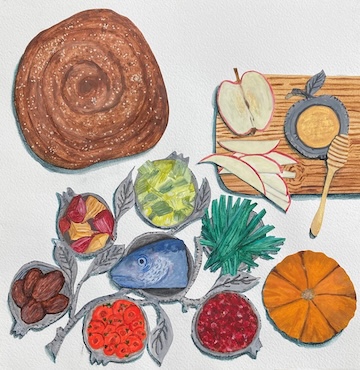
If you thought that a seder was only scheduled on Pesach, think again. There is a seder on Tu b’Shevat, the birthday of Israeli trees, and on Rosh Hashanah, the birthday of the world.
Many Sephardic and Mizrahi Jews will have a seder on the first night of Rosh Hashanah, and some Ashkenazi families have adopted the practice. In Hebrew, the blessings for the various seder foods are plays on words. For example, the Hebrew word for dates is related to the Hebrew word “to end,” so the blessing is: May it be Your will, Lord our G-d and the G-d of our fathers, that there come an end to our enemies, haters and those who wish evil upon us.
The blessing for the aforementioned lubiya is: May it be Your will, Lord our G-d and the G-d of our fathers, that our merits shall increase and that You hearten us.
Leeks also appear at this seder. Because the Hebrew word for leek is related to the Hebrew word to “cut,” people recite a blessing similar to that for the dates: May it be Your will, Lord our G-d and the G-d of our fathers, that our enemies, haters and those who wish evil upon us shall be cut down.
Beets are similarly blessed because the Hebrew for beet is seleck, which can also mean “to remove decisively.” Thus, the New Year’s wish here is: May it be G-d’s will that our enemies be removed from our presence.
Gourds are also part of the seder. The Hebrew word for gourd is kara, which means to tear up or to read (using a different spelling). Its blessing goes like this: May it be Your will, Lord our G-d and the G-d of our forefathers, that the decree of our sentence be torn asunder; and may our merits be proclaimed before you.
Apples and honey (wish for a sweet year), pomegranates (hope for a year full of good deeds and abundance) and a sheep or fish head (for us to be leaders rather than followers) round out the Rosh Hashanah seder foods. Educator Noam Zion suggests using a head of cabbage or lettuce to people who would rather not use the sheep or fish head. According to writer and anthropologist Claudia Roden, Egyptian Jews ate a variety of peas and beans on Rosh Hashanah, all meant to symbolize a new beginning. Roden further notes that, if olives are served at the holiday table, only green olives would be used. Black olives are apparently judged to be too morbid for the New Year.
Both Ashkenazi and Sephardi communities serve various sweet dishes on Rosh Hashanah. As a child, my Ashkenazi family ate tzimmes, made with cooked carrots, sweet potatoes, white potatoes, prunes and brown sugar.
Other communities have incorporated new customs, with an emphasis on a food’s colour. Thus, some people now eat shelled sunflower seeds to represent white, which encompasses all the colours, reminding us that all our food is dependent on the sun’s light. Other additions include chickpeas (earth-toned), symbolizing the soil. Blueberries (blue) are symbolic of and nourishes an abundance of life. Blueberries (blue) are symbolic of water, a necessity for all life. Peas (green), fresh or fried, also symbolize the vegetation that makes this planet verdant and alive. Golden raisins symbolize sunrise and sunset, while cranberries (red) represent the sun’s heat. (For more on these customs, visit associated.org/stories/a-seder-plate-for-rosh-hashanah-earths-birthday.)
While we eat round challah on Rosh Hashanah – symbolizing the cycle of the year, of life, and the crown of G-d – the traditional blessing over bread is said: Blessed are You, Lord our G-d, King of the Universe, who brings forth bread from the earth.
Happy holidays.
Deborah Rubin Fields is an Israel-based features writer. She is also the author of Take a Peek Inside: A Child’s Guide to Radiology Exams, published in English, Hebrew and Arabic.
***
LUBIYA: BLACK-EYED PEA STEW
(recipe from poppyandprune.com)
1 lb cooked black-eyed peas, canned or from dried, drained (if cooking from dried, reserve 1 cup of cooking liquid)
2 tbsp olive oil
2 medium onions, finely chopped
2 medium carrots, peeled and finely chopped
6 garlic cloves, minced
2 tsp salt
2 tsp ground cumin
2 tsp paprika, hot or sweet
1/2 tsp ground ginger
1/2 tsp cayenne
4 large tomatoes, grated, or 1.5 lb canned tomatoes
2 tbsp tomato paste
1 cup black-eyed pea cooking liquid, vegetable broth or water
chopped fresh cilantro for serving, optional
Heat the olive oil in a large saucepan over medium heat. Add the onions, carrots and salt, stirring occasionally, until the vegetables
begin to soften, about 10 minutes. Add the garlic, cook for a minute. Add the cumin, paprika, ginger and cayenne, stirring until fragrant, about two minutes.
Stir in the grated tomato pulp and the tomato paste. Bring to a simmer, stirring occasionally, until the mixture thickens slightly, about 10 minutes. Add the drained beans and the liquid, raise the heat to medium-high and bring the mixture to a simmer. Turn the heat to medium-low, partially covered, stirring occasionally, about 30 minutes. Serve hot or warm. Refrigerate leftovers for up to three days.