Physical Address
304 North Cardinal St.
Dorchester Center, MA 02124
Physical Address
304 North Cardinal St.
Dorchester Center, MA 02124

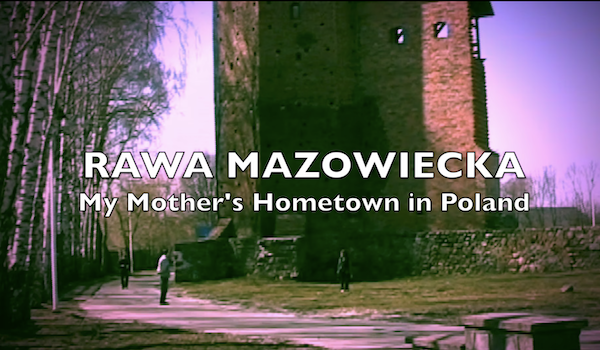
Prior to the Holocaust, 3.3 million Jews were living in Poland. By 1945, only 300,000 to 350,000 had survived. Haya Newman’s parents were among the survivors, and she has documented their stories in film. In 2014, she completed Wolbrom: My Father’s Hometown in Poland and, this year, she finished Rawa Mazowiecka: My Mother’s Hometown.
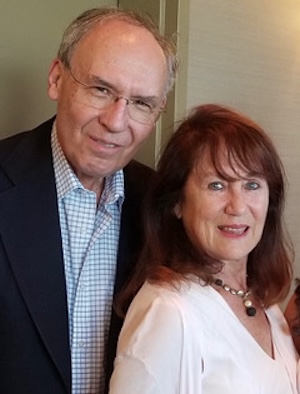
Haya and her husband Tim traveled to Poland in 2005. It was then that they visited Wolbrom and Rawa Mazowiecka.
“We also visited Tim’s father’s family hometown, Tomashev, which is, fascinatingly, about 20 miles away from my mother’s hometown,” said Haya Newman.
The couple went to Poland with the intention of using the video footage and interviews in a film one day, but Newman wasn’t sure she’d follow through. “Once the footage shot by Tim was in my hands, it gave me the drive to learn how to edit and produce films,” she said.
To date, she has made eight films, on various topics. She hopes a local community group will present this latest one.
Her 2016 documentary about soprano and Yiddish folk singer Claire Klein Osipov, called A Life Sung Yiddishly, screened at the Vancouver Jewish Film Festival that year. In this latest film, the song “Oyfn Veg Shteyt a Boym,” based on a poem by Itzik Manger, is often played in the background, sung by Klein Osipov, who passed away in 2020.
Newman’s other films include a short documentary about community member Sam Shamash, who died in 2016. Shamash was a local businessman and philanthropist who was born and raised in Iraq. Sam Shamash, I’m an Iraqi Jew also screened at the VJFF, in 2017.
Among Newman’s other films is the feature-length Everything Was Left Behind (2022), exploring the personal experiences of 10 Jews who were among those expelled from Muslim countries in the Middle East and North Africa and who found refuge in countries such as Canada and Israel.
In Rawa Mazowiecka: My Mother’s Hometown, Newman herself is interviewed (by her husband) and she and her cousin, Roza Hofnung, share what they know about their great-grandparents, grandparents and parents during the Holocaust. So many of their family were murdered by the Nazis.
Newman’s long-held goal has been to bear witness to and document her parents’ Holocaust experiences. It was for this reason she bought the video camera. On that 2005 trip to Poland, she interviewed elderly villagers – people who would have been children during the war, but could have seen “the atrocities of the Nazis and their collaborators with their own eyes,” she said.
While her hope is that the film will reach many people, it is also so that this history will not be forgotten.
“Primarily for my children and my grandchildren, as a family heirloom,” she said about why she made the documentaries about her parents. “I wanted them to have this legacy as intimately told by me of their family history.”
Newman went through family archives and photo albums, as well as various Holocaust publications to gather the archival images for the film. She also used resources found in research online.
As for her next endeavour, Newman said, “I have a number of remaining film projects, lots of unedited footage on different themes. I am not sure when I will get to them. Some of them may be of interest to the BC Jewish Museum and Archives; for example, I have interview footage of the surviving family members who ran Miller’s Jewellers on Hastings Street from 1922 to 1985. Whether this will get into the can, I don’t know. But I would be glad to eventually donate the footage to the museum and archives.”
Newman is grateful for her husband Tim’s support and help on her various projects. She said the films would not have gotten made without him, and that she would not have gone to Poland by herself.
“Significantly,” she said, “we were also very lucky to have visited Poland in 2005 due to a political climate more receptive to a Jewish presence – largely due to, I suggest, Pope John Paul’s recognition of Jewish life in his homeland – and, notably, at this time, a number of our interviewees, for example, had not yet passed on.”