

Long before the Vancouver Holocaust Education Centre opened its doors, a powerful, innovative way of bringing the history of the Shoah to young British Columbians was underway.
The High School Symposium on the Holocaust, which marks its 50th anniversary this year, has introduced survivor speakers and historians to tens of thousands of students – some of whom now are the children of earlier participants. There are even teachers who were inspired by their interactions with the event to choose education as their vocation.
The annual symposium began in 1976 when a small group of academics concluded that the Holocaust was too consequential to remain largely absent from the education of local students. Dr. Robert Krell, a University of British Columbia professor, psychiatrist and child Holocaust survivor, shared that concern with Dr. William (Bill) Nicholls of UBC’s department of religious studies and Dr. Graham Forst, an educator at Capilano College. Forst brought on his graduate student Robert Gallacher.
Working with Morris Saltzman, regional executive director of Canadian Jewish Congress, the group set out to provide first-person testimony about the history of the Holocaust, based on the idea, as Krell explained recently to the Independent, that high school students were sufficiently open-minded to encounter difficult history without the ideological rigidity that might develop later.
The first symposium was held in the auditorium at Oakridge shopping centre. The inaugural event included a daytime program aimed primarily at students and teachers, followed by an evening program for the general public. Dr. Charles Harris of the Council of Christians and Jews offered a welcome. They screened the 11-minute 1947 film Camps of the Dead, made up of footage captured by Allied soldiers of mass graves, emaciated survivors and crematoria at Buchenwald, Dachau and other camps. UBC historian John Conway and Rabbi Wilfred Solomon took part. Among the speakers was Rudolf Vrba, the Auschwitz escapee whose testimony helped alert the world to the machinery of mass murder. For Krell, it was also a memorable personal encounter: “That’s the first time I met Rudi.”
Krell and many others participated last year in the unveiling of a monument to Vrba. The first of a three-part biography of Vrba, Holocaust Hero, was released last year, by BC author Alan Twigg.
The 1976 program also featured Dr. Ludmila Zeldowicz, who had escaped the Warsaw Ghetto, while Krell discussed the United Nations’ 1975 resolution equating Zionism with racism. At that stage, he was not yet speaking publicly about his own Holocaust experiences as a hidden child in the Netherlands. He would begin doing so several years later, after coming to understand himself as a child survivor.
The symposium’s basic division of labour emerged naturally. Nicholls provided the historical and religious context. Forst built relationships with schools, teachers and students. Krell recruited survivors.
That role was possible, Krell said, because survivors knew him as the child of a survivor family. People who had resisted speaking publicly were sometimes willing to trust him with their survivor narratives.
By the second symposium, held at the Jewish Community Centre, attendance had grown to several hundred students. Krell assembled a panel intended to represent different dimensions of the Holocaust experience: Harry Greenhut, a Theresienstadt survivor; Leon Kahn, a partisan; Chaim Kornfeld, a survivor of Mauthausen; and Vera Slyomovics, who had survived Auschwitz.
Students received historical background, encountered survivor testimony and heard educators discuss how the Holocaust could be taught in schools.
A third symposium at the Ridge Theatre continued the evolution. The 1956 film Night and Fog was shown, followed by discussion. Survivor speakers included Slyomovics, Leo Lowy, Peter Parker and Niki Wisniewski, a non-Jewish Polish prisoner who was forced to perform in the Auschwitz orchestra.
By the fourth year, the symposium moved to UBC’s Instructional Resources Centre. The venue allowed the program to reach approximately 1,000 students – 500 on each of the program’s two days. For nearly three decades, UBC would remain its principal home.
The format that generations of students would come to know took shape there. A scholar introduced the historical context. A film was screened. Students then divided into smaller groups, where survivors spoke and answered questions for about an hour. Some rooms held 100 students; others 50 or as few as 20, depending on the available space. These sessions brought teenagers face to face with people who had endured ghettos, camps, hiding, forced labour and resistance. The students later reconvened for a featured speaker and a concluding survivor panel.
For Krell, the most profound moments came when students recognized that what they were hearing contradicted prejudices absorbed at home. Some approached survivors afterward and said they had changed their minds or that the history was unlike what they had heard elsewhere.
Across decades, former attendees have repeatedly told Krell that the symposium remained one of their most enduring high school memories. Some became teachers and returned with students of their own.
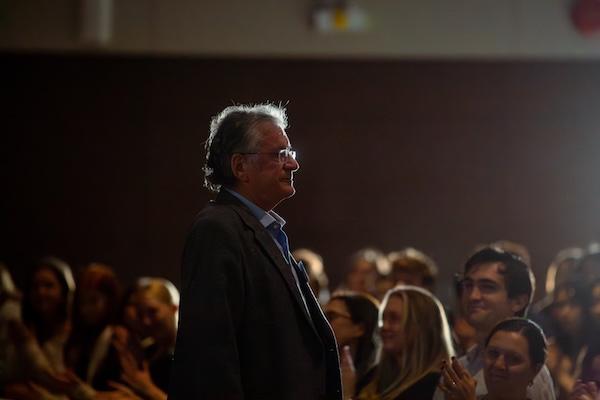
At 85, Krell remains astonished that the initiative has endured for half a century, but he is restrained in reflecting on his role. “I’m satisfied I did the right thing,” he said.
The annual symposium was rolled into the programming of the Vancouver Holocaust Education Centre after the VHEC opened its doors in 1994. Krell was the organization’s founding president.
In addition to operating the symposium, the VHEC welcomes school groups to its museum, sends educators and survivor speakers into classrooms, develops exhibitions, produces digital and printed teaching resources, and provides professional development training for teachers across the province. The symposium remains an important part of that larger educational mission, and a model the centre has repeatedly adapted to reach new generations.
Beginning about 20 years ago, the VHEC began offering smaller symposia in communities around the province. Four district symposia were held during the most recent school year: two in Vancouver, one in West Vancouver and one in Langley.
The 50th annual symposium brought approximately 500 students to the Italian Cultural Centre in Vancouver. It was the first time the event had been held there, after transportation and parking made UBC increasingly impractical for participating schools, particularly those traveling from the Fraser Valley.
Lise Kirchner, director of education at the VHEC, said the symposium and the centre’s broader work reflect the multiplicity of survivor experiences and Holocaust history. There was no single Holocaust experience, she said. Survivors had endured ghettos, camps, hiding, forced labour, separation, displacement and resistance under vastly different circumstances. Hearing several accounts allows students to recognize both the differences among individual experiences and the historical patterns that connected them, she said.
In earlier decades, students were sometimes shown graphic footage of liberation and the aftermath of mass murder. Holocaust education has since moved away from presenting disturbing images without extensive context, she said. Rather than attempting to shock students with scenes of atrocities, the VHEC uses shorter films connected directly to the survivor students are about to hear.
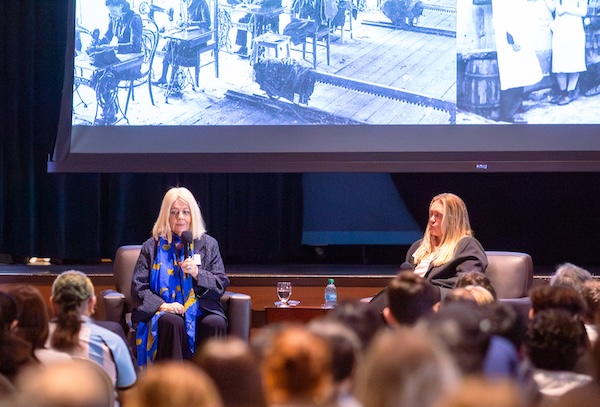
At the anniversary symposium, for example, students heard from author and survivor Lillian Boraks-Nemetz about her childhood in the Warsaw Ghetto and her escape. Before her presentation, they watched a film explaining the function of ghettos in the Nazis’ systematic persecution and murder of European Jews, with particular attention to Warsaw.
The symposium is now a half-day program and the small breakout sessions have ended, largely because there are no longer enough survivors able to participate in such an intensive format. More intimate interactions with survivors remain part of the VHEC’s work, however. During the past school year, the VHEC organized 38 survivor presentations, delivered in person or online to individual schools and community groups.
The long-term influence of these encounters can be seen. Kirchner recently met a mother and daughter from Vancouver Island, both teachers and both former symposium participants.
The legacy of the symposium also lies in the testimony and evidence preserved because the centre’s founders understood that survivor testimony could not depend forever on the physical presence of eyewitnesses. In 1978, just two years after the first symposium, Krell began using the then-new technology of video recording to document survivor narratives.
To Kirchner, the recording project demonstrates that the symposium’s creators never regarded Holocaust education as something static. This principle is especially urgent now, in an era of social media where Holocaust denial and distortion can circulate rapidly and appear alongside legitimate historical information, she said.
The VHEC’s response has been not simply to tell students that denial is false, Kirchner said, but to teach them how historical knowledge is constructed: how to examine primary sources, how to compare evidence and ask informed questions about where information comes from.
This approach shapes Fragments in Focus, the VHEC’s teaching resource combining recorded testimony with artifacts, photographs, documents and historical context. Its 19 thematic modules allow teachers to build lessons around selected aspects of the Holocaust rather than attempting to compress the entire history into a few classes. The online resource was created to coincide with the Province of British Columbia’s mandate that Holocaust education be included in the core Grade 10 curriculum.
For Kirchner, this is how Holocaust education will continue after survivors can no longer attend classrooms themselves. Recorded voices will be studied beside the objects and documents survivors entrusted to the centre, guided by educators who help students interpret what they are seeing and hearing.
While other Canadian communities have adopted versions of the symposium model, Vancouver’s is the only one that has continued without interruption for 50 years.



