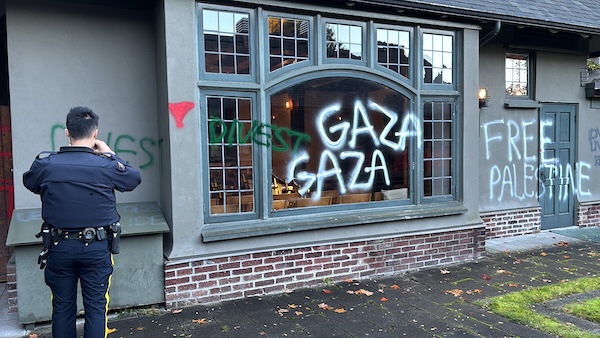

Graffiti, like this on the UBC campus in 2024, is emblematic of the atmosphere on most campuses, as major new study confirms. (photo from Hillel BC)
A federally commissioned study released this month depicts antisemitism as a pervasive feature of campus life in Canada.
The Campus Antisemitism and Student Experiences (CASE) report is a Government of Canada–commissioned national study of antisemitism on Canadian campuses. It was initiated by the now-defunct Office of the Special Envoy on Preserving Holocaust Remembrance and Combatting Antisemitism, and was conducted by the Association for Canadian Studies and the Metropolis Institute. It was released by the Department of Canadian Heritage earlier this month.
Surveying 900 Jewish students and recent graduates from postsecondary institutions across the country, the report concludes that anti-Jewish bias, rhetoric and intimidation affect students’ safety, academic participation, mental health and willingness to express their Jewish identities. Antisemitism should no longer be understood primarily as a series of isolated incidents, the authors conclude. Instead, they characterize it as a broader campus-climate problem that, at some institutions, is now systemic.
Respondents quoted in the study described antisemitism in classrooms, student organizations, residences, online spaces and areas surrounding campuses. More than 1,200 open-ended comments were submitted to the investigators, documenting experiences ranging from social exclusion and pressure to conceal Jewish identity to harassment, threats, Holocaust denial and physical violence.
One of the most serious findings indicates that professors are introducing Israel, Zionism or the Israel-Hamas war into courses where the subjects are unrelated to the curriculum, assigning material students regard as biased or antisemitic, and pressuring Jewish students to state or defend political positions concerning Israel.
Institutional responses are inadequate, according to many respondents, and most incidents go unreported because students do not anticipate anything constructive resulting from complaints processes. The report’s authors note that, in addition to expectations that the issues would not be adequately addressed, students also expressed fears of retaliation.
“Low reporting must therefore not be mistaken for low incidents of antisemitism,” the authors state. “It reflects a lack of confidence that reporting will lead to meaningful action.”
The survey was not a random or weighted sample and, therefore, should not be treated as providing precise prevalence estimates for every Jewish student in Canada, the authors acknowledge. The results, they said, are “intended as descriptive evidence of the experiences of respondents rather than a statistically representative measure of the entire Jewish student population.”
Speaking remotely during an Ottawa news conference releasing the report, University of British Columbia student Rachel Seguin described some of her experiences on campus. After being treated in a way she perceived as discriminatory by a student resource group, Seguin met with the university’s equity and inclusion office.
“I was told that students are entitled to their own opinions and that whether the comments I experienced constituted discrimination was subjective,” she recalled. She was referred to the ombudsperson for the Alma Mater Society (AMS), the student society, and, after months without a response, was summoned by email to a meeting with 20 minutes’ warning.
“During that meeting, I was told that because my complaint involved an AMS resource group, there was a conflict of interest and the ombudsperson couldn’t assist me,” Seguin said. “I found that especially concerning because the ombudsperson’s role is to provide students with an impartial and independent avenue for support. Instead, I was advised that if I wished to pursue the matter further, I could file a complaint with the BC Human Rights Tribunal. As a student, I wasn’t looking to begin legal proceedings.”
Martha Piper, a former president of UBC, also spoke at the Aug. 5 news conference.
“The survey reveals a shocking presence of campus antisemitism throughout this country, along with a troubling institutional failure to respond,” Piper said. “The results suggest a university culture that is not welcoming to Jewish students and systemically tries to exclude and vilify them.
“As well, it implicates professors, who are often seen as a source of antisemitic incidents,” she continued. “The findings suggest a reluctance on the part of campus leaders to address the issue with the urgency the problem requires, as well as a failure to apply their own policies and standards that are ensured to other groups of students. We do not need any more studies or committees or task forces to confirm the issue or define the underlying causes. The time for decisive action is now. Universities must publicly commit to addressing the ongoing prevalence of antisemitism on their campuses.”
In a statement, the Jewish campus organization Hillel BC reiterated that antisemitism on Canada’s campuses “is persistent, it is growing, and it is not being adequately addressed.”
“The survey confirms what Jewish students in BC have been saying for years,” according to Hillel. “We are proud of the students who came forward and shared their experiences. We will keep bringing their voices to university leadership to ensure the campuses we serve are a safe and welcoming place for Jewish students.”
The Jewish Academic Alliance of British Columbia (JAABC) said in a statement that the report also confirms what Jewish faculty and staff have been seeing on Canadian campuses: pervasive antisemitism, including incidents involving faculty and administrators, politicized or biased classroom content, vandalism, intimidation and violence, as well as widespread student distrust in the complaint processes available.
The academic group highlighted that only 33% of respondents reported the incidents of antisemitism they had experienced, and 63% were dissatisfied with how those reports were handled by authorities. More than half of respondents who did not report the incidents they experienced (52%) said they did not think reporting would help the situation.
David Freeman, a professor of economics at Simon Fraser University, said the report depicts campus antisemitism as substantially more pervasive and consequential than many Canadians may realize.
Freeman told the Independent that the experiences described in the report challenge the contention that campus conflicts involving Israel and Zionism are simply intellectual disagreements over Israeli government policy. He characterized what the report documents as evidence of a broader anti-Jewish movement on campuses.
Freeman argued that antizionism has become normalized in parts of academia, particularly within some liberal arts and social science disciplines, and said political advocacy surrounding Israel can sometimes enter the classroom and affect the educational environment.
He urged incoming Jewish students to research departments, programs and individual instructors when choosing courses and to think in advance about how they will navigate their Jewish identity in academic and social settings. At the same time, Freeman stressed that conditions vary considerably between departments and professors and cautioned against treating universities as monolithic.
He also praised Jewish campus organizations, including Hillel and Chabad, saying students have told him that they provide welcoming communities for both Jewish students and non-Jewish allies. He encouraged incoming students to connect with those organizations.
The Network of Engaged Canadian Academics (NECA), a non-partisan group of Jewish and non-Jewish academics who share concerns about rising antisemitism on campus, responded to the report with a list of 10 recommendations. These include applying existing policies and procedures to protect students from being bullied, harassed and targeted for any aspect of their Jewish identity including Zionism; implementing institutional neutrality and impartiality policies; recognizing that academic freedom must be accompanied by academic responsibility and integrity; denouncing campaigns that limit academic freedom, such as boycott, divestment and sanction (BDS) campaigns; revising equity, diversity and inclusion policies, as well as human rights policies, to explicitly include antisemitism; providing mandatory training about antisemitism; ensuring funding applications are evaluated without prejudice around Judaism, Israel, Zionism, antisemitism and in relation to Israeli scholars; ensuring curricula and course content adhere to university policies and do not promote hateful ideologies; assessing campus climate yearly, addressing identified weaknesses and implementing a centralized, transparent incident reporting system; using Canada’s definition of antisemitism, which is the International Holocaust Remembrance Alliance (IHRA) version, as a tool for addressing antisemitism on campus; and funding a position for a special advisor on antisemitism on every campus, reporting to universities’ top leadership.
Also speaking at the report’s release were Andrew Cardozo, a senator from Ontario; Cary Kogan, co-president of the Network of Engaged Canadian Academics; Marc Gold, a former senator and a member of the Ministerial Advisory Council on Rights, Equality and Inclusion; Jack Jedwab of the Association for Canadian Studies and Metropolis Institute, who co-authored the report with Paul Holley; and Alexa Barett-Taller, a recent graduate of Carleton University.
The federal government commissioned the study following parliamentary calls for better data on antisemitism in educational institutions. A second CASE report, examining attitudes and experiences among the broader Canadian postsecondary student population, is expected separately.
Among the findings in the Campus Antisemitism and
Student Experiences report are:
• 84% of Jewish respondents said antisemitism is a serious problem on campus.
• 95.7% said they had experienced or witnessed at least one instance of antisemitism over the previous 12 months.
• 70% said their university does not take antisemitism seriously, and 68% said their campus is not a safe and inclusive place for Jewish students.
• 72% limit what they say in class about being Jewish, and 57% avoid wearing or displaying Jewish symbols because of safety concerns.
• 18% of incidents cited faculty members, 7% involved teaching assistants, and 7% involved administrators or staff.
• 36% encountered course content or classroom discussion they experienced as antisemitic or biased, while 34% said a professor introduced Jews, Judaism, Israel or Zionism when unrelated to the course subject.
• 45% encountered Holocaust denial or distortion often or sometimes, and 65% encountered it “at least rarely.”
• 81% reported hateful or discriminatory treatment of Zionists on campus often or occasionally; 71% reported antisemitic vandalism; 54% reported intimidation or threats directed at Jews; 22% reported physical violence directed at Jews.
• 34% identified online or social media spaces as a location where incidents occurred, 33% identified student organizations or campus events, 25% classrooms or lecture halls, 23% nearby off-campus spaces, 9% in student residences and housing.