

On Nov. 8, the local Jewish community celebrated Sigd for the first time together, hosted by the Jewish Federation of British Columbia at Congregation Beth Israel. More than 200 people came to learn about Beta Israel, the Jewish community whose roots are in Ethiopia, and participate in some of the traditions of the holiday, which is observed 50 days after Yom Kippur, and signifies a recommitment to Jewish life and peoplehood.
“Sigd holds a special meaning for me,” said emcee Orian Yona, a Vancouver Talmud Torah and King David High School alum. “Not only as a celebration of our Jewish heritage, but also through my family’s connection to Yona Bogale, whose remarkable work and legacy you’ll hear more about today. It is a privilege to be a part of this celebration and to share a tradition that connects our history, our identity and our sense of belonging.”
The Sunday event included a cultural exhibit, children’s programming, music and dancing. There were displays of traditional Ethiopian clothing, and photos and educational posters about Beta Israel history, including key leaders, like Bogale (1908-1987). Celebrants got to sample a few Ethiopian stews and injera (spongy flatbread).
The event honoured educator Bogale and Dr. Will Recant, who, as the former executive director of the American Association for Ethiopian Jews, played a central role in organizing Operation Solomon, the 1991 airlift that brought about 14,500 Ethiopian Jews to Israel.
The idea for the Nov. 8 celebration came from Yona’s mother, Ronit Reda Yona, and Federation’s Elisheva Darar Malede took the lead in creating the program, as well as compiling an Ethiopian Jewish Heritage Toolkit, which is available at jewishbc.ca/ethiopian-jewish-heritage.
“For generations, the Jewish community of Ethiopia, Beta Israel, sustained a distinctive Jewish religious and communal life,” said Orian Yona. “Its spiritual leaders, the qessim, help to preserve the prayers, teachings and traditions.”
A video highlighted the melodies of the qessim. “In 1958, Moshe Bar-Yehuda, a religious officer who traveled to Ethiopia on behalf of the Jewish Agency, encountered the Jewish communities living in remote villages,” explained Yona. “He was deeply impressed by their religious traditions and by striking similarities he observed between their practices and those of biblical-era Judaism. Years later, recognizing how much of this rich oral tradition was at risk of being lost, he undertook an important preservation project. He brought together qessim from across the Ethiopian Jewish community and recorded their prayers and sacred melodies, ensuring that these voices and traditions could be preserved and shared with the wider Jewish world.”
Jonathon Leipsic, chair of the JFBC, said he was proud to be “a descendant of a people that gathered at the foot of the mountain with Orian’s family some 3,500 years ago, and we really brought forward, of course, my ancestors’ and Orian’s, the word of God, the oneness of the creator, the righteousness of the Ten Commandments and the social justice of tikkun olam. And, honestly, when we think about that message, I often say this is an eternal message … but, when we stand here and we reflect on Sigd, if I had any question about the eternity of Am Yisrael, how could I?… [Sigd represents an] undying and unwavering faith and commitment to that eternal message.”
Beth Israel’s Rabbi Jonathan Infeld led a discussion with Recant, who sits on the JFBC board, and Bogale’s granddaughter, Leah Tegegne, who also lives here.
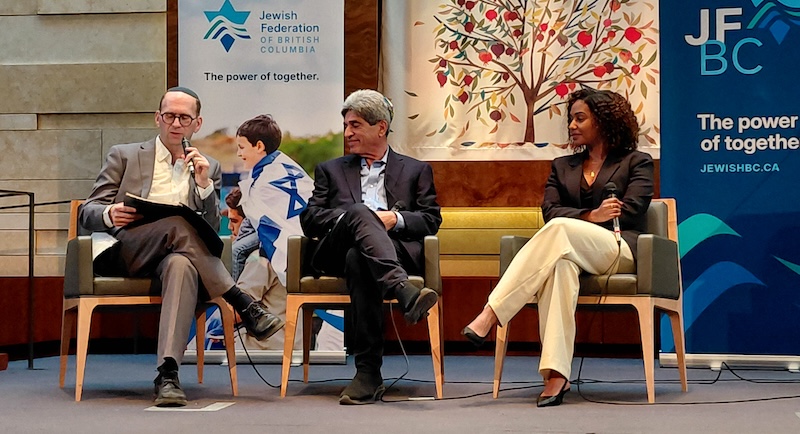
Infeld had with him a copy of his senior thesis from Brandeis, titled From Ethiopia to Zion: A Century of Education for Beta Israel, from which he read an excerpt about Jacques Faitlovitch, who “spent more than half a century as the world’s leading spokesman of behalf of the Jews of Ethiopia.” Faitlovitch had two students who became influential leaders of the community, Taamrat Emmanuel and Yona Bogale.
“So I begin with that,” said Infeld, directing his question to Tegegne. “Can you tell me about the second individual that I wrote about in 1995, please?”
Tegegne said she never had the privilege of meeting her grandfather, as he passed away shortly after she was born, “but his legacy lives, and he’s very much alive through the stories told to us…. He was a very soft-spoken, gentle individual. He loved to have people around, and a story that I keep hearing about, especially from my mom, is around the late ’70s, there weren’t a lot of Ethiopian Jews yet in Israel and so, during the holidays, my grandfather had a habit of inviting everyone over for the chaggim [holidays], and my mother always spoke of how happy it made him to sit at the head of the table and see everyone having a good time, and he would lead the dinners and the prayers.”
Being able to celebrate in Israel, she said, “was something he truly valued.”
Even after her grandfather died, the family house remained a central gathering place, said Tegegne. “My grandmother was very much active in the community and so, whenever something came up, if someone, for example, lost a family member in Ethiopia, she would be the one delivering the news, and so people would come over for that. Or, if someone was getting married, they would come for her blessing.”
Recant became involved, he said, in 1986. “At that time, there were about 20,000 Ethiopian Jews in Israel and an estimated 30,000-plus still in Ethiopia. My job was to be involved in rescue, relief and advocacy on behalf of the community.
“It was a very difficult job because the advice from Israel at the time was shkita, quiet diplomacy, that the only way of helping Ethiopian Jews was to be quiet, and that the Government of Israel was, quote, doing everything in their power to help the Ethiopian Jews get out and come to Israel.
“I was the head of an organization that didn’t take that advice to heart,” he said, noting that the Ethiopian leadership was saying: “We want out, we want to get to Israel as soon as possible. There’s famine in Ethiopia, there’s civil war in Ethiopia. Our sons are being conscripted, our daughters are being raped. It is terrible, terrible conditions. We want to go to Israel.”
Recant, the son of Holocaust survivors, recalled that, when he had his bar mitzvah in 1966, Eli Wiesel had just come out with the book The Jews of Silence.
“He had just returned from the Soviet Union, and he saw that the Jews in the Soviet Union were silent,” said Recant. “And it was students in the United States that started the student struggle for Soviet Jewry, that became the advocacy effort that led to over a quarter of a million Jews coming to Washington, DC, in 1988 to demonstrate for Soviet Jewry. I didn’t understand why we could have a public campaign to rescue Soviet Jews but not a public campaign for Ethiopia.”
Infeld turned the conversation to Zionism.
“In our narrative, in our history … Israel as an entity to us is Jerusalem, Yerushalayim,” said Tegegne. “How that plays into the Zioinist aspect, I’ll leave it open to interpretation. But, Yerushalayim, it was never a question of if we will go, it was always a question of when, and there was always hope that it would happen.”
In Tegegne’s view, “you can’t equate racism and Zionism. One is fueled by hatred of the other and the other is just, you know, a home, finding a home for us and our future generations,” she said.
“Sigd, literally translated, means ‘to prostrate yourself,’” added Recant, describing how, for more than 500 years, on Sigd, the Ethiopian community would gather at the base of a mountain. They would climb it together and, at the top, the qessim would lead prayers, he said, “and they would prostrate themselves, they would lay down facing Yerushalayim.… There is not a more Zionistic holiday in the Jewish calendar than the holiday of Sigd, that the Ethiopian Jewish community has been practising for centuries.”
After the discussion, Yona introduced a video of the song “The Journey to the Land of Israel,” written by Haim Idisis, composed by Shlomo Gronich and performed by Gronich with the Sheba Choir. He concluded the event by thanking all those involved in planning and hosting it.
“Every new question, every conversation and every connection, helps build a community where more of us can feel at home,” he said.
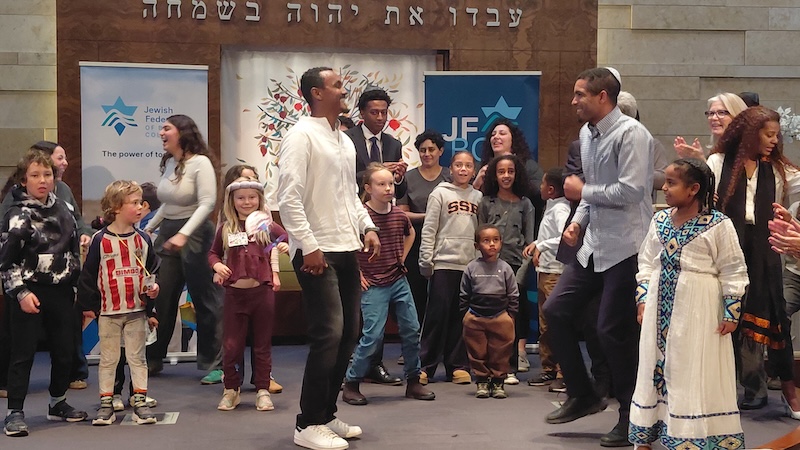
Shoshana Bluman and Naomi Infeld, who sang O Canada at the event’s opening, closed it with Hatikvah. Coach Abe, an Ethiopian dancer and performer, then demonstrated some traditional dances and people joined in.