

“In 1930, Germany was a democracy,” Prof. Chris Friedrichs told those gathered at Congregation Beth Israel to commemorate Kristallnacht on Nov. 9. “Yet, in March of 1933, less than two months after Adolf Hitler was appointed to head a coalition government, the German parliament itself voted to transform Germany into a dictatorship.”
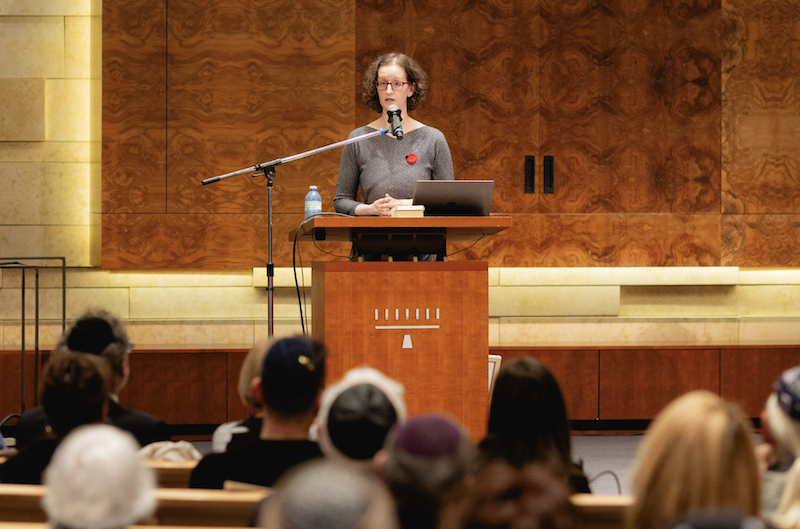
Friedrichs, a University of British Columbia professor emeritus of history, was offering context for the evening’s keynote speaker, Dr. Heidi Tworek, a Canada Research Chair and professor of history and public policy at UBC. Tworek directs the Centre for the Study of Democratic Institutions and is a senior fellow at the Centre for International Governance Innovation.
Friedrichs acknowledged the vulnerability of Jewish places of worship, including the original home of Temple Sholom, which was burnt down in 1985, and the attempt, two years ago, to do the same thing to Schara Tzedeck Synagogue. Eighty-eight years ago, he said, hundreds of synagogues were burned down over the space of one night, Nov. 9, 1938, and into the next day. “And these actions were planned, organized and orchestrated by the government of Germany itself,” he said.
Tworek’s talk delved into how the Nazis used then-new media to transform Germany from democracy to dictatorship. In addition to being a night of vandalism and greed, a pogrom and a key escalation to the Holocaust, Kristallnacht was “a propaganda event,” she said.
The choice of Nov. 9, 1938, was intentional, said Tworek. Twenty years earlier, on Nov. 9, 1918, left-wing politician Philipp Scheidemann made a declaration from the balcony of the Reichstag “that there would no longer be a monarchy, that Germany would become a republic, a democracy…. For those who were on the far-right, they would come to claim that this day was a stab in the back to Germany. They would claim that Germany could have won the war, and that they were merely undermined and the war was ended by socialists and by Jews.”
The Nazis grabbed onto this mythology. On Nov. 9, 1923, they tried to overthrow the government, in the Beer Hall Putsch, said Tworek. Hitler was hoping for an outcome like that of Benito Mussolini’s March on Rome a year earlier, which culminated in fascist Italy. However, Hitler’s putsch failed, and he was imprisoned.
In prison, he wrote Mein Kampf, “in which he singles out Nov. 9, 1918, as his day of purported conversion towards the far-right and towards Nazism,” said Tworek, who later pointed out that “the actual records do not bear this out…. It was a little bit later, in 1919 and 1920, when he couldn’t really find a job, when economic conditions were precarious, that he moved towards the far right.”
So, Nov. 9, 1938, was not a random day of spontaneous violence and, “in Nazi propaganda that would follow, on every Nov. 9, there would be propaganda posters discussing Nov. 9 as a date that would be inspirational for Nazis.”
There were Germans who disagreed, Tworek said, noting that, one year after Kristallnacht, Johann Georg Elser tried to assassinate Hitler, but failed. Hitler claimed “providence” had saved him.
As it happens, Nov. 9 was also the day, in 1989, that the Berlin Wall fell, so, now, “it seems a day where there is some redemption at the end,” said Tworek. But we should be careful about reading it like that, she said, stressing that much of how we talk about Nov. 9 has been formed by Nazi propaganda.
The spreading of this propaganda was heavily reliant on what was new media of the time. “In fact,” said Tworek, “the Nazi propaganda minister, Joseph Goebbels, said it himself in August of 1933, seven months after the Nazis had come into power. He said, our way, meaning the Nazi way, of taking power and using it would have been inconceivable without the radio and the airplane…. Hitler, during campaigns up to 1933, used to fly around in an airplane, obviously a very new technology at the time, to portray himself as a modern leader, to give speeches in multiple places around Germany in a way that no other political campaigner was doing.”
The Nazis also famously used film to spread propaganda.
But propaganda was not the only method they used to consolidate and retain power, said Tworek. The 1992 book Ordinary Men by Christopher Browning, she said, talks about ideological indoctrination, pushing for conformity to the group, psychological distancing from Jewish people, the bureaucratization of mass murder, and the mutually intensifying effects of war and racism.
“Now, I wish that all of this was far away and long ago, but, unfortunately, I spend half my time thinking about how these issues affect us in the present, and what it is that public policy can do about this,” said Tworek.
She spoke about the recent report on campus antisemitism that was commissioned by the Department of Canadian Heritage. Jewish students – 84% of whom saw antisemitism as a problem on campus – reported that 34% of incidents occurred online.
Tworek thinks Canada is behind many other countries – the United Kingdom, Australia and Germany, for example – in regulating the internet. She said Bill C-34, the Safe Social Media Act, for which she was an expert advisor, aims to set up “systemic regulation of the online space.”
While the bill is necessary, it is not sufficient, Tworek said. “But I’m hoping that this bill is at least one step towards doing something in that online world, the new media that, we know, in the 1930s, also contributed to Nazi propaganda.”
Having spoken about the Nazi interpretations of Nov. 9, Tworek noted that “we, as a Jewish community, have also chosen this date – to commemorate, to remember … so I want to end with thinking about that meaning.”
One of the synagogues attacked on Kristallnacht was Neue Synagogue, in Berlin. It was set aflame but saved – “by a German policeman called Wilhelm Krützfeld, who ordered the police to help put out the fire…. He managed to remain a policeman for several years after that, until he decided to resign in what he claimed were health grounds, and then, after World War II, he became a policeman again. It reminds us that other paths were possible, that other actions were possible,” said Tworek.
Rabbi Adam Stein echoed Tworek’s observations, sharing a story about the San Francisco Bay Area congregation he grew up in. The cantor, Hans Cohn, was a survivor. As a child in Berlin, Cohn had watched his synagogue burn down, firefighters unwilling to do anything to help. In contrast, when Temple Beth Jacob was burnt down in 1979, Cohn witnessed a firefighter save one of the Torah scrolls from the shul’s chapel.
“I think, today, as we do every year, we hold on, maybe, to bits of hope about the Berlin Wall falling on the same date, but … that doesn’t mean we should mix them together and turn it into a day of hope, because it’s still a day every year of sadness and commemoration and memory,” said Stein. “But, maybe, as we look at the lights of the candles here, we can hold on to just a little bit of hope.”
Hannah Marazzi, executive director of the Vancouver Holocaust Education Centre, led the proceedings, acknowledging a proclamation from the City of Vancouver. Cantor Yaacov Orzech chanted El Maleh Rachamim, as survivors lit memorial candles. The program was presented by the VHEC with Beth Israel, and funded by the Jewish Federation of British Columbia annual campaign and the VHEC’s Robert and Marilyn Krell Fund.