
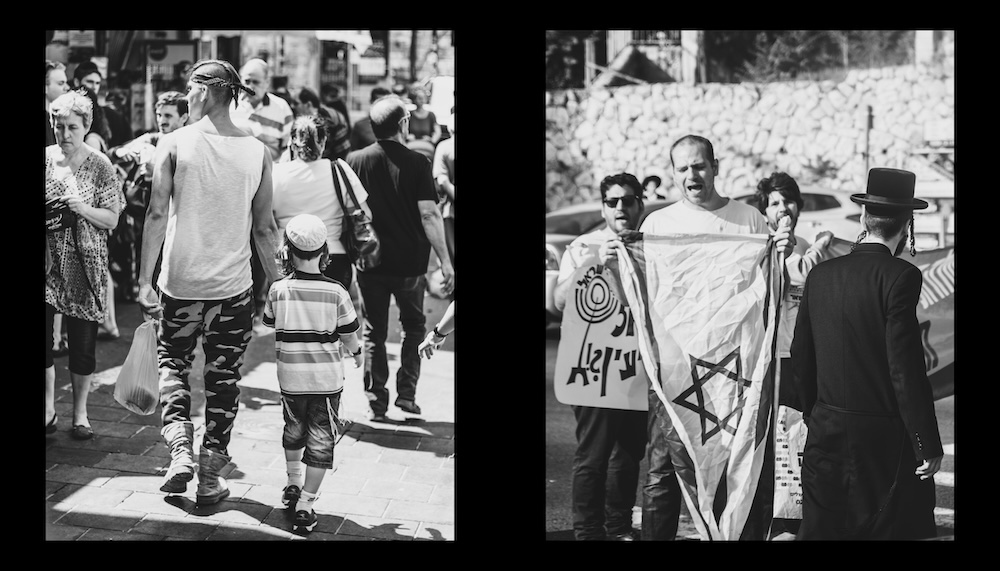
Israeli photographer Sharon Gabay’s Jerusalemites is a slow page-turner. Every image in this visual essay invites exploration. Every face, colour, line, shadow, tells multiple stories. The people demand your attention. The larger conflicts and struggles don’t disappear, but Gabay’s work brings your eyes and heart back to what should be valued most highly: our humanity.
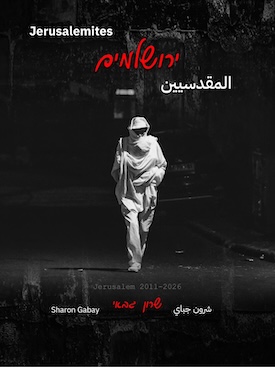
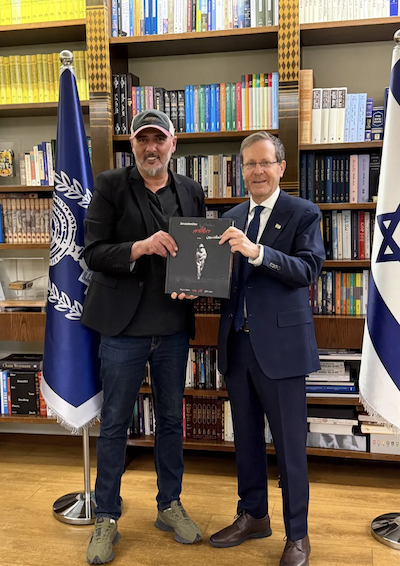
Jerusalemites is Gabay’s sixth photography book. Written in Hebrew, English and Arabic, it comprises images taken over a 15-year period, from 2011 to 2026. Only 2,000 copies of the 304-page museum-grade hardcover were printed.
“Out of an archive of a million and a half frames, 286 photographs were carefully selected to distill the essence of the city,” notes the project description. “The result is not a Jerusalem of stone and sanctity, but a city of flesh and blood, where ultra-Orthodox Jews, Arabs, nuns, merchants and children share one space. A humanist, non-judgmental gaze that tells the city’s story through the faces of those who live it.”
Gabay’s work has been shown around the world, in various exhibits and displays. The Israeli government has published hundreds of his photos. He has photographed countless and varied people, from the renowned to the unknown.
Born in Jerusalem, Gabay notes in the book, “The perspective presented here is that of a native son, from a family whose roots run generations deep in this city. It is a gaze formed by living in the city, not by visiting it.”
He highlights the complicated nature of street photography in Jerusalem. “The camera is present in a charged space: religions, identities, political tensions and social divides,” he writes. “And yet, within this complexity there are moments that do not seek to represent anything. Two nuns, a woman in a hijab with her children and a baby stroller, an ultra-Orthodox man – all at the same gate of the Old City, in the same moment, breathing in the smell of the same bagel.”
It is this aspect of the book – complexity and simplicity combined, the contrasts and harmonies that Gabay underscores with how he has laid out the images – that offers some hope in the beauty of humankind, that it exists beyond our friends and families.
As part of the Ot Chaim (A Sign of Life) memorial initiative, which honours the victims and fallen soldiers since Oct. 7, 2023, the Hebrew lettering in Jerusalemites is based on the handwriting of Aner Shapira, z’l, “a musician and soldier, a son of Jerusalem,” the press material for the book notes. “On October 7, Aner stood at the entrance of a crowded roadside shelter near the Nova festival and threw back, one after another, seven grenades hurled inside – saving many lives. The eighth took his. He was 22.”
“This journey was for me far more than editing; it was a lifeline,” writes Gabay in the book. “After the difficult documentation of Kfar Aza in October 2023 and the work on the exhibition Holocaust in the Village, I withdrew into the studio for two years. The work on Jerusalemites saved me from the noise of the war, and it was the need to complete the book that drew me back out into the street for the first time at the end of 2025 and the beginning of 2026. Facing that sea of material, I understood that it is truly impossible to find ‘the best ones.’ Letting go of certain images was as hard as a farewell, but the final selection was made out of an honest attempt to present Jerusalem as it really is: exposed, complex and human.”
It is this side of “the conflict” one really wishes all the protesters could see, but there is less hope in that.
“On 18 September, the Indian Photo Festival in Hyderabad, one of South Asia’s main photography festivals, informed me that my photobook Jerusalemites had been selected for its Photobook Exhibition,” Gabay wrote in an email to the Independent. “The festival says all 1,020 submissions from 66 countries were judged anonymously, by a panel that includes two National Geographic photo editors. My name was published on the festival website as ‘Sharon Gabay / Israel.’ Within hours, it was removed, alone among the 24 selected photobooks, and that evening the festival canceled my participation.”
Gabay said the festival explained itself on Facebook the next day. He shared what it posted: “The selection, it wrote, is made ‘without access to the photographer’s name, nationality or background.’ In the following paragraph: ‘Following the concerns raised, we have removed the artist from the exhibition selection.’ Between the two, it declares that it stands ‘against genocide.’ In a formal letter to me, the festival confirmed that the objections came ‘from persons outside that jury process,’ that ‘the likely effect of proceeding in the face of them’ was part of its decision, and that ‘the festival’s regard for the artistic quality of the work is unchanged.’”
As Gabay put it, “The work passed the jury. The passport did not.” He said, “What was removed is a book about people, not territory. About life, not politics.”
There has been pushback. More than 10 of the festival partners have pulled their support, said Gabay, including Press Trust of India, Lufthansa and Panos Pictures, while others have joined. An official inquiry into the incident has been requested by the government of Telangana, the state where the festival is held. In the meantime, the festival has changed its rules, allowing it to withdraw works to protect its reputation and other reasons that weren’t part of the terms and conditions prior to the removal of Jerusalemites from the program.
To follow the case, but also to read more about the book and to buy it (there were only 85 copies left of the initial printing at the JI’s press time), visit sharongabay.com.