
The young people whose lives were destroyed by the Nazis were the focus of this year’s Kristallnacht commemoration hosted by the Victoria Shoah Project. Held at Congregation Emanu-El on Nov. 9, the theme of the ceremony was “Broken Windows, Broken Childhoods.”
“We remember and honour the children separated from their families. We remember and we honour the children who never saw their families again. We remember and we honour the children with the wounds that will last a lifetime, and we honour too many children who suffered and died,” said Joan Greiff of the Victoria Shoah Project.
Greiff said we have an obligation to remember what happened and to ensure that those destroyed childhoods are never reduced to a distant, historic event. We also have “responsibilities to the families of survivors and to all peoples to confront the ever-growing hatred in the world today before never again becomes yet again,” she said.
Kristallnacht – the Night of Broken Glass – took place Nov. 9-10, 1938. It was a state-sponsored pogrom against Jews, carried out in Germany, Austria and the Sudetenland (the western regions of the modern-day Czechia).
Kristin Semmens, a professor of history at the University of Victoria, traced how Nazi policies, threats, humiliations and harms directly impacted Jews’ lives after Adolf Hitler became chancellor of Germany on Jan. 30, 1933.
“Teachers barred Jewish children from field trips and omitted their names from prizes. Teachers also demonized their supposedly non-Aryan surnames and supposedly inferior facial features. In the schoolyards, they subjected them to verbal taunts, threats and physical bullying,” Semmens explained. “Indeed, once Hitler was in power, Hitler Youth members, both boys and girls, inflicted bodily harm and public humiliations. And yet, some Jewish children longed to join this organization and pestered their parents about why it was not possible. The exclusion from such communal experiences was devastating for many.”
Loneliness and isolation are recurring themes in the diaries and memoirs of Jewish youth living under the Nazis during this period, Semmens said. Surrounded by antisemitic propaganda in newspapers, on the radio and in cinema, Jewish youth experienced their families’ economic distress and the anxiety of where to seek refuge.
“As Nazi Germany lurched towards that fateful night, the November pogrom, their suffering increased,” said Semmens.
The Nazis, she added, also targeted children with disabilities, the Roma, Sinti and Black people.
Germany’s youth played a defining part in Kristallnacht, with Hitler Youth members setting fires in synagogues and stealing goods and belongings from Jewish residences.
“They taunted and jeered at Jews, and several physically assaulted them. Adolf Hitler had once claimed that whoever owns the youth is the future. On Kristallnacht, the Nazi regime sent a clear message to Jewish children and youth: there was no place for them in Germany’s future,” Semmens said.
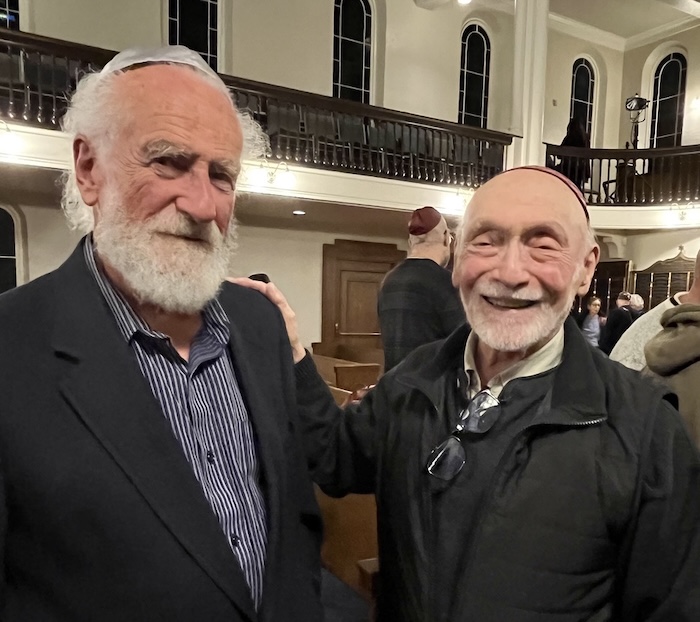
Leo spoke about being a child survivor of the Holocaust. Born in Amsterdam in 1940, he said his parents could not have foreseen that, three years later, they would see him for the last time and, shortly thereafter, they would be tortured and murdered in Auschwitz.
“I think of what must have gone on in their minds during that time,” he said. “They gave away their child, their baby. How is it possible for a parent to do this? Where did they find the strength to bypass the boundaries of love?”
By August 1943, he said, his parents were surely aware of the fate that awaited them.
“When I was a young father,” said Leo, “I struggled with what I would do under the same circumstances. Could I have given away my son? My daughter? Ask yourself, could you?”
In 2025, Leo visited the Dutch Holocaust Memorial of Names in Amsterdam, constructed with more than 100,000 bricks, each representing an individual victim, with their name, date of birth and age when they were murdered. The bricks honouring Leo’s parents were within arm’s length of each other.
“After more than 80 years, we became a family of three again. It was a deeply emotional moment in my life. I have finally found the place to say thank you,” he said.
Harry Brechner, rabbi emeritus at Emanu-El, spoke to the unprecedented nature of the current time in the lives of many Jews.
The commemoration of Kristallnacht is a moment, he said, “for our community to say, it’s not how we are here. Here, we don’t allow or institutionalize racism, hatred and prejudice. Here, we reach out towards understanding and connection and finding our way forward. And I always felt like Victoria holds incredible potential for us to truly be an example of a compassionate city.”
There was a musical performance by klezmer ensemble Kvell’s Angels, whose members are Nechama Ferstman, Laura Rosenberg, Lucila Nerenberg and Richard Kool. Psalm 23 was performed by Josie and Greg Davidson.
Brechner and Congregation Emanu-El’s Rabbi Elisha Herb, along with other religious and civic leaders in the Greater Victoria community, recited a community pledge of mutual respect and support. Survivors and descendants of survivors took part in a candlelighting ceremony. Eli Brandt, in honour of his parents, led Kaddish.
Sam Margolis has written for the Globe and Mail, the National Post, UPI and MSNBC.