

Benjamin Franklin famously said that nothing is certain except death and taxes. Estate planning may not prevent the inevitable, but it can help reduce certain costs. One of those costs is probate, which, depending on the value and composition of the estate, can amount to thousands of dollars.
What is probate?
Probate is the court process that confirms a will is valid and gives the executor legal authority to deal with estate assets. Financial institutions often require probate before assets can be transferred or sold. Depending on the circumstances, obtaining probate and administering an estate can take time, which may delay the distribution of certain estate assets.
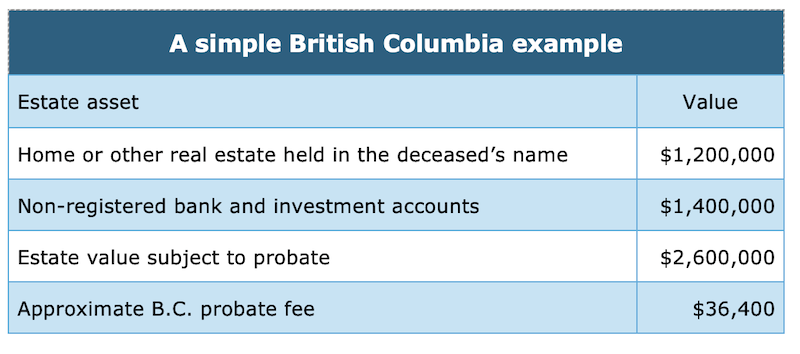
In British Columbia, on estates worth more than $50,000, probate fees are 1.4% or roughly $14,000 per $1,000,000. A simple example is laid out in the table. In it, an estate value of $2,600,000 would mean an approximate BC probate fee of $36,400.
Joint accounts: important considerations
Some parents add an adult child as a joint owner of an account as part of their estate planning. While this may help reduce probate exposure, joint ownership can have other implications. Depending on the circumstances, these can include exposure to the joint owner’s creditors or family-law matters, as well as potential disagreements among family members about how the assets were intended to be distributed.
A new estate planning option
Scotia Wealth Management now offers an account structure for eligible non-registered investments that allows clients to name successor owners. Upon death, eligible assets may pass directly to the named successors rather than through the estate, which may reduce the assets subject to probate.
• You stay in control. The account remains in your name. You continue to make all investment and withdrawal decisions and continue to receive the statements.
• Your successors have no access while you are alive. Naming them does not make them joint owners and does not give them trading or withdrawal authority.
• The account passes directly at death. Investments transfer to the living successors in equal shares without first passing through the estate.
• You can transfer eligible investments. Cash or eligible securities can be moved without triggering tax into a newly opened account while you retain full ownership and control.
• No additional account or legal fees. The account operates much like your existing investment account, with the added ability to name successor owners and have assets pass directly to them outside the estate.
Is it right for you?
This solution may not be suitable for everyone and should be explored as part of a financial and estate plan. To learn whether this may be appropriate for you, connect with Scotia Wealth Management for more information and personalized guidance: keilinvestmentgroup.com.
Shay (Shy) Keil is a senior wealth advisor at Scotia Wealth Management who works with established retirees and business owners, helping them structure sustainable, tax-efficient retirement income through strategic cash-flow planning.