
On Oct. 7, 2023, Hamas and other Islamist extremist groups launched a brutal attack on Israel, massacring approximately 1,200 people, most of whom were civilians, firing approximately 13,000 rockets, wounding thousands, and taking 251 people hostage into Gaza. Three years later, I was present alongside students at the Israel on Campus (IOC) table inside the Alma Mater Society (AMS) Nest at the University of British Columbia (UBC), serving as regional program manager for StandWithUs Canada. I was there on the third anniversary of that horrific attack to support students as they commemorated the victims of one of the darkest days in recent Jewish history and to ensure that Jewish life and support for Israel remained visible.
Jewish students at UBC marked the day with resilience and community solidarity. Chabad hosted a table inside the Nest, which students visited, while Hillel House organized a Run to Remember, where students ran in memory of those lost on Oct. 7. At the IOC table, we handed out literature about the attack, engaged in conversations with passing students, and featured a display board honouring Canadians who were murdered in the attack. Our presence ensured that Jewish and pro-Israel students were not isolated or forced into hiding, offering a space where students could connect, process grief and remember the victims together, while educating others about the massacre.
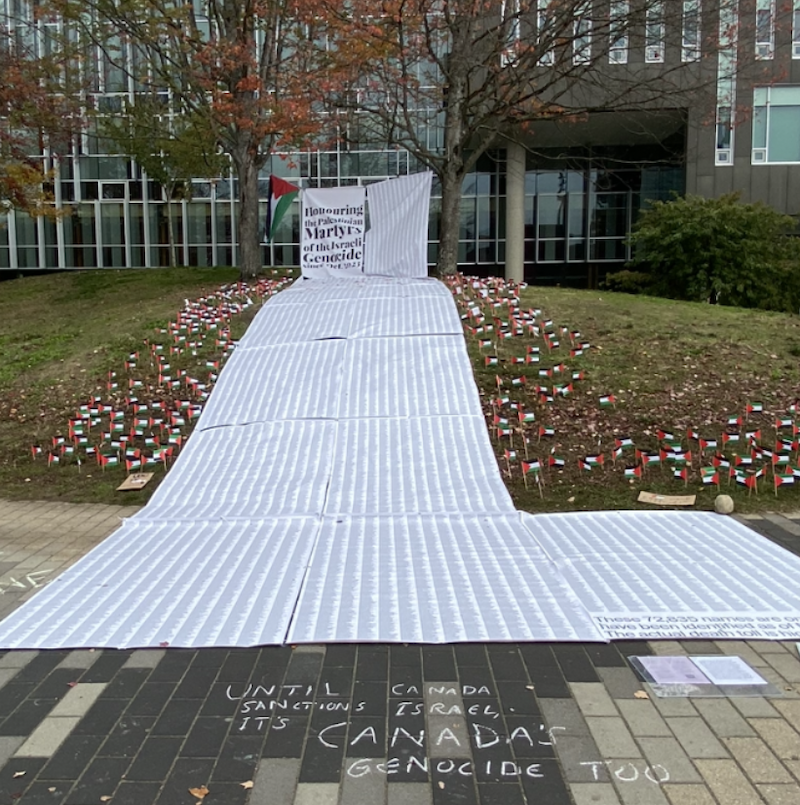
Outside the Nest, in a disturbing contrast to our commemorations, Palestine Solidarity Action UBC organized an all-day rally in the central plaza, and UBC Grad Students 4 Palestine hosted an evening vigil at the Musqueam Post. The physical setup of the rally was designed for maximum public visibility: organizers displayed a massive banner reading “Honouring the Palestinian Martyrs of the Israeli Genocide” alongside an interactive lawn display where passersby were encouraged to stick small Palestinian flags into the ground in honour of Palestinians who the display claimed had been “martyred” since Oct. 7, 2023. Surrounding walkways were covered in chalked slogans, including “Free Palestine” and “from the river to the sea,” both of which are understood by the Jewish community and others as calling to end the existence of the state of Israel.
The use of the term “martyrs” cannot be separated from the context in which it appeared. On the anniversary of the Oct. 7 massacre, when Jewish students were mourning the victims of Hamas’s atrocities, rhetoric that glorifies those responsible for the attacks amounts to a celebration of terrorism, not simply an expression of solidarity with Palestinian civilians. The distinction matters: mourning innocent lives lost is fundamentally different from honouring those who deliberately murdered and abducted civilians.
Furthermore, claiming that Oct. 7, 2026, marks three years of genocide is an historical inversion. Israel’s military campaign in Gaza was a direct response to the Hamas-led massacre, but activist networks began levying the genocide charge as early as Oct. 9, 2023, while Hamas terrorists were still active inside Israeli towns, and weeks before Israel launched its ground operation on Oct. 27, 2023. Following the national call-to-action campaign led by National Students for Justice in Palestine, these events at UBC deliberately selected Oct. 7 to weaponize a day of profound Jewish trauma by running events that celebrated and mischaracterized Oct. 7, 2023.
These events were not merely political or a legitimate exercise of the freedom of expression that we all value at UBC. The Jewish students and others who condemned and opposed these events were not simply engaging in a routine exchange of opposing views; these events and the movement behind them are inherently hateful, unethical and fundamentally at odds with the values of UBC. Transforming the solemn anniversary of the slaughter of 1,200 innocent people and the kidnapping of hundreds into a platform for activism based on hatred for Israel and the Jewish people is an offensive act of disrespect to Jewish grief. By deliberately choosing this date to honour those involved in the violence and demonize the country that was attacked, the groups behind these events created an atmosphere of hate, hostility and intimidation for Jewish students and completely surpassed any reasonable protection for freedom of expression at UBC.
These measures extended beyond public rallies. Literature distributed at the events actively promoted motions before UBC’s Senate to sever academic ties with Israeli institutions, including the Hebrew University of Jerusalem, Tel Aviv University and the Technion-Israel Institute of Technology; aligning directly with the Palestinian Campaign for the Academic and Cultural Boycott of Israel and the broader boycott, divestment and sanctions (BDS) movement. Far from being benign political advocacy, these academic boycott campaigns enforce an ideological litmus test across campus. Rather than critiquing government policy, they assign collective guilt, halt collaborative international research and cancel exchange programs based solely on national origin and institutional affiliation. By weaponizing university governance, such initiatives systematically undermine academic freedom for the entire campus community, depriving UBC students of global opportunities while signaling to Jewish and Israeli students that their heritage, academic connections and right to participate fully in university life are under constant threat of exclusion.
Contemporary campus antisemitism manifests through hostile environments, ideological isolation and BDS campaigns. Recent data from the Campus Antisemitism and Student Experiences study highlights that a vast majority of Jewish students now experience hostility, self-censor their identities or feel excluded from student spaces simply because of their Jewish identity or connection to Israel. Furthermore, B’nai Brith Canada’s Annual Audit of Antisemitic Incidents consistently documents unprecedented surges in targeting Jewish institutions and campus communities across the country. When anti-Israel rallies on campus glorify the perpetrators of Oct. 7 and promote student Senate motions to sever ties with Israeli universities, they directly fuel this hostile climate.
The deliberate timing, messaging and rhetoric of these demonstrations were morally reprehensible and fundamentally at odds with the core values of respect, inclusion and belonging that UBC claims to uphold. Allowing the demonstrations to proceed without adequately addressing conduct that undermines these foundational principles breaches the ethical boundaries of academic life and dismisses Jewish students’ grief and dignity. UBC has a responsibility to actively enforce its own community standards and translate its stated values into meaningful protections. Meeting this responsibility requires investigating targeted harassment and policy violations and consistently applying consequences when campus events degrade into environments of intimidation and exclusion. While the responsibility for confronting campus antisemitism rests on university leadership, the wider community – including alumni, parents, civic leaders and communal organizations – has a role in holding UBC accountable.
On Oct. 7, 2026, our presence inside the Nest affirmed a vital principle: Jewish students should never have to compromise their identity or connection to Israel to feel like they belong on campus. While freedom of expression is fundamental, it must not be weaponized to excuse antisemitism or normalize the exclusion of Jewish grief. University leadership must enforce its standards and policies consistently and ensure that Jewish life remains visible, respected and fully integrated into campus life.
Chloe Heuchert is an historian specializing in Canadian Jewish history. During her master’s program at Trinity Western University, she focused on Jewish internment in Quebec during the Second World War. She currently works as a regional program manager for StandWithUs Canada.