
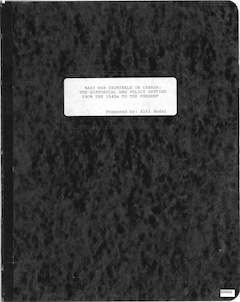
The “full” Rodal Report is finally out. The federal government’s exhaustive study of how Nazi war criminals managed to evade capture and find a new home in Canada can now be accessed online from Library and Archives Canada’s website. (Search the collections at canada.ca/en/library-archives.html.)
Entitled “Nazi War Criminals in Canada: The Historical and Policy Setting from 1940 to the Present,” the 618-page study by historian Alti Rodal is part of the Deschênes Commission’s investigations into whether Josef Mengele and other Nazi war criminals were living in Canada. The study was published in December 1986, but large sections of it were sealed from public view until 2024 for cited privacy and national security concerns.
Since that time, B’nai Brith Canada and other advocacy organizations have been trying to get the remaining redactions lifted. Last year, B’nai Brith took the Library and Archives Canada to court. Federal Court Justice Simon Fothergill, who conducted the federal review of the case, eventually supported B’nai Brith’s argument that the public had a right to know about their country’s history, said Rich Robertson, B’nai Brith Canada’s director of research and advocacy.
“I think Justice Fothergill was very clear in his decision that [in regard to] historical information and its potential harm, under the Access to Information Act, the criteria [should not be] viewed in relation to contemporary issues,” Robertson told the Independent. “The individuals in these reports are all likely deceased. The potential for this to have an adverse impact on our national security when we take into context the historical nature of the information, is quite minimal.”
Fothergill ordered LAC to restore public access to all sections that had been restricted under 15(1) of the Access to Information Act (matters relating to international affairs, defence or national security), arguing that enough time had passed to warrant the report’s release. One final section, which contains an unattributed quote by a US government official, remains sealed under 13(1) of the ATIA (regarding records requested that contain information obtained in confidence from governments).
The newly released sections of the report tell the story about Canada’s role in the resettlement of Nazi war criminals and Canada’s complicated relationship with the United States at the onset of the Cold War with the Soviet Union. According to Rodal, Canada was considered an asset when it came to resettling anti-communist informants and defectors that had aided the United States during the war. Since many of those applicants lacked suitable clearances, falsified documents were surreptitiously provided by the Americans to accompany their immigration review. The names of at least 35 to 40 suspected Nazi collaborators, 98 Nazi Party members and 738 German prisoners of war were funneled through the US research and resettlement branch of the army (USAREUR), the Canadian immigration department’s US contact. It wasn’t until some years later, when the Royal Canadian Mounted Police discovered that the USAREUR was a cover for the Central Intelligence Agency, that it became clear that some applicants would have been considered ineligible for immigration due to acts of “moral turpitude,” a grouping that included Nazi collaborators.
“It would appear then that large numbers of former agents were being resettled by the Americans, and it was perhaps the less desirable ones, for whatever reason, whom they would have wished to resettle in another country, such as Canada,” the report noted.
But the problems that Canada, and many of the allied nations, faced when it came to establishing appropriate protocols for screening for Nazi war criminals and collaborators went further back than that. By 1944, Rodal wrote, “none of the Allies had established procedures or machinery for the investigation of war crimes.” That lack of oversight would continue to create legal and political headaches decades later when Canada was faced with the prospect of extraditing suspected criminals.
In 1967, then-justice minister Pierre Trudeau was forced to defend his decision not to strip the citizenship of an alleged war criminal and extradite him to the Soviet Union. At the time, Trudeau’s decision was controversial. But, because Canada had not established robust procedures for investigating alleged war crimes during the war, it also lacked the historical records to fairly evaluate the Soviet Union’s claim that Subject F, as he was called, was a war criminal.
Further, there was nothing in the Canada’s Citizenship Act during the 1960s that required applicants to affirm they had never committed a war crime in a foreign country. Therefore, Trudeau insisted that Subject F could not be stripped of his Canadian citizenship, nor extradited for execution by the Soviet Union. Subject F was allowed to live out the rest of his life in Canada.
The debate over the extradition of Nazi war criminals would come up again in 1982, when Helmut Albert Rauca was arrested by the RCMP, at the behest of the West German government, for the alleged mass murder of more than 10,000 Lithuanian Jews. In this case, West Germany had provided evidence to support its request for extradition, but Rauca, who had entered Canada legally in 1950, was now a Canadian citizen. His lawyers argued that, as a Canadian, he enjoyed certain privileges and could not be extradited. However, even though Canada’s newly passed Charter of Rights and Freedoms was in effect, the Crown found that Canada’s Extradition Act posed “a demonstrably reasonable limit” on the rights of a Canadian citizen under the Act. Rauca was extradited to Europe and died in jail awaiting trial.
In 1987, the federal government amended the Citizenship Act to include “war crimes” as a restriction against obtaining citizenship under the Act. That restriction is still in effect today.
As to Mengele, the “Nazi Angel of Death,” although he is alleged by the Simon Wiesenthal Centre to have applied for a Canadian visa in 1962, the Commission found no record that he had done so, nor been granted entry. He is now believed to have settled in South America, where he died.
“Despite Allies’ declared policy to bring to justice those involved […] in the dispossession, enslavement and murder of millions of civilians during World War II,” wrote Alti Rodal, “and notwithstanding the various postwar trials conducted by the Allies and by a number of countries in Europe, the vast majority of perpetrators of crimes evaded justice.”
According to Robertson, the Deschênes Commission’s “Nazi War Criminals in Canada: The Historical and Policy Setting from 1940 to the Present” should be a compulsory read for all Canadians. But it’s only part of what the Deschênes Commission uncovered, he noted.
“We are also continuing to pursue the release of Part II of the Deschênes Commission’s Report,” said Robertson. This part of the report, which has remained fully redacted for the past four decades, possibly includes the names and identities of Nazis or Nazi collaborators who found safe harbour in Canada following the Holocaust.
Jan Lee is an award-winning editorial writer whose articles and op-eds have been published in B’nai B’rith Magazine, Voices of Conservative and Masorti Judaism and Baltimore Jewish Times, as well as a number of business, environmental and travel publications. Her blog can be found at multiculturaljew.polestarpassages.com.