

For just shy of 40 years, the Raging Grannies have been an active voice for social justice. Clad in stereotypical grandmother attire, the women, all of a certain age, have been a regular presence at rallies, belting out progressive political messages with lyrics adapted to familiar tunes.
For much of their history, Jewish community member Freda Knott, 90, has been a mainstay of the organization, which was founded in Victoria in the winter of 1986/87. Originally from Vancouver, Knott came to Vancouver Island 60 years ago, first as a teacher, before she started raising a family. In 1995, she sailed on a Greenpeace ship to Alaska as part of the Greater Victoria Disarmament Group. On that voyage were members of the Raging Grannies, many of whom she knew. Ultimately, they took her on as a member.
“I was the youngest at the time. Now I’m the oldest and the longest member,” Knott told the Independent.
Over the decades, the Raging Grannies have advocated for such causes as climate action, LBGTQ+ rights, peace, Indigenous rights, women’s rights and the fight against homelessness.
Nuclear disarmament was their first cause. During a protest at the Legislative Assembly of British Columbia in 1987, ahead of a hearing on uranium mining, the Raging Grannies brought a laundry basket to the legislative grounds, stretched out a clothesline and hung up women’s underwear – which signified “briefs” they wanted to present at the hearings.
On July 1, 2012, the Raging Grannies, dressed in black and, placing themselves under 10 metres of black cloth, moved through the lawn of the BC legislature to protest the Enbridge pipeline and warn of the possibility of an oil spill.
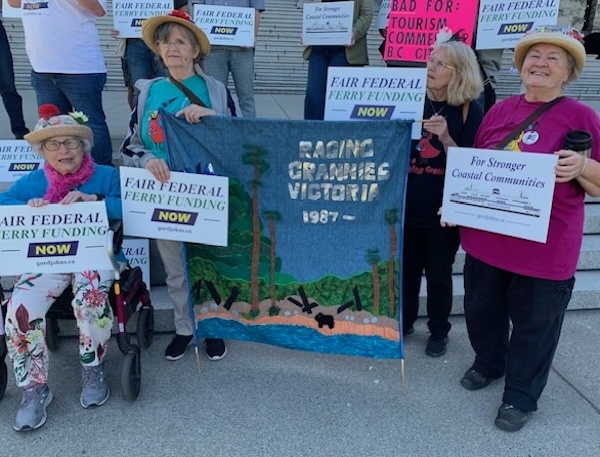
One memorable episode for Knott occurred in the early 2000s, when the BC Liberals were in power. Ahead of question period at the legislature one day, the Grannies alerted the NDP that they were going to be in the visitors’ gallery.
“One at a time, we would get up and shout out ‘affordable health care for everyone!’” Knott recalled. “And they took us out to put us into a meeting room. We would do it separately, and we just kept doing it.
“There were about six or seven of us, and one of the grannies stayed outside to handle the media, who came right away. There was a big write-up about us in the paper the next day. We weren’t evicted or jailed, but we were banned from going into the legislature for many years.”
As the Raging Grannies’ reputation grew, they were invited to appear at venues such as Seattle’s Folklife Festival. Groups of women elsewhere liked the work they were doing, and Raging Granny chapters – known as “gaggles” – have been formed in dozens of cities throughout Canada and the United States, as well as in other countries. There is, for example, a gaggle in Israel.
According to Knott, there are currently 10 members in Victoria, with one having recently moved away. The number of members fluctuates between 10 and 15. More than that, she said, and it becomes too difficult to manage.
“We’re all very strong women that meet once a week. We can be very argumentative with each other and disagree on some issues, and sometimes we yell at each other,” she said.
These days, the situation in the Middle East is a topic of discussion among the Grannies. Knott says that, while members are pro-Palestinian, they are not anti-Israel.
“We all feel that Israel should be there, but do not like the kind of government they have right now,” she said.
The history of the Raging Grannies has been chronicled in print with Off Our Rockers and into Trouble: The Raging Grannies (2004) by Alison Acker and Betty Brightwell, and The Raging Grannies: Wild Hats, Cheeky Songs and Witty Actions for a Better World (2004) by Carole Roy.
They have also been the subject of several documentaries, including Granny Power (2014), directed by Jocelyne Clarke and Magnus Isacsson. In April 2017, to mark their 30th anniversary, the Raging Grannies were the subject of an exhibit at the Canadian Museum of Human Rights in Winnipeg.
These days, groups of Raging Grannies are active across North America in the Black Lives Matter and No Kings protests, as well as in rallies on immigration, coal mining and the Alberta Disability Assistance Program.
The Santa Fe gaggle, for example, recently posted a viral parody on YouTube titled “The Battle Hymn of the Donald,” set to the abolitionist anthem of the American Civil War and aimed at the current president of the United States. Other viral videos of theirs include “Hit the Road, ICE” and “House of the Epstein Crimes.”
“The Raging Grannies just spread all over the place, and they’re very strong in the States now,” said Knott. “The more trouble there is, I think, the more Raging Grannies come out.”
Sam Margolis has written for the Globe and Mail, the National Post, UPI and MSNBC.