

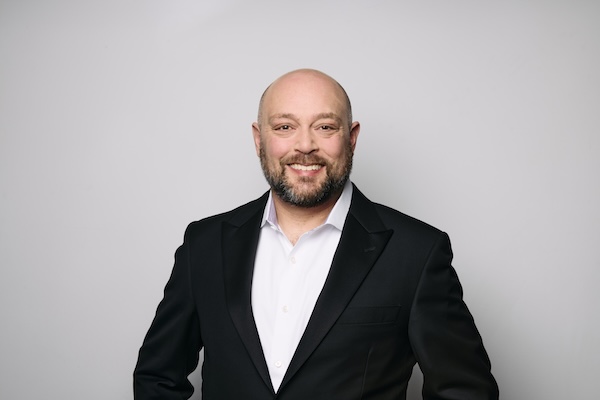
For Jaime Stein, politics and Jewish communal life have long been intertwined. The Conservative candidate in Vancouver-Langara describes himself simply as “a Vancouver Jew,” born and raised in the city, educated at Vancouver Talmud Torah and bar mitzvahed at Congregation Beth Israel, where he remains a member. More recently, he also joined Temple Sholom, drawn in part by its Friday night services, which he calls “a peaceful way to end the week.”
Stein says his understanding of Jewish identity was shaped most profoundly by his father, the late Dr. Howard Stein, whose community involvement included bringing the Israeli and Jordanian ambassadors together in Vancouver at a 2005 event called Partners for Peace. His father encouraged Jews to participate across the political spectrum.
“The best advice my father ever gave me was to treat people equally,” Stein said. “That’s a simple idea, but it carries the weight of Jewish history behind it.”
The Jewish idea of tikkun olam, repairing the world, has always felt practical to Stein.
“It’s about showing up, building relationships with people who are different from you, and doing the work,” he said. “I’m much more interested in action than in talking about action, and I think that’s a very Jewish instinct: the Talmud is full of argument, but it always comes back to how we live.”
That combination of Jewish identity, community involvement and civic participation runs through Stein’s resumé. He has served on committees of the Jewish Federation of British Columbia and on the advisory board of the Canadian Jewish Political Affairs Committee. This summer, he completed the two-year Wexner Heritage Program, focused on Jewish history, texts and leadership. Professionally, he is director for Western Canada at Friends of Simon Wiesenthal Centre, where his work focuses on Holocaust education and combating antisemitism.
Before moving into Jewish communal work, Stein had careers in broadcasting, sports media and technology, with senior roles at companies including Hootsuite and BroadbandTV. He holds an MBA from the University of Toronto’s Rotman School of Management and a journalism degree from Toronto Metropolitan University.
Stein said events since Oct. 7, 2023, were an important factor in his decision to seek office.
“It has changed everything for me, personally and professionally,” he said, describing conversations with Jewish parents worried about identifying their children publicly as Jewish, university students who have concealed their Jewish identity on campus and seniors who feel less secure.
Stein argues that government responses to antisemitism should focus on enforcement, security and institutional accountability. He wants hate crimes properly investigated and prosecuted, better training for police and greater provincial participation in the security costs borne by Jewish institutions. He also wants antisemitism more explicitly incorporated into provincial anti-racism programs and training for public servants, educators, health professionals and police.
“It isn’t about creating a hierarchy of hate,” Stein said. “It’s about making sure no community falls through the cracks.”
On Israel, Stein draws a distinction between criticism of government policy and antisemitism. He supports use of the International Holocaust Remembrance Alliance working definition of antisemitism, arguing that it has often been characterized inaccurately as prohibiting criticism of Israel.
“Criticism of Israeli government policy is legitimate,” he said. “Israelis themselves do it loudly and constantly, and I’ve heard and seen plenty of it firsthand. That’s what democracies do.”
Education is another area where Stein sees a need for clearer boundaries. Schools and universities, he said, should protect robust debate while enforcing rules against harassment, intimidation and exclusion. For K-12 education, he said Middle East curriculum should be “accurate, balanced and age-appropriate rather than activist.”
On balancing protections for Jewish students with legitimate freedom of expression, Stein sees no contradictions.
“Those two responsibilities aren’t in conflict,” he said. “Universities and schools should be places where hard ideas are debated vigorously. But freedom of expression has never included the right to harass, intimidate or exclude other students, and institutions have a duty to enforce their own codes of conduct consistently, no matter who is involved.”
In practice, that means clear policies applied evenly, leaders who speak up the same way they would for any other group when Jewish students are targeted, protecting the ability of students to get to class and participate in campus life without fear, and making sure educators have the training to handle these conversations responsibly, he said.
Stein is careful not to present himself as a spokesperson or to suggest there is a monolithic Jewish electorate.
“There’s an old joke: two Jews, three opinions,” he said. “It’s funny because it’s true.”
Jewish British Columbians should not be expected to answer collectively for Israel or for other Jews, he said, stressing that, if elected, his responsibility would extend to everyone in Vancouver-Langara.
As he knocks on doors in the riding, the issues Stein hears most frequently about are affordability, access to health care, public safety and transit. Those are the priorities he says he would take to the legislature.
For Stein, the through-line is less about choosing between Jewish communal engagement and broader public service than seeing the two as connected.
Spiking antisemitism convinced Stein “that democratic institutions are only as strong as the people willing to defend them,” he said. “Public service, for me, is a way of taking that lesson seriously.”



