Physical Address
304 North Cardinal St.
Dorchester Center, MA 02124
Physical Address
304 North Cardinal St.
Dorchester Center, MA 02124

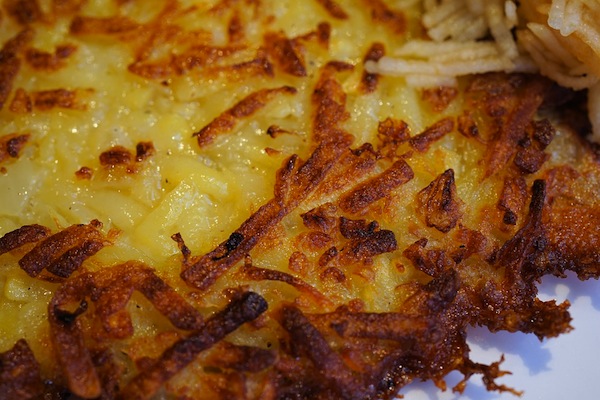
With all the oil used for frying Chanukah potato pancakes – otherwise known as latkes, in what we think is Yiddish, or as levivot in Hebrew – they may be considered an unhealthy food. Yet, each Chanukah, many of us, who are staunch-hearted and old-fashioned, spend time grating potatoes by hand, always accidentally suffering at least one scraped finger. The more modern among us risk coming out with liquid mush by using a food processor or blender.
Why do we keep making these little pancakes year after year? Why do we eat them for Chanukah in the first place? An old folk proverb says: “Chanukah latkes teach us that one cannot live by miracles alone.”
Jewish food writer and cookbook author Joan Nathan contends that the word latke is not in fact Yiddish but rather stems from “a Russian word, latka, and a pastry, from obsolete Russian, oladka, or flat cake of leavened wheat dough.” This, in turn, probably came from a Middle Greek word, eladion, or oil cake, stemming from elaion, meaning olive oil.
Potato pancakes seem to have originated among poor Eastern European Jews, but potatoes did not become a staple until the mid-19th century. John Cooper, in Eat and Be Satisfied: A Social History of Jewish Food, comments that Jews from Lithuania ate pancakes made from potato flour for Chanukah and had borrowed the idea from Ukrainians, who made a potato pancake dish with goose fat called kartoflani platske, which they ate for Christmas. Since Chanukah fell about the same time, and there were plenty of geese to provide goose fat or schmaltz, we could conclude that schmaltz became a substitute for oil. Jews living in the Pale of Settlement in the 17th century probably adapted it for Chanukah as a way to dress potatoes differently for the holiday. Cooper also states that many Eastern European Jews ate buckwheat latkes for Chanukah, while Polish Jews made placki, pancakes, from potato flour and fried them in oil.
Here are a few types of latkes that would be nice to serve during Chanukah.
ROMANIAN ZUCCHINI POTATO LATKES
(six to eight servings)
2 pounds zucchini, peeled and grated down to the seeds
2 large potatoes, grated
1 medium onion, grated
3 eggs
1 tsp vegetable oil (I use canola)
3/4 cup matzah meal (I use flour)
salt and pepper to taste
vegetable oil for frying
TUNA LATKES
This recipe came from Starkist Tuna, with adaptations. It makes 16 latkes.
2 cans drained tuna
2 grated potatoes
1 chopped onion
2 eggs
2 tbsp breadcrumbs
3 tsp dry parsley flakes
3 tsp dry chives
salt and pepper to taste
2/3 cup flour
oil
dressing
1 cup sour cream
3 crushed garlic cloves
4 tbsp olive oil
6 tsp dry herbs such as chives, thyme or dill or mixed
1 tbsp sugar
salt to taste
HERBED ZUCCHINI FETA LATKES
With a few changes, this recipe is from Food & Wine and is by Didem Senol, a chef from Istanbul, Turkey, who trained at the New York French Culinary Institute. It makes four to six servings.
4 medium grated zucchini
1 tbsp kosher salt
2 large eggs
1/2 cup flour
1/2 cup chopped dill
1/4 cup chopped parsley
1/2 cup crumbled feta cheese
sauce
1 seeded chopped, peeled cucumber
1 cup sour cream
salt and pepper to taste
vegetable oil
Sybil Kaplan is a journalist, lecturer, book reviewer and food writer in Jerusalem. She created and leads the weekly English-language Shuk Walks in Machane Yehuda, she has compiled and edited nine kosher cookbooks, and is the author of Witness to History: Ten Years as a Woman Journalist in Israel.