Physical Address
304 North Cardinal St.
Dorchester Center, MA 02124
Physical Address
304 North Cardinal St.
Dorchester Center, MA 02124

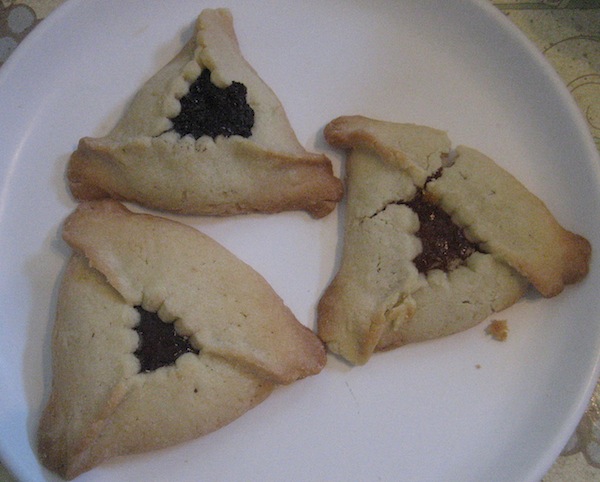
When Eastern Europeans immigrated to America, they brought their hamantashen recipes with them. (photo from Infrogmation via Wikimedia Commons)
When it comes to Purim pastries, hamantashen are what most of us think of first. The word is taken from the German mohn, meaning poppy seeds, and taschen, referring to pockets. Some say the pockets refer to Haman, who stuffed his pockets with bribe money.
The original name, mohntaschen, and the tradition of eating them, may date back as far as the 12th century. Israeli historian, caterer and cook Shmil Holland says that, when Jews fled Germany for Eastern Europe in the late Middle Ages, they took the poppy seed pastry with them and added the Yiddish prefix ha, thus making it hamantash.
In the Encyclopedia of Jewish Food, Gil Marks (z”l) writes that Eastern Europeans and their foods came to dominate the Ashkenazi world in the 19th century, and “hamantashen emerged as the quintessential Ashkenazic Purim treat.” The original dough was kuchen, a rich yeast dough, and common fillings include poppy seeds, chocolate, prunes or other fruit fillings. When Eastern Europeans immigrated to America in the late 19th and early 20th centuries, the idea came with them.
(An aside: In 18th-century Bohemia, Jews added a prune filling. The story is that a local merchant was accused of selling poisoned plum jam; when he was cleared of the charges, his family marked the occasion as a holiday, called povidl Purim, or plum jam Purim.)
In addition to the pocket imagery, several other explanations have been suggested for the triangular shape of hamantashen. Some say they represent a triangular-shaped hat worn by Haman, the villain in the Purim story, and that we eat them as a reminder that his cruel plot was foiled. Others say they represent Esther’s strength and the three founders of Judaism: Abraham, Isaac and Jacob, as a midrash says that, while reflecting on his plan to get rid of the Jews, Haman realized the three Patriarchs would intercede.
Yet another explanation lies in the cookies’ name in Israel, oznei Haman, Haman’s ears – perhaps referencing an old custom of cutting off the ears of criminals before they were executed. When the resulting treat became known as Haman’s ears for Purim is unknown, although it is mentioned as early as 1550. However, according to Marks, historical oznei Haman were strips of dough fried in honey or sugar syrup – a 13th-century Andalusian cookbook has a recipe for this “ear” dish and it was adopted by Sephardim.
Whatever their name, the reason behind eating hamantashen remains the same: remembering how close the Jewish people came to tragedy and celebrating the fact that they escaped death.
Here are some recipes from my family for your own celebration of Purim, which starts this year on March 12. My grandmother (z”l) made the most beautiful-looking yeast hamantashen.
GRANDMA’S PRUNE FILLING
1 1/2 cups finely cut prunes
1/4 cup sugar
2 tsp lemon juice
GRANDMA’S POPPY SEED FILLING
1 cup ground poppy seeds
1/4 cup milk or water
2 tbsp butter or margarine
1/2 cup raisins
1/2 cup finely chopped nuts
2 tbsp honey
1 tsp vanilla
GRANDMA’S YEAST HAMANTASHEN
4 tsp dry yeast
1/2 cup lukewarm milk
2 eggs
1/2 cup sugar
1/2 cup butter or margarine
1 tsp salt
1 cup sour cream
4-5 cups flour
vegetable oil
Day before baking:
Next day:
MOM’S COOKIE HAMANTASHEN
2 eggs
1/2 cup sugar
1/2 cup margarine
2 3/4 cups flour
2 tsp baking powder
1/4 tsp salt
1 tsp vanilla
juice of half an orange or 1/2 cup sour cream
Sybil Kaplan is a journalist, lecturer, book reviewer and food writer in Jerusalem. She created and leads the weekly English-language Shuk Walks in Machaneh Yehudah, she has compiled and edited nine kosher cookbooks, and is the author of Witness to History: Ten Years as a Woman Journalist in Israel.