Physical Address
304 North Cardinal St.
Dorchester Center, MA 02124
Physical Address
304 North Cardinal St.
Dorchester Center, MA 02124


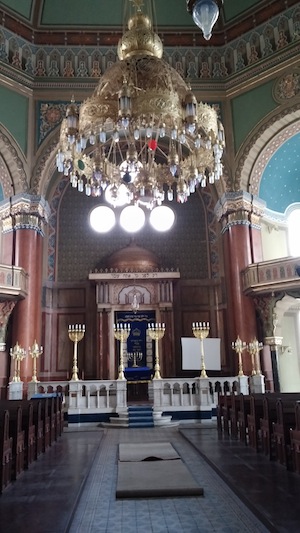
The roof of Sofia’s synagogue. (photo by Deborah Rubin Fields)
Until recently, if someone had asked me what I knew about Bulgaria, I would have said, “Isn’t that the name of a cheese?” Now having visited Bulgaria, I realize how limited was my perspective.
Bulgaria’s colorful Jewish history dates back to antiquity. According to Elko Hazan’s comprehensive 2012 book The Concise Illustrated Encyclopedia of Jewish Communities and their Synagogues in Bulgaria, over the centuries Jews had a presence in some 40 Bulgarian cities and towns.
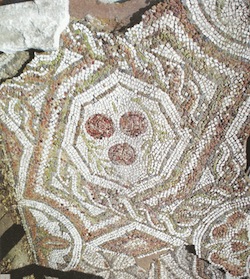
For example, near Plovdiv’s Maria Luiza Boulevard, archeologists uncovered a third-century CE synagogue. Its proximity to ancient Philippopolis’ Roman forum suggests that wealthy Jews in good standing with the Romans built the structure. The accomplishment of these well-placed Jews is all the more remarkable when you consider that Philippopolis had an estimated population of 100,000. Archeologists discovered two mosaic synagogue floors, one over another. The stunning mosaic featured both the Four Species (lulav, etrog, myrtle, willow) and a menorah. The second floor may have had geometric patterns. That more than one floor was found probably indicates the synagogue was renovated in the fifth century and destroyed in the sixth century. (See The Jewish-Greek Tradition in Antiquity and the Byzantine Empire, edited by James K. Aitken.)
Greek inscriptions commended the synagogue’s donors or founders. The east and west mosaic panel read: “‘From the gifts of Providence … Cosmianus, also called Joseph, executed the decoration (of the building). Blessing to all!” The central panel read: “From the gifts of Providence … El … also called Isaac made decoration of 120 feet (mosaic).” The adoption of a Roman-sounding second name attests to adaptation by Jews to the Greek and Roman culture. (See Negotiating Diaspora: Jewish Strategies in the Roman Empire, edited by John M.G. Barclay.) Ironically, as the synagogue remains are in storage, the only way to get a sense of how grand the floor was is to visit the impressive new museum of the (fifth-century) Small Basilica.
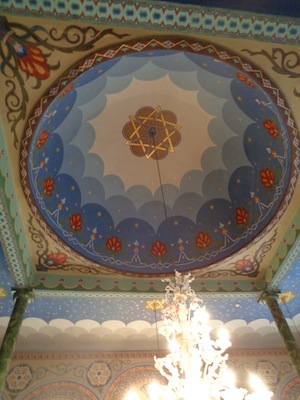
But Plovdiv’s charming Zion Synagogue (13 Tsar Kaloyan St.) is still up and functioning (one of two still active in Bulgaria). It was first built in 1886-1887. In 2003, the extensive five-year renovation of the starry-sky ceiling and the colorful geometric-paneled walls was completed. The building is only open for Kabbalat Shabbat prayers, so visitors should contact Eva Mezan (at +359-87-944-8675) to verify hours.
Although there is seating for 250 worshippers, some 20 local men and women attend this service. The second floor ezrat nashim (women’s section) is not used. Instead, an invisible mechitza (divider) has men sitting on one side of the aisle, women on the other. The congregation’s lay cantor leads services from the raised bima adjacent to the aron ha-kodesh (Torah ark). The congregation uses a Bulgarian-Hebrew siddur. Vocal congregants despair over the sad state of their community, with its high rate of intermarriage.
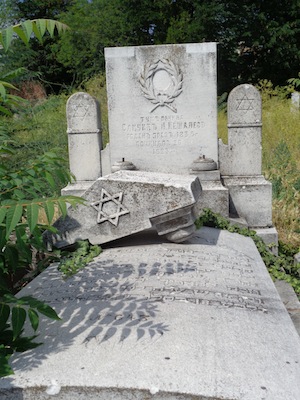
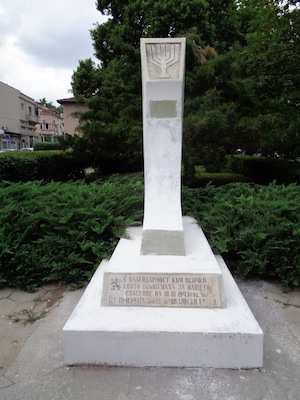
Plovdiv’s small Jewish community likewise has difficulty managing the graves in the Jewish section of the municipal cemetery (73 Knyaginya Maria Louisa Blvd.). While there is upkeep of “new” graves, headstones laid as recently as 1923 are somewhat neglected. Near the corner of the Sixth of September and Russki boulevards, Plovdiv’s Jews, however, do maintain a Bulgarian/Hebrew/English thanksgiving monument to the Bulgarian people for their help during the Second World War.
Sofia’s opulent 1,170-seat, 100-year-old Central Synagogue (16 Ekzarh Joseph St.) is also struggling, with barely enough people to hold daily morning prayers. The small on-site Jewish nursery school and the tiny, underdeveloped Jewish museum strikingly contrast with the enormous octagonal-shaped synagogue sanctuary. (Note: museum hours are limited, and not necessarily in accordance with posted times.)
Within walking distance of the synagogue, visitors may see (upon receiving special written permission from Dr. Lyudmil Vagalinski, director@naim.bg) another example of Bulgaria’s ancient Jewish history in the National Institute of Archeology with Museum’s (2 Saborna St.) lapidarium. A Latin marble pedestal from Oescus – a first- to fifth-century CE Roman town near the Danube – mentions the lay synagogue head Archisinagogus, according to Hazan.
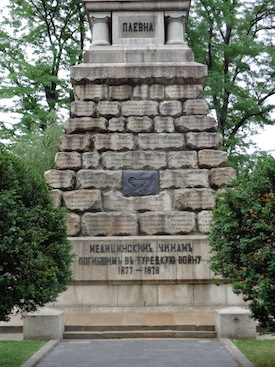
Sofia’s 131-year-old Doctors’ Garden (located close to the National Library and Sofia University) memorializes the 531 fallen medics of the Russo-Turkish War (1877-1878), most of whom died in battles at Pleven, Plovdiv, Mechka or Shipka. A good number of these Russian medical personnel were Jewish, a credit to the reforms established by Russian Emperor Alexander II.
A few blocks away is the street named after biochemist Asen Zlaratov. The street plaque mentions he helped to set up the Committee for the Protection of Jews. Even beforehand, Zlaratov published a newspaper article critical of Germany’s book burning.
More than 51,000 Jewish Bulgarians (most of the community) moved to Israel in the mid- to late-1940s. Between 1967 and 1990, Communist Bulgaria had no diplomatic relations with Israel. Today, estimates are that 5,000 Jews live in Bulgaria. Chabad Rabbi Yosef Salamon and Rabbi Yossi Halprin and their spouses supervise Jewish educational, social and religious functions for the small remaining Bulgarian Jewish population. According to the Hebrew language Chabad Bulgaria website, Bulgaria has more than 15 organized Jewish community centres or Shalom organization representation. In Sofia, Chabad runs King David, a kosher restaurant offering take-outs and hotel deliveries.
Over the centuries, Bulgarian Jews have influenced both their own community and the larger non-Jewish community. Here are some of the “big names”:
Many more signs of the once vibrant Jewish community still exist, but it takes experts like Elko Hazan to guide us to them.
Deborah Rubin Fields is an Israel-based features writer. She is also the author of Take a Peek Inside: A Child’s Guide to Radiology Exams, published in English, Hebrew and Arabic.