Hundreds gathered in Victoria on Sept. 17 to launch the 2026 campaign for the Jewish Federation of Victoria and Vancouver Island (JFVVI), hear a speech from featured guest Ben Mulroney and celebrate the collaborative efforts of JFVVI and the Jewish Federation of British Columbia (JFBC).
JFBC representatives, including chief executive officer Ezra Shanken and board chair Jonathon Leipsic, traveled to the island, where they joined the local community and JFBC community connectors. The evening’s message was one of unity, highlighting the increasing connection between JFBC and smaller communities across the province. This year’s campaign theme, “We Are Federation,” was featured prominently in the programs and on the screen as the audience entered.
Rabbi Meir Kaplan of Chabad of Vancouver Island began the proceedings by sounding the shofar, and Rabbi Ilana Krygier Lapides of Victoria’s Kolot Mayim Reform Temple followed, leading the audience in singing O Canada and Hatikvah.
Barry Zalmanowitz, the president of JFVVI, noted that this year’s campaign launch in Victoria was momentous because it opened not only as a JFVVI initiative but as part of JFBC. He described JFBC as “a provincial federation committed to strengthening Jewish life in every corner of British Columbia and supporting our community locally, globally and particularly in Israel.
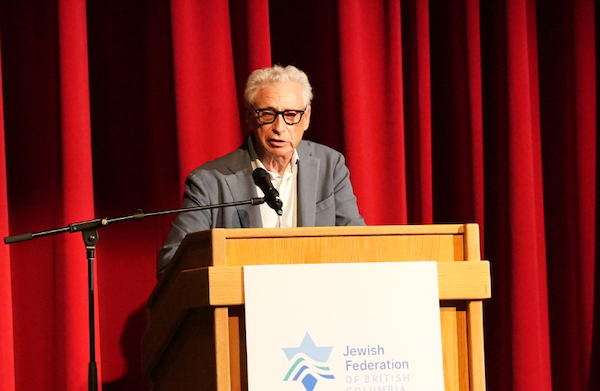
“This is a significant moment for our community, and for Vancouver Island and for our province,” Zalmanowitz said. “Why does this matter? It matters because our communities have evolved, and Federation must evolve with them and to serve them.”
Stan Shortt, a founder of JFVVI, said the launch was the beginning of an important new chapter for Jewish life in Victoria and Vancouver Island. He discussed the growth of the community since the early days of JFVVI in the 1980s. Since then, Victoria has opened new synagogues, Jewish educational opportunities and groups, he said. According to the 2021 census, the city has the fastest-growing Jewish population in the country.
“As our communities grow and change, so does our responsibility to ensure that every Jewish person, no matter where they live, can feel connected, supported and part of something larger than themselves,” Shortt said. “This is why our collaboration with the Jewish Federation of British Columbia is so important.”
Mijal Ben-Dori, JFBC’s chief planning officer, spoke of the rich Jewish ecosystem in Victoria, developed by the organizations and community leaders that have spent decades building the community. She said the job of JFBC and its 12 community connectors across the province is not to duplicate their work but to strengthen it.
“Federation of British Columbia’s role is not to replace any of that. It is to make that table bigger and to connect the tables,” Ben-Dori said. “And, where there isn’t a table, to help someone build one. That is what the campaign makes possible, and that is what we are celebrating here tonight.”
In his keynote address, Mulroney documented much of the Jewish community’s history in Victoria, from the first residents to the present. The relationship with the greater community has, for the most part, been harmonious, he pointed out. In 1863, for example, when Congregation Emanu-El, the oldest synagogue in continuous use in Canada, opened, members of other communities gathered with the city’s first Jews, as one newspaper wrote, in goodwill to mark the occasion.
In Mulroney’s view, that sense of alliance with the broader community is missing today. He highlighted the multiple attacks on Jewish spaces in recent years, including the arson at Vancouver’s Schara Tzedeck in 2024 and the antisemitic graffiti written at the entrance of Congregation Emanu-El in 2025. He cited a 2025 JFBC survey, which found that 61% of Jews in the province avoid wearing anything that would identify them as Jewish in public.
“This is not a Jewish problem,” he stressed, but a Canadian one. “A problem for every one of us because a country that will tolerate it for this group will eventually tolerate it for another; it has always been this way. And you already know what the answer to it looks like because this city has produced it before,” he said, referring to the allyship exhibited at least as far back as 1863.
Following Mulroney’s remarks, there was a brief question-and-answer session between Mulroney and Shanken. Leipsic closed the event by wishing everyone well in the days leading to Yom Kippur, and that the new year bring peace and prosperity.
To donate to the campaign, click here.
Sam Margolis has written for the Globe and Mail, the National Post, UPI and MSNBC.