On Aug. 25, the Vancouver Holocaust Education Centre (VHEC), in partnership with the Montreal Holocaust Museum, presented Football, History and Society: A Discussion with Simon Kuper. The talk explored Holocaust history and the global impact of football (soccer) at a time when the recently completed 2026 World Cup was still fresh on the minds of many.
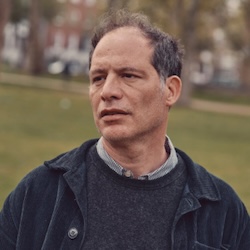
Kuper, a Financial Times journalist based in Paris, covered this summer’s soccer extravaganza, shuttling from city to city and working 90-hour weeks. He said in his introduction that Canada and the United States were ideal hosts for so many competing countries because of all the diaspora communities in North America.
The August talk was moderated by Sebastian Huebel, an assistant professor in modern European history at the University of the Fraser Valley who specializes in the history of Nazi Germany and the Holocaust. Huebel led with questions about Kuper’s 2003 book, Ajax, the Dutch, the War: Football in Europe During the Second World War.
Ajax, the most successful soccer club in the Netherlands, has historically been associated with Amsterdam’s Jewish community, and supporters are known to wave Israeli flags. In the Netherlands of the 1930s, as in other European countries, people belonged to soccer clubs and one’s identity was tied to the club, Kuper pointed out.
“You have a lot of your friends and your social life at the club; you spend the weekends hanging around the canteen, chatting to people, drinking beer, watching football,” he said. “And so, I thought, football is such a big part of Dutch daily life, even then. The book is a way to understand how people experienced the war, or the German occupation.”
Kuper wrote the book when many of those he interviewed, all Holocaust survivors, were entering the latter stages of their lives. One person he spoke with in Israel said that his father, in 1939, wanted to show that he was part of Dutch society and so was a soccer fan. Kuper said the crowds at Ajax games represented a cross-section of the population.
The conversation then steered towards international soccer’s tolerance of authoritarian regimes. A dark day in the game’s history, for example, transpired on Dec. 4, 1935, when Germany played England at London’s White Hart Lane, and a swastika was flown on a flagpole at the stadium. More recently, the World Cup was played in Russia in 2018, Qatar in 2022 and Saudi Arabia will host the event in 2034.
“If you look at the number of full democracies in the world, there’s a democratic recession. There aren’t many of us left,” Kuper noted. “In football, we don’t have the kind of power that Western Europe had in the postwar decades. It’s a global game. FIFA has 200-plus members – probably the majority of them are authoritarians. With the support of lots of FIFA members, [many people] don’t mind at all that the Saudi regime is a tyranny.”
Kuper returned to the topic of the Netherlands during the war, with most Dutch people trying to persevere “without hassle” through boredom and hardships, such as the 1944-45 famine, and how football served as a beacon of light.
“People would sell food, even in the Hunger Winter, to get tickets to matches. It probably meant more than at any point since because there was nothing else, there was nothing else that was fun,” Kuper said.
Nearly 75% of Jews in the Netherlands were killed during the Holocaust, largely due to bureaucratic collaboration by the government, the civil service, the railway workers and the police, said Kuper.
“It’s not German policemen who round up Anne Frank and her family. It’s Dutch policemen,” he noted.
That said, Jews connected with Ajax had high survival rates relative to other Dutch Jews because they were friends with gentiles. For example, Jaap van Praag was hidden by club members during the war. He would become chair of Ajax and help lead them to three European championships in the early 1970s.
Conversely, the same solidarity would help collaborators associated with Ajax.
“Often, the ties that people have to their friends and within a football club are more important to them than their ideological beliefs. After the war, and I think you see this across Dutch society, people want to protect their friends who had collaborated,” Kuper said.
Kuper’s other books on soccer include The Football Men: Up Close with the Giants of the Modern Game (2011), Barça: The Rise and Fall of the Club That Built Modern Football (2021) and this year’s World Cup Fever: A Soccer Journey in Nine Tournaments. Since 2010, he has co-authored, with economist Stefan Szymanski, several editions of Soccernomics, analyzing the economics, statistics and psychology of soccer.
On Oct. 27, the VHEC will host the talk Holocaust Education in the Modern Stadium. The in-person event will feature panelists José Antonio Guevara Bermúdez, a Mexican lawyer, human rights expert and academic with more than 25 years of experience in international human rights law, criminal law and humanitarian law; and Daniel Lörcher, a founder and director of What Matters, which works with organizations and corporations that seek to develop and implement values-based projects focusing on socially relevant issues addressing antisemitism, racism and other forms of discrimination. For more information, visit vhec.org.
Sam Margolis has written for the Globe and Mail, the National Post, UPI and MSNBC.