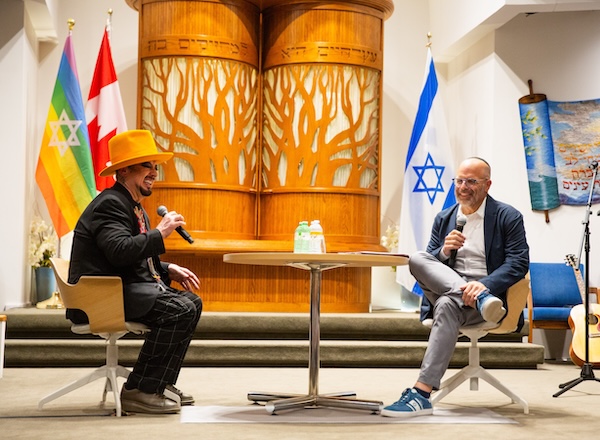
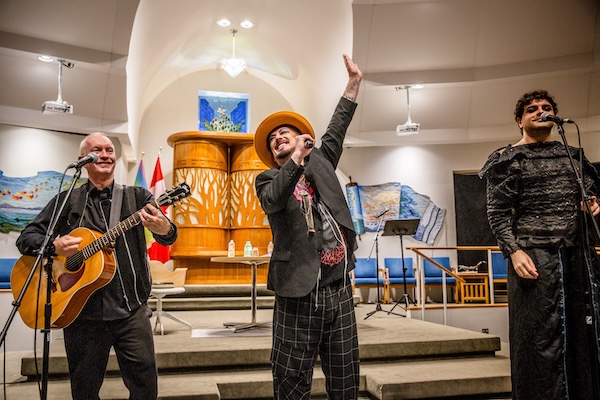
Approximately 800 members of the Metro Vancouver Jewish community and allies were at Temple Sholom on Sept. 9 to hear musician Boy George in conversation with Rabbi Dan Moskovitz. Wearing a bright orange hat, the 65-year-old performer reflected on his Jewish friendships and his song “We Will Dance Again,” which he performed live for the first time ever.
Introducing Boy George, Moskovitz recalled a letter he penned to the artist after first hearing the song. “I wrote, I just wanted to give you a hug, not just from me but from thousands of people in my community, because we’ve felt, as you have, that the world has lost its sense of humanity and is upside down. You’ve put it right side up, and we thank you for that.”
Boy George explained that the impetus for “We Will Dance Again” was attending the Nova exhibition in London, England. There, he met some of the survivors, and heard firsthand from the father of a young British man who was murdered on Oct. 7.
“I looked at a wall filled with photographs of people who had been murdered that day, and I saw so much beauty, love and radiance in their faces,” he recalled. “I said to myself, I’m going to write a song about it, one that will say something unequivocal.”
He added that he didn’t discuss the song or its subject matter with anyone ahead of time and chose artificial intelligence rather than a human collaborator because “AI doesn’t argue with you or tell you, ‘You can’t say that!’
“It was a beautiful experience writing and recording it and, afterwards, it made me feel emotional and I was sobbing,” he said. “I had no idea what was going to happen, and I didn’t think about it before I hit ‘post.’”
Moskovitz asked Boy George why he’d taken this stance. At first, the musician said he had no reason. Then, he tried to explain. “I kept hearing the word genocide over and over, and I thought, why can’t I, as an artist, question that as a concept? I’ve been to Israel and I know that word makes no sense. In London, no one Jewish is attacking anyone – the Jews I know are beautiful and funny. I’m loud, I have a big mouth and I have opinions. I’m here to say, my Jewish friends are beautiful people and I’m not going to turn my back on them.”
Boy George said he forged his first close friendship with a Jew when he was 15 years old and that he has fasted many times and celebrated many Jewish holidays over the years.
“The silence in the last few months has been so disappointing to me,” he said before discussing the backlash he experienced after releasing “We Will Dance Again.”
“The most disappointing thing is that I know some of these people don’t care about anything, least of all Palestine,” said Boy George. “These are people with no political instincts. If you’re going to choose a conflict, there are many you could choose.”
He said many friends have turned on him since the song’s release, “but I’m 65, I couldn’t care less. Jew love is true love!” he announced to applause and cheering from the audience.
As someone with Irish blood – his mother was Irish – Boy George expressed his shock at the level of antisemitism coming from Ireland. “That’s not how I was raised to be, and my mother would be proud of me today,” he said.
Still, the fallout from the song has taken a toll, he admitted. “I’ve had some really horrible things threatened on me, and it is scary. I’ve had to question myself, are you mad? Why have you done this? It is what it is. I don’t have a reason. But my Instagram following has gone up, so being canceled works!” he joked.
“I think, to turn on Jewish people in this moment is so disgusting,” he added. “I can’t get my head around it. I’ve been to Israel many times and I’ll be going back there to perform in a couple of months. My reaction to people telling me not to go, is f**k off. I don’t hate Netanyahu. What the f**k was he supposed to do? I don’t know what it’s like to run a country!”
On the upside, Boy George said the outpouring of support and gratitude he’s received from Jews worldwide has been overwhelmingly positive. “People I haven’t heard from in 40 years are reaching out to thank me for this song,” he said. “I’ve got so many Jewish friends, and I’m not going to turn my back on them.”
A young Jewish mother and member at Temple Sholom took to the podium to thank Boy George for what he represents. “Your words in ‘We Will Dance Again’ are the words we’ve all tried to speak over the past three years,” she said. “You don’t have to be here, but you are here, standing with us, with my people, my synagogue, my rabbi, with my kids. You’re courageous and resilient in the face of so much anger and hate, and your message of hope and peace is brave. For writing this song at this time, we thank you. Words can’t [express] how much we appreciate and love you.”
Moskovitz agreed, presenting the gift of a shofar to the artist, who also performed “Karma Chameleon,” one of Culture Club’s biggest hits.
“Boy George is a mensch, an ally, our friend,” said the rabbi. “His music and voice have been guided by a willingness to speak the truth as he sees it even when that truth is unpopular. He’s helped reshape our culture to see outsiders with greater empathy and, right now, he’s a voice of courage, compassion, empathy and a hero for humanity.”
Lauren Kramer, an award-winning writer and editor, lives in Richmond.