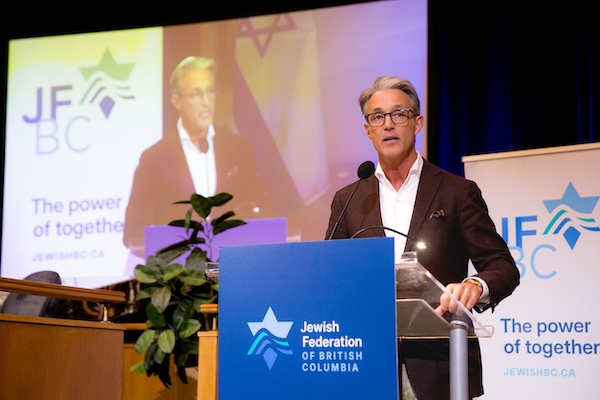
Antisemitism is “the exception that proves the rule” of moral progress, broadcaster and commentator Ben Mulroney told an audience at Schara Tzedeck Synagogue Sept. 16, warning that “the oldest hatred has become the newest.”
Mulroney – host of the nationally syndicated radio program The Ben Mulroney Show and a National Post contributor – has become one of Canada’s most prominent non-Jewish voices of allyship with Jews and Israel. He spoke at the Jewish Federation of British Columbia’s annual campaign opening event.
“There is a loud group in this country,” Mulroney said. “They have decided that you have to choose – that standing with the Jewish community means standing against someone else. That is a false choice. That is a manufactured choice. That is a lie.”
A son of the late former Canadian prime minister Brian Mulroney, Ben Mulroney spoke of his marriage to Jessica Brownstein and how their three children experience Mulroney’s Irish Catholic heritage and holidays, as well as those of his wife’s Jewish family.
He cited spiralling anti-Jewish hate crimes in Canada, including the 2024 arson attack on the synagogue he was speaking in, and quoted a survey indicating that 61% of community members avoid wearing anything that identifies them as Jewish in public.
Mulroney, who has a law degree from Université Laval and a degree in history from Duke University, contested the idea that antisemitism is just a Jewish problem.
“When 1% of the country has to hide who they are to walk down the street, that is a Canada problem,” Mulroney said.
He drew a sharp historical contrast. Every other prejudice in the Western story – against the Irish, the Italians, the Ukrainians, the Japanese – has a beginning, a middle and an end, he said. Antisemitism alone “has a beginning, and a middle, and a middle, and a middle. It does not run out of fuel. It just changes its fuel. It was about religion, then it was about race, then it was about money. Now it’s about a country.”
He traced that pattern from the Dreyfus Affair in turn-of-the-century France – where a Jewish army officer was convicted of treason on forged evidence and exonerated only after non-Jewish allies risked their careers and freedom – to Theodor Herzl, who, as a journalist, witnessed Dreyfus being stripped of his rank and humiliated. Herzl concluded that Jews would never be secure even in the most enlightened of nations and so he effectively launched the modern movement of political Zionism.
Mulroney connected his father’s legacy on apartheid – facing down Margaret Thatcher at the 1987 Commonwealth summit in Vancouver, and earning a phone call from Nelson Mandela the day after Mandela’s release from prison – to a broader principle: “The arc of history does not bend on its own. It bends because someone grabs it with both hands and pulls.”
The Jewish community’s record of showing up for others demands reciprocity, said Mulroney.
He catalogued the Jewish community’s history of allyship: immigrant Jewish women who founded Mount Sinai Hospital in Toronto when no hospital would hire Jewish doctors, a hospital that today describes itself as “the Jewish community’s gift to the city.” Kalmen Kaplansky, whose Jewish Labour Committee organized joint anti-discrimination committees that led to Canada’s first fair employment law. Jewish co-founders of the NAACP, the National Association for the Advancement of Coloured People. Andrew Goodman and Michael Schwerner, murdered in Mississippi while registering Black voters in 1964. Rabbis forming rings of protection around mosques after the 2017 Quebec City shooting, and the Muslim community reciprocating around synagogues after the 2018 mass murder at Pittsburgh’s Tree of Life synagogue.
“Do not let anyone tell you that the Jewish community only shows up for itself,” Mulroney said. “The record says otherwise. For a century, in every moment of civil unrest, in every fight for somebody else’s dignity, there was a Jew in the front row who had no reason to be there except they knew in their bones that it was right. You have been the ally over and over again. Now, you need allies, and I think you are entitled to ask where the heck they are.”
After visiting Israel – a mission he acknowledged was funded by that country’s government, while joking that some people suggest the free trip is a devious secret – a coalition of groups announced a boycott of every program Mulroney hosts.
“Spoiler alert,” he said, “they failed spectacularly.”
While the boycott failed, Mulroney said there was an important lesson in the attempt.
“It wasn’t about things I had said. It was where I had been. From that alone, people decided they knew exactly what I believed and exactly what kind of person I must be.”
He noted the impact a similar attack might have on someone less familiar with the rough and tumble of politics.
“I’m a public figure with a microphone and skin as thick as a rhino.… If this is what people are willing to do to somebody with a platform, imagine what they’re doing to people without one.”
He returned to his father’s words: “Antisemitism is born in ignorance and nurtured in envy,” and – in what Mulroney called the wisest thing his father ever said – “No child comes into the world with hate. Hatred is learned. Therein lies both the problem and the solution. Education, education, education.”
Earlier in the evening, Federation leadership framed its annual campaign in concrete terms. Eighty-five percent of housing needs across the province remain unmet. Fifty percent of mental health needs are unmet. Twenty percent of food security needs are uncovered. Seniors’ programs are operating beyond capacity. The campaign aims to grow its unrestricted funding to more than $10 million – money that can be allocated wherever the need is greatest.
Federation also marked its structural evolution, transitioning from the Jewish Federation of Greater Vancouver to the Jewish Federation of British Columbia, reflecting a mandate that now stretches from one end of the province to the other.
Michael Mann, an animation director and improv coach from Salt Spring Island, spoke about Jewish life beyond urban centres, including the intentionality required to build community when there is no Jewish Community Centre down the street. After the sudden death of his father last year, Mann said, it was Jewish friends who showed up.
“Community isn’t about celebrating together. It’s about knowing that, when life gets hard, someone will show up,” he said.
Mann credited Federation’s regional communities initiative with enriching Jewish life across the province.
“Jewish life shouldn’t depend on how close you live to a Jewish institution,” he said.
Ezra Shanken, Federation’s chief executive officer, interviewed Mulroney on stage after the keynote address and thanked the volunteers, Federation staff, partner agencies and donors.
Earlier in the evening, Sue Hector, campaign chair, and Lisa Boroditsky, women’s philanthropy chair, each spoke about the centrality of the work Federation and its partner agencies do.
Mulroney closed with a challenge, evoking Martin Luther King.
“The arc of the moral universe is long,” he said. “It does bend towards justice, but it bends because people bend it, and it only stays bent as long as they keep holding on. The Irish are proof that it bends. The Jewish people are proof that you can never let go.”
To donate to the campaign, go to jewishbc.ca.