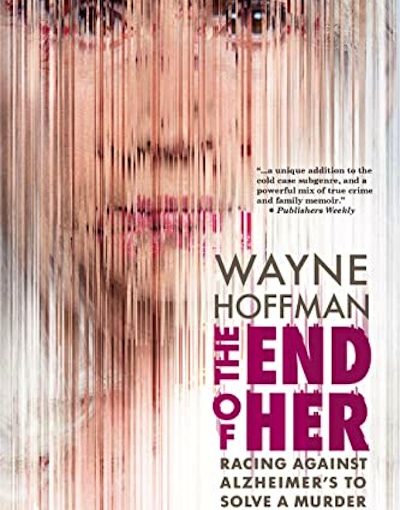
Wayne Hoffman’s latest book is about his efforts to solve the 1913 murder of his great-grandmother before his mother’s dementia takes full hold of her mind.
Well into his book The End of Her: Racing Against Alzheimer’s to Solve a Murder, Wayne Hoffman notes that it wasn’t until his mother was admitted into a nursing home that he began to read books and watch films about the disease, finding comfort in other people’s stories.
Hoffman’s nonfiction account of his mother’s decline – and his search for his maternal great-grandmother’s killer – was released this past February by Heliotrope Books. Perhaps coincidentally, I only cracked its proverbial spine (I have an electronic copy) a couple of weekends ago, the same weekend my father moved into a retirement home.
I was drawn to The End of Her both as the daughter of a parent with dementia and as a former Winnipegger. It was indeed comforting to read about how Hoffman’s family dealt with his mother’s dementia, how her dementia presented itself and how difficult the medical system was to navigate. There were many commonalities with my family’s experience, despite this part of Hoffman’s story taking place in the United States. Originally from Maryland and now living in New York, Hoffman is executive editor of the Jewish online magazine Tablet. He is a journalist, who also has published three novels, which almost guaranteed the The End of Her would be a compelling read.
Admittedly, I did not follow all the connections between Hoffman’s relatives across generations, nor find that part so interesting. But I did understand how Hoffman discovered more family during his research than he knew he had, and that this was a silver lining, though it could never compensate for the lost relationship with his mother.
Hoffman’s mother loved to tell stories and one of the more intriguing ones was of how her maternal grandmother, who had lived in Winnipeg, had been shot by a sniper while sitting on her porch nursing her new baby. Never believing the story, Hoffman kept his thoughts to himself until a video he made at Passover in 2010 revealed that his mother’s memory was failing. He thought about how the Passover story is handed down through generations, and how his family’s stories also become a part of history. He decided to challenge his mother’s – and his aunt’s – narrative about the 1913 murder of their grandmother, Sarah Fainstein. And his mother returned the challenge – asking him to tell her, then, what had happened.
Over the next 10 years or so, Hoffman searched, in fits and starts, for the true story of his great-grandmother’s death, finally finding information when he searches for Feinstein instead of Fainstein. The death certificate notes that it was, indeed, homicide. The amount of information Hoffman is able to piece together from a wide variety of sources, including conflicting newspaper reports and official documents, is impressive. He figures out the mystery to his satisfaction, but its veracity is unlikely to ever be known.
Unfortunately, by the time he reaches his conclusion, his mother’s dementia is to the point where she cannot absorb it. The photos and stories that his mother shared with him throughout his life are now his responsibility. A responsibility he takes seriously.
I freely admit it, I was one of those angsty teens who wrote bad poetry to express all my big feelings. I also wore a lot of black, but that’s not relevant here. What kind of surprises me about myself is that, despite having taken piano for years, learned various other instruments and sung in choirs since I was in single digits age-wise, it wasn’t until last year that I put some not-bad (not-great) poetry to music and wrote a song. It was inspired by my wife and it must have been beginner’s luck, because I’ve not been able to replicate that success.
This is a long preamble to why I was excited when award-winning songwriter and music consultant Molly Leikin emailed that she had a new book out: Insider Secrets to Hit Songwriting in the Digital Age (Permuted Press). While it’s too soon to say whether it will help me write another song, I did find it informative, easy to read – Leikin has a great sense of humour – and full of practical advice. I’ve just been too busy to do many of the myriad exercises and put in the time necessary to hone any skills.
There is a whole chapter on making the time to write, as well as how to quiet the inner critic, who often stops creative-aspiring people dead in their tracks. Other chapters focus on writing lyrics, composing a melody, picking a strong song title, working with a writing partner, overcoming writer’s block and other aspects of the process. There are also chapters on what needs to be done to get a song published, what royalties are, and what types of jobs you might be able to do to sustain yourself until your music can. Interspersed between the how and what chapters are interviews Leikin has conducted with some of her peers, other songwriters, producers and industry professionals.
Insider Secrets is targeted at writers who want to get into the business. And whether one succeeds at that is as much hard work as it is talent, probably more. One great aspect of Leikin’s approach is that she believes in being kind to oneself, so offers several ideas for how to reward yourself when you do put in the hard work.
“Whatever you do,” she writes, “make a point of acknowledging that you’re doing it as a reward for what you’ve just created. It is a victory in itself, just because you did it, not because your song was downloaded 10 million times. The victory starts with you.”
Ultimately, Leikin says, it comes down to persistence. It is also crucial to understand that a creative life is not a straight path, but an up-and-down one, and you have to learn how to navigate the challenges.
“A writer’s job is to write,” states Leikin. “If you do that, keep raising the level of your craft and write your fingerprint, and hustle your hustle, someday, the world will know your work. But until then, I want you to feel in your bones that you have the magic to go the distance. No Grammy can give that to you. Honestly, you have to give it to yourself, every day, all day, for the rest of your life.”
To purchase the book and for more information on Leikin, visit songmd.com.
Two picture books recently released by Kalaniot Books exemplify the publisher’s mission “to help young children and their families explore the diverse mosaic of Jewish culture and history.”
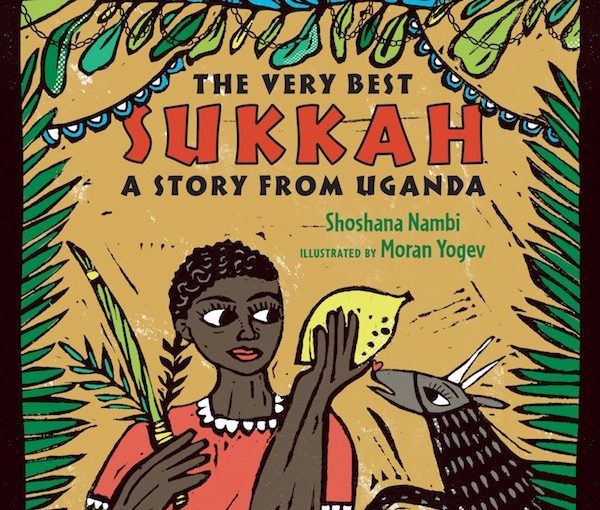
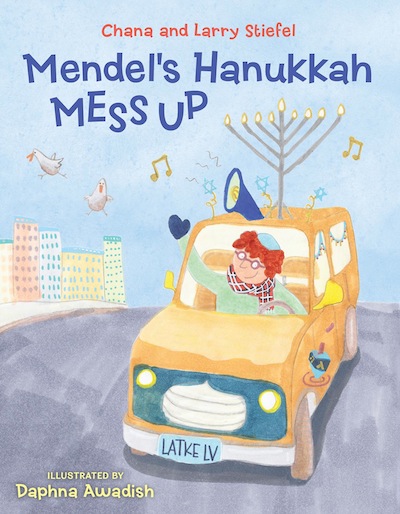
On the face of it, The Very Best Sukkah: A Story From Uganda by Shoshana Nambi and illustrator Moran Yogev may not seem to have much in common with Mendel’s Hanukkah Mess Up by Chana and Larry Stiefel and illustrator Daphna Awadish. But both charming publications explore the themes of inclusion via the experiences of their youthful protagonists.
The Very Best Sukkah centres around Shoshi, who likes to win any challenge, even when there’s none put forward. For example, despite her brother Avram’s plea for her to wait up, she makes sure to beat the other children to school – again. Shoshi shares, “My grandmother is always reminding me that life is not a competition. ‘Jajja,’ I tell her, ‘it’s not like I always have to win the race. I just like being at the front. The view is better there!’”
Shoshi and her brothers live with their “grandparents in a little house surrounded by coffee trees in the Abayudaya Jewish community of Uganda.” Shoshi races home on Friday nights to help her jajja make the holiday meal, in particular the kalo bread – it’s her job to mix the cassava and millet flour for the dough. The family then walks to synagogue, where the rabbi reminds the kids that their favourite holiday is coming up: Sukkot. The siblings start planning how they will make the best sukkah in the village.
Every family’s sukkah is different, “and each one reflects its builder’s special skills and talents.” For the most part, the differences are respected, but there is jealousy that Daudi, who sells samosas in the village, has enough money saved to buy “fancy battery-operated lights and elegant crochet trim in the big town of Mbale to decorate his sukkah.”
Life has a way of making playing fields level, however, and unfortunate weather one night causes mayhem, even for Daudi and his daughter, especially for Daudi, whose sukkah is destroyed. But the villagers rally around him and, in the end, the most beautiful sukkah is the one to which everyone contributes. A wonderful message, well delivered and boldly and colourfully drawn.
The Very Best Sukkah has a page about the Abayudaya, a glossary of terms and the lyrics of “Hinei Ma Tov” in Hebrew, Luganda and English: “See how good and pleasant it is for brothers and sisters to sit down together.”
Mendel’s Hanukkah Mess Up also features something getting wrecked. In this story, it’s a crashed-up Mitzvah Mobile rather than windblown sukkot. And, whereas it’s nature that destroys Daudi’s sukkah, it’s Mendel who doesn’t notice the bridge that’s so low as to crumple the large chanukiyah on the Mitzvah Mobile’s roof.
Anyone who knew Mendel could have predicted such an outcome when the rabbi asked him to drive the vehicle, as Mendel has a long history of mishaps, including having accidentally left a tray of jelly doughnuts on the rabbi’s chair. “Splat! ‘Oy, Mendel.’”
The unique nature of the vehicle and the accident draw a TV news team to the scene.
“‘What’s the story here?’ asked Rachel, the reporter.
“‘Um, well…’ Mendel’s words mushed like applesauce. ‘I blew it again,’ he sighed.
“Then Mendel thought of the lessons Rabbi Klein taught him. He stood up taller, like the shamash – the special Hanukkah candle that lights all of the others.
“As Mendel faced the camera, his words began to flow like silky sour cream.
“‘Hanukkah shows us the power of every person to make a difference. To rise up like the Jewish soldier Judah Maccabee fighting the mighty Greeks,’” he told Rachel. ‘If a tiny flask of oil can light up a menorah for eight days, we each have a spark to light up the world.’”
Mendel manages to turn his mistake into a win – spreading the story and joy of Hanukkah. It’s a fun story, with illustrations that are imaginative, engaging and detailed.
Mendel’s Hanukkah Mess Up ends with the story of Hanukkah and a glossary, instructions on how to play dreidel, the words to “Oh, Hanukkah” and a recipe for potato latkes, meant to be used by the young readers and their chosen adult.
For more information on these and other books, visit kalaniotbooks.com.
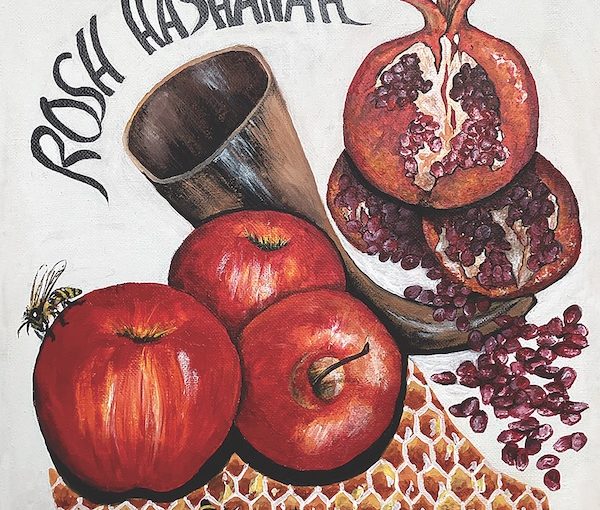
Merle Linde, working out of Malka’s Studio in Steveston Village, chose four symbols of Rosh Hashanah for her painting.
The shofar: the mournful cry, sounded 100 times during the traditional Rosh Hashanah service, evokes the freedom we gained when we returned to the Holy Land.
The pomegranate: a symbol of righteousness, knowledge and wisdom because it is said to have 613 seeds (arils), each representing one of the 613 mitzvot (commandments) of the Torah.
The apples: slices dipped into honey are eaten to symbolize the desire for a sweet new year.
The honey: given to us by the bees, who can inflict pain with their sting and yet produce delicious honey. Linde would suggest that we eat only “sustainable” honey (the food of the bees) so that the bees can survive and continue to pollinate the pomegranate and apple trees.
L’shanah tovah u’metukah! Wishes for a good and sweet new year.
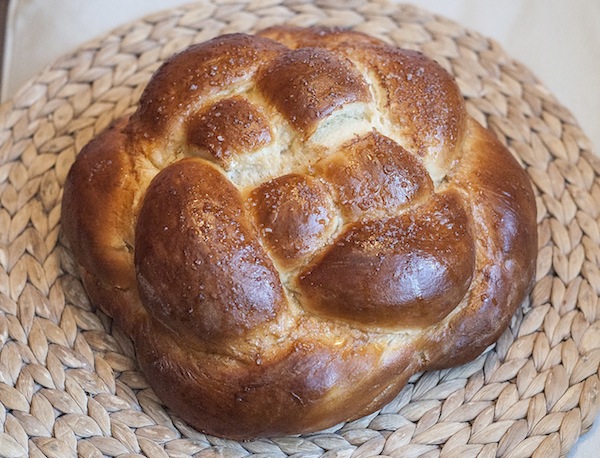
A round challah symbolizes a long life, or the unbroken circle of the full new year to come. (photo by Przemyslaw Wierzbowski)
On Rosh Hashanah, we are supposed to feast. Why? This is said to come from the passage in the book of Nehemiah (8:10): “Go your way, eat the fat and drink the sweet, and send portions unto him for whom nothing is prepared; for this day is holy unto our lord.”
Round, sweet challah
The most common Rosh Hashanah custom for Ashkenazi Jews is the making of sweet challah, primarily round in shape, to symbolize a long life or the unbroken circle of the full new year to come. Some people place a ladder made of dough on top of the loaf, so our prayers may ascend to heaven, or because it is decided on Rosh Hashanah “who shall be exalted and who shall be brought low.” Some place a bird made of dough on top, derived from the phrase in Isaiah: “as birds hovering so will the Lord of Hosts protect Jerusalem.”
According to John Cooper, in Eat and Be Satisfied: A Social History of Jewish Food, the tradition in disparate Jewish communities of baking fresh loaves of bread on a Friday morning has its roots in the talmudic era. The custom was ignored by medieval rabbinic commentators, he writes, but was revived by the Leket Yosher, a report compiled by Joseph ben Moses in the 1400s on the teachings and practices of his teacher, Austrian Rabbi Israel Isserlin; and by Rabbi Moses Isserles, the 16th-century Polish scholar of halachah, at the end of the Middle Ages.
According to Jewish tradition, the three Sabbath meals (Friday night, Saturday lunch and Saturday late afternoon) and two holiday meals (one at night and lunch the following day) each begin with two complete loaves of bread. This “double loaf” (lechem mishneh) commemorates the manna that fell from the heavens when the Israelites wandered in the desert after the Exodus. The manna did not fall on Sabbath or holidays; instead, a double portion would fall the day before the holiday or Sabbath.
Pomegranate blessings
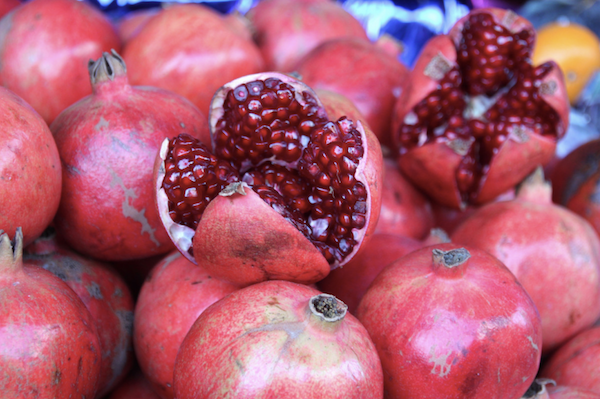
The pomegranate is eaten to remind us that G-d should multiply our credit of good deeds, like the seeds of the fruit. (photo from pxhere.com)
On the second evening of Rosh Hashanah, it is customary to eat a new fruit not yet eaten in the season and recite the Shehechiyanu, a prayer of thanksgiving for the first time something happens. It is said that, in Europe, this fruit was often grapes; in Israel today and around the diaspora, it is often the pomegranate.
The pomegranate is eaten to remind us that G-d should multiply our credit of good deeds, like the seeds of the fruit. For many Jews, pomegranates are traditional for Rosh Hashanah. Some believe the dull and leathery skinned crimson fruit may have really been the tapuach, apple, of the Garden of Eden. The word pomegranate means “grained apple.” In Hebrew, it is called rimon – also the word for a hand grenade!
Some say each pomegranate has 613 seeds for the 613 mitzvot, or good deeds, we should observe.
Symbolism of fish
The first course of the Rosh Hashanah holiday meal is often fish. Fish is symbolic of fruitfulness: “may we be fruitful and multiply like fish.” Fish is also a symbol of immortality, a good theme for the New Year, as are the ideas that we should aim to be a leader (the head) and that we hope for the best (to be at the top). Another reason for serving fish might be that the numerical value of the letters of the Hebrew word for fish, dag, is seven and Rosh Hashanah begins on the seventh month of the year.
Importance of tzimmes
Tzimmes is a stew made with or without meat and usually with prunes and carrots. It is common among Ashkenazi Jews, particularly those from Eastern Europe and Poland, and its origins date back to Medieval times. It became associated with Rosh Hashanah because the Yiddish word for carrot is mehren, which is similar to mehrn, which means to increase. The idea was to increase one’s merits at this time of year. Another explanation for eating tzimmes with carrots for Rosh Hashanah is that the German word for carrot was a pun on the Hebrew word, which meant to increase.
Tzimmes also has come into the vernacular as meaning to make a fuss or big deal. As in, they’re making such a tzimmes out of everything.
Lekach & other sweets
Among Ashkenazim, sweet desserts for Rosh Hashanah are customary, particularly lekach, or honey cake, and teiglach, the hard, doughy, honey and nut cookie. Some say the origin of the sweets comes from the passage in the book of Hosea (3:1): “love cakes of raisins.” There is also a passage in Samuel II (6:10) that talks about the multitudes of Israel, men and women, “to every one a cake of bread and a cake made in a pan and a sweet cake.”
Ezra was the fifth-century BCE religious leader who was commissioned by the Persian king to direct Jewish affairs in Judea and Nehemiah was a political leader and cup bearer of the king in the fifth century BCE. They are credited with telling the returned exiles to eat and drink sweet things.
According to Cooper’s Eat and Be Satisfied, references to honey cake were made in the 12th century by a French sage, Simcha of Vitry, author of the Machzor Vitry, and by the 12th-century German rabbi, Eleazar Judah ben Kalonymos. By the 16th century, lekach was known as a Rosh Hashanah sweet.
Among the Lubavitch Chassidim, it was customary for the rebbe to distribute lekach to his followers; others would request a piece of honey cake from one another on Erev Yom Kippur. This transaction symbolized a substitute for any charity the person might choose to receive, like the traditional kapparot ceremony, where, before Yom Kippur, one transfers their sins to a chicken.
Some Sephardi customs
Food customs differ among Jews whose ancestors came from Spain and Portugal, the Mediterranean area and primarily Muslim Arab countries. For example, whereas Ashkenazim dip apple in honey, some Sephardim traditionally serve mansanada, an apple compote, as an appetizer and dessert, according to Gil Marks (z”l) in The World of Jewish Desserts.
Just as gefilte fish became a classic dish for the Ashkenazi Jews, baked sheep’s head became a symbol – dating back to the Middle Ages – for many Sephardi Jews for Rosh Hashanah. Some groups merely serve sheep brains or tongue, or a whole fish (with head), probably for the same reason – fruitfulness and prosperity and new wishes for the New Year for knowledge or leadership.
The Talmud mentions the foods to be eaten on Rosh Hashanah as fenugreek, leeks, beets, dates and gourds, although Jewish communities interpret these differently. According to Rabbi Robert Sternberg in The Sephardic Kitchen, Sephardi Jews have a special ceremony around these and sometimes other foods, wherein each one is blessed with a prayer beginning “Yehi ratzon” (Hebrew for “May it be thy will”). The Yehi Ratzones custom involves preparing in advance and then blessing the Talmud-mentioned foods, or dishes made with the foods, as well as over the apples and honey, the fish or sheep head (some substitute a head of lettuce or of garlic) and pomegranate. In doing this, people recognize G-d’s sovereignty and hope He will hear their pleas for a good and prosperous year.
Sybil Kaplanis a Jerusalem-based journalist and author. She has edited/compiled nine kosher cookbooks and is a food writer for North American Jewish publications.
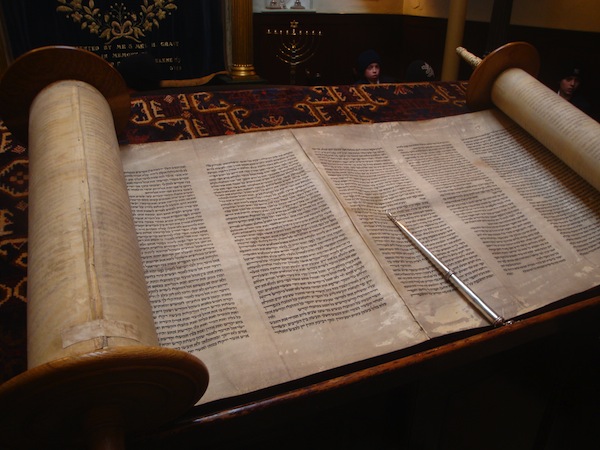
Just as in life outside shul we don’t understand everything we encounter, we don’t all necessarily understand the Torah reading and other parts of the High Holiday service. The High Holidays serve as a metaphor for life itself. (photo from flickr / Lawrie Cate)
Throughout the High Holidays, we repeat in the liturgy pronouncement after pronouncement about our lack of control: we are born against our will, we die against our will, we are but clay in the hands of God, we turn our eyes heavenward as children before a parent, and as slaves before a master. It would be dissonant in such an environment to try to assert our autonomy, to try to shape the experience around our own emotional needs.
And, while we want the High Holidays to be relatable for people, the season by necessity must not be customized to the individual. This is because their meaning lies precisely in the challenge of giving up our individual sense of entitlement in favour of something more important: meaning.
The High Holidays serve as a metaphor for life itself. During this season, we enter into an experience that has been curated for us, that existed before we ever did and which has elements that we are comfortable with and elements that challenge us. I may find myself standing in a synagogue next to people I don’t know, reciting words that I don’t know or would never have written, on a date that means very little to me personally except as a construct of the Jewish calendar.
This is true to life in general: I participate in a world that I don’t completely shape, with others who think differently than I do, within a system that I did not create. We do not choose to be born, nor to which families, nor under what circumstances or accompanied by what baggage. We likewise do not choose what natural successes or tragedies befall us. And, while we do our best to shape our lives, so much of the table is set for us and is beyond our control.
The High Holidays then bid us instead to think about meaning, about the control we do have. If life is not about what we choose, it is about how we choose to engage with what we encounter. We choose how we are going to interpret and how we are going to make meaning of it. How will we choose to see life, and how will our attitudes guide our actions? We may choose to read what we experience charitably or stingily, optimistically, realistically or nihilistically, or more often a messy combination of all of the above. But make no mistake: it is our own choices that will give rise to what we make of those lives that are given to us, to those circumstances that challenge us.
Eschewing a sense of entitlement and control in favour of a sense of meaning and potential is the work of the High Holiday season. It allows us to reflect on how and why we get in our own way, how our sense of entitlement, whether consciously or subconsciously, overrides our good judgment. This helps us to understand the idea of repentance, which is at the core of the High Holidays.
The talmudic sage Rava declared: those who are willing to forgive others easily will likewise be forgiven by God. The language attributed to him is literally, “One who overlooks his/her measurements, [God will overlook all of their sins].” Forgiveness, too, is about letting go of what we may still feel we are owed in favour of building relationships with others. Rather than standing on ceremony over what could have been, I am willing to loosen the reins, to be open to what might emerge. Oftentimes what needlessly keeps us from forgiveness is a focus on what we deserve, what we are entitled to. And, when this happens, we find ourselves once again getting in our own way and holding on to a vision of complete control over what happens or does not happen to us.
Letting go of trying to control the experience is hard. But it can also be liberating. For the High Holiday season, it relieves us of the expectation that we need to relate to everything. More importantly though, for life itself, it relieves us of the expectation of perfection – from ourselves, from others, from life itself.
At the same time, it reminds us of the depth of the human heart and the power of our own will in deciding how we will chart our path forward: that we can come to synagogue not only to be forgiven, but also to forgive; not only to be moved, but to choose to move ourselves.
Wishing all a meaningful New Year.
Dr. Elana Stein Hain is the director of faculty and a senior fellow at the Shalom Hartman Institute of North America, where she serves as lead faculty, directs the activities of the Kogod Research Centre for Contemporary Jewish Thought and consults on the content of lay and professional leadership programs. Articles by Stein Hain and other institute scholars can be found at hartman.org.il. This article was first posted on Times of Israel.
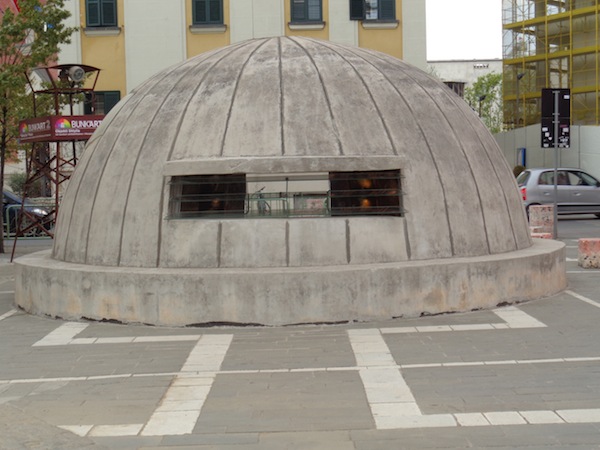
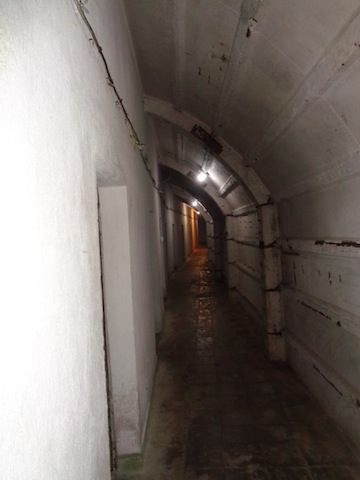
A bunker in Tirana, Albania, that is now the Bunk’Art art and history museum. (photo by Deborah Rubin Fields)
Albania is a country of great contrasts. It has stunning, clean beaches, so gorgeous that locals refer to them as the Albanian Riviera, and it also has hills and mountains that spring up in all directions. The contrasts seem to extend to Albanians themselves – Enver Hoxha, Albania’s longtime communist dictator, who died in 1985, started off as a partisan fighting the Italians and Germans in the Second World War.
Until not too long ago, Albania existed in isolation. Long before COVID-19 raised its head, Hoxha had kept the country shut off from the world. This is remarkable, given that Hoxha had at various periods aligned his Marxist-Leninist politics with the Soviet Union and China.
As in other communist regimes, many Albanian citizens became suspect during Hoxha’s 40-year reign. They were imprisoned, tortured and murdered. Further, over a 20-year period, Hoxha went on a bunker-building spree. He worried that Albania might be invaded by its neighbouring countries and by the Soviet Union. Between 1971 and 1983, at extreme cost to the general economy, Hoxha had more than 173,000 bunkers constructed. Hundreds of soldiers and civilians died in work accidents. Once the bunkers were built, local citizens as young as 12 years of age were expected to defend them from invaders. The bunkers were only abandoned in 1992, seven years after Hoxha died.
Today, some of the bunkers have other uses. In the capital of Tirana, for example, one series of bunkers has been converted into the Bunk’Art, an art and history museum. In Gjirokastra, there is the Cold War Tunnel Museum.
Part of the Cold War Tunnel Museum in Gjirokastra, Albania. (photo by Deborah Rubin Fields)
Hiking is also a fantastic way to see this beautiful country, although, in more remote parts of the country, older Albanians do not speak English and the younger, English-speaking generation is leaving Albania to seek their fortunes in other parts of Europe. Also be aware that even visiting castles requires a bit of hiking over either loose or highly polished stone, so it may be advisable to use walking sticks.
Generally, when people talk about blue eyes, they mean the eye colour of other humans or of their pets. But, in Albania, the Blue Eye is a lovely nature site. Reaching unknown depths (divers have gone down as far as 50 metres without reaching the bottom), the Blue Eye is more accurately a blue hole fed by an underground spring.
Albanian mythology recalls mountain spirits who live near springs and torrents in the northern Albanian Alps. These spirits or zanas are courageous and often protect Albanian warriors, but they can also go the other way, doing evil.
Even some of Albania’s mountains have stories. Take Mt. Tomor, for instance. Baba Tomor, or Father Tomor, is the personification of the mountain, a range whose highest peak is in central Albania. Baba Tomor appears as an older man with a long white beard that reaches his belt. Four eagles serve as his assistants. His bride is the young Earthly Beauty. When his territory is threatened, Tomor battles his enemy, Mt. Shpirag. The furrows running down Shpirag’s mountainside are said to be the knocks Tomor gave to Shpirag. Ultimately, the two fought to their deaths. The young bride is said to have drowned in her tears, which then became the Osum River.
Indeed, this is a country with many local legends. Take the story related to Shkoder’s Rozafa Castle. Apparently, the walls of this ninth-century BCE castle kept collapsing. Only when Rozafa (the wife of one of the three brothers building the castle) was enclosed in the castle walls did it stabilize and remain standing. Booker Prize-winning Albanian writer Ismail Kadare based his book The Three-Arched Bridge on this legend.
One of the spots to visit in Gjirokastra is called Sokaku i te Marreve, or Mad People Street. On this street, there is the reconstructed home of the above-mentioned – but sane – writer Kadare.
More interesting things about Gjirokastra include the Gjirokastra Castle, which houses the remnants of a U.S. Air Force Lockheed T-33. Some claim Albanian forces downed the jet during the Cold War (1957). Others say the plane was an American spy jet forced to land at Tirana’s Rinas Airport in December 1957 after developing mechanical problems and flying off course. Both scenarios are unlikely, but they make for good stories.
In a country that has almost no Jews, it is intriguing to know that (protectively covered by sand) Sarande has mosaics containing images of a shofar, a menorah and an etrog. Apparently, back in the fourth- or fifth-century CE, the Jewish community had its own synagogue in Sarande. According to the late Ehud Netzer and the late Gideon Foerster – the Israeli archeologists who dug there (along with an Albanian team) – this synagogue even had a ritual bath.
In contrast to radical Islam, there is Albania’s Bektashi Order, a Sufi Islamic creed with a long mystic tradition in Albania. The Sufi faith does not force devotees to observe the basics of traditional Islam. For example, the Bektashi creed allows for the drinking of alcohol and does not demand men and women be segregated, nor that women wear a veil. Curiously, this order appreciates Sabbatai Zvi, who was a false messiah, according to most Jews. Baba Mondi, the spiritual leader of the Bektashi sect, calls Sabbatai Zevi a dervish – a Farsi word for a spiritual Muslim who ascetically devotes his life to serving Allah; the term has also been used to describe, in rare instances, a Jew.
Ironically, Berat, the city of 1,001 windows, has a Jewish history museum established by the late Prof. Simon Vrusho, who wasn’t Jewish. Since his passing, the small Solomon Museum has been run by his widow. This museum exemplifies the good relations Albanian Jews had with both the Muslim and Christian community. Amazingly, local non-Jews saved almost 2,000 Jews during the Holocaust.
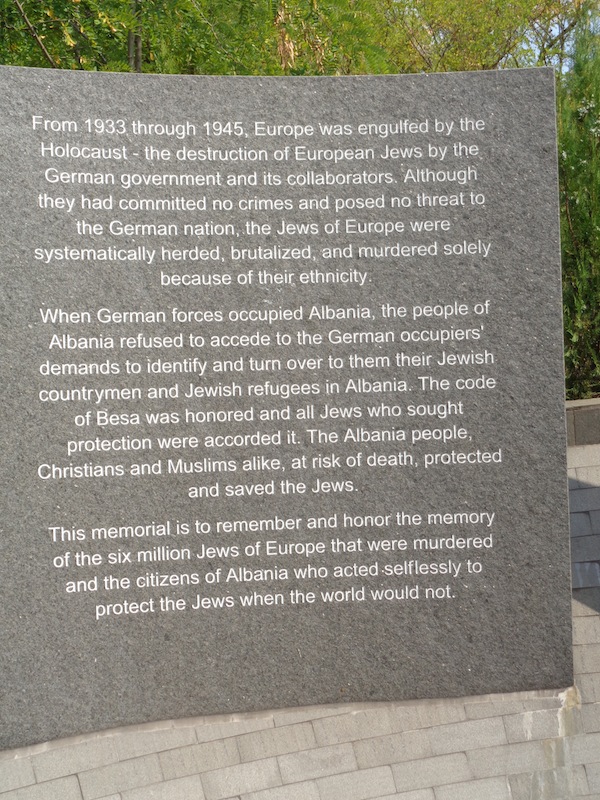
In Tirana’s Grand Park, there is a newly installed Holocaust memorial. It consists of three large plaques in Albanian, English and Hebrew, highlighting the stories of Albanians who saved Jews during the war.
The English plaque of the Holocaust memorial in Tirana. (photo by Deborah Rubin Fields)
Relatively unknown is an Albanian tragedy that exemplifies the worldwide refugee problem. In 1997, the ship Katër i Radës departed from the Albanian port city of Vlora, carrying 120 refugees fleeing the violence that had engulfed the country following that year’s massive collapse of pyramid schemes. On March 28, 1997, the Italian navy warship Sibilla – acting in accordance with an Italian blockade of Albania (designed to prevent refugees from entering the country) – intercepted, rammed and sunk the Katër i Radës in the strait of Otranto, killing 81 of the refugees aboard. Among the victims were many women and children.
Since ancient times, Jews have lived in Albania. However, there are a few theories about how and when Jews arrived there. According to historian Apostol Kotani, Jews may have first arrived in Albania as early as 70 CE, as captives on Roman ships that washed up on the country’s southern shores. Others report that, in Roman times, Jews already lived in the port of Durres. The Jewish population has fluctuated over the centuries, but most of the Jewish population made aliyah in the 1990s and, today, only a few Jews remain.
Deborah Rubin Fields is an Israel-based features writer. She is also the author of Take a Peek Inside: A Child’s Guide to Radiology Exams, published in English, Hebrew and Arabic.
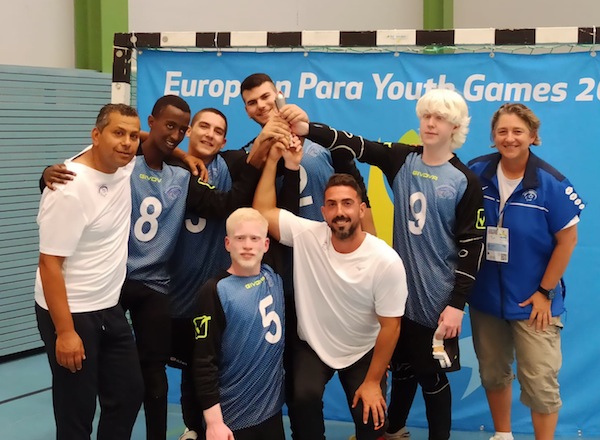
This past summer, Israel’s male youth goalball team won the European ParaYouth Games. (photo by Lilach Weiss)
Can you imagine a sporting event in which the audience sits in silence? Well, this is how goalball is played. Why? So that the visually challenged players can hear the bells inside the game ball.
And, speaking of the ball, it differs quite a bit from a soccer ball. In addition to having eight small holes in it – which allow the players to hear the two bells inside of it – the hard rubber ball is approximately 76 centimetres in circumference and weighs 1.25 kilograms. By contrast, a standard soccer ball has a circumference of 68 to 70 centimetres and weighs significantly less, between 400 and 450 grams.
To ensure fair competition, goalball participants must wear opaque eye shades. All international athletes must be legally blind, meaning they have less than 10% vision and are classified as B3 (partial sight), B2 (less sight than B2) or B1 (totally blind).
The goalball court has slightly raised markings so each player knows where their post is and the game is played indoors on a court measuring 18 metres long and nine metres wide, usually with short walls to help keep the ball inside. Again, this is different from soccer, which is played on a field that is 125 metres by 85 metres.
Each game is broken down into two 12-minute sessions with a three-minute break between the first and second halves. There are six players on a goalball team, with just three members playing at any one time.
Each goalball player has a specific job. The centre is the most responsible for defence, as they have the ability to support the left or right wing. The right winger defends the right-hand side of the goal and the left winger the left, but both are also main attacking players. The objective, as with most such games, is to score the most goals.
The team area is the first defence section, which starts from the goal line. In this area, defenders are allowed to block and control the ball to stop it from entering the goal.
The landing area starts at the end of the defence line. In this section, the attacking player can move around to take a shot at the opposing goal. The neutral areas are safe zones that provide space for defending teams to hear the ball coming towards them.
Here is how the game is played in a few situations. When the defending team blocks the ball, thus preventing a goal, the game continues. When the ball is blocked and then crosses the sideline, the play is restarted by the team that blocked the ball. When the ball is thrown over the sideline, the other team restarts the game.
Players protect the goal on their hands and knees. Unlike in soccer, the ball is not kicked, it is thrown from either a standing position underarm, or rolled. To reduce the sound and make it difficult for the opponents, players try to release the ball close to the floor. They can also make the ball quieter by spinning it. The team is given a foul if their player doesn’t throw the ball within 10 seconds of touching it.
Blind soccer, another sport played by visually challenged players, differs from goalball in several ways. For instance, while players in both games wear eye covers, players in blind soccer chase the ball in an upright position. Blind soccer halves are longer, at 20 or 25 minutes, and, in blind soccer, each team has five players on the pitch at any time, four outfield players who are visually impaired and a goalkeeper – who need not be visually challenged.
Israeli goalball coach Raz Shoham said most of the injuries in the game come from over-use of the body and not from being hit by the ball. In Israel, players’ free time is limited by the fact that almost all of them work or study.
Goalball player Lihi Ben David in action at the Toyko Paralympic Games in 2020. (photo by Keren Isaacson)
Before each practice, there is a 40-minute warmup session in which players exercise their torso, hands and legs. Practices are held on Thursdays and Fridays in four locations: Beer Sheva, Jerusalem, Tel Aviv and Afula. Men and boys practise mostly in Afula, while the women practise mostly in Jerusalem. Practice times are a function of when the sports auditorium is available.
Traveling can sometimes be an issue. Shoham explained that a strong player showed up at the team’s summer camp and wanted to continue playing after the summer ended, but there was a problem getting her from her village to practices. On the other hand, sometimes players leave the sport for a stretch of time and then return. Take Orel, who started playing while still in elementary school, left for a few years and now, at the age of 15, is a key player on the male youth team.
According to Shoham, goalball players range in age. At the moment, the oldest person who comes out to play is a 65-year-old grandmother. Currently, on the official playing teams, the oldest player is 35. The official team players get a few thousand shekels for playing, but it is not like regular soccer, in which team members frequently earn high salaries.
Israeli goalball players are expected to attend some 25 practices a month. And there have been good results from the hard work. Just this past summer, Israel’s male youth goalball team – players Asad Mahamid, Doron Hodeda, Shai Avni, Ariel Alfasi and Orel Ybarkan – won the European ParaYouth Games.
Coach Snir Cohen knew before the tournament that he had good players, but said he just didn’t know how good. His goal is developing this youth team into a strong adult team.
Nineteen-year-old player Lihi Ben David, who plays left wing, spoke with the Independent about her recent training experience in Brazil. The cost of the trip was largely covered by the Israel Sports Association for the Disabled (ISAD). The Israeli and Brazilian players conversed in English. She said it was refreshing to learn about a different culture. The hard part for Ben David, who is an observant Jew, was playing during the nine mourning days of the Hebrew month of Av.
Deborah Rubin Fields is an Israel-based features writer. She is also the author of Take a Peek Inside: A Child’s Guide to Radiology Exams, published in English, Hebrew and Arabic.
My favourite fall/winter fruit is apples, and not just because they are a main symbol of Rosh Hashanah, helping us start off the new year with a sweet dip of honey. I believe the adage that an apple a day keeps the doctor away. Although the phrase was uttered by Benjamin Franklin, it originated in 1866 in Wales – “eat an apple on going to bed and you’ll keep the doctor from earning his bread.”
Why are apples healthy? They may lower high cholesterol and blood pressure; they have fibre, which can aid digestion; they support a healthy immune system; are a diabetes-friendly fruit; and the antioxidants in apples may play a role in cancer prevention.
All that aside, they just taste great. Here are some recipes to try out, one of which features another New Year’s symbol – the pomegranate.
MOTHER’S ROSH HASHANAH APPLE CAKE
2/3 cup vegetable oil 2 cups brown sugar 2 eggs 2 tsp cinnamon 1 tsp ground cloves 2 cups applesauce (or 2 finely chopped apples) 2 tsp baking soda dissolved in 1 tsp wine 4 cups flour 2 tsp vanilla 2 cups raisins 1/2 to 1 cup finely chopped nuts
Grease two cake pans. Preheat oven to 350°F.
With an electric or hand mixer, cream oil and sugar.
Add eggs, cinnamon and cloves.
Add applesauce, dissolved baking soda and blend. Add flour, vanilla, raisins and nuts.
Pour into the well-greased cake pans and bake for 45 minutes or until a toothpick inserted in the centre comes out clean.
APPLE ENCHANTMENT (This recipe was in my files from the 1970s, from Carmel wine company.)
1/4 cup sugar 1/4 cup caramel amaretto grated rind and juice of 1 orange 4 large, firm apples
In a saucepan, combine sugar, amaretto, orange rind and juice. Bring to a boil.
Peel, core and thickly slice apples. Place in the pan as they are sliced. Reduce heat and simmer until apples are tender and liquid has evaporated.
Remove to a dish. Chill.
Garnish with shredded coconut or whipped cream.
BAKED STUFFED APPLES (This recipe by Ann Chantal Altman is from a 2001 Food & Wine cookbook.)
3 tbsp lightly toasted slivered blanched almonds 1.3 ounces of finely crumbled kosher amaretti (almond-flavoured Italian macaroons) 1/3 cup dry currants 2 tbsp brown sugar 1/2 tsp cinnamon finely grated zest of 1 lemon 2 tbsp softened unsalted butter or margarine 4 apples 1 cup apple juice 2 tbsp dark rum
Preheat oven to 375°F. Grease a square baking dish.
In a bowl, mix almonds with amaretti crumbs, currants, brown sugar, cinnamon and lemon zest.
Remove interior core and seeds of apples within half-inch of bottom. Score apple skin lengthwise at 1.5-inch intervals and arrange in the baking dish. Spoon filling into apples. Pour apple juice and rum around the apples.
Bake for 20 minutes. Cover loosely with foil and bake 45-50 minutes longer or until apples are very soft. Transfer to plates. Spoon juices on top.
QUICK AND EASY MICROWAVE APPLE COMPOTE
4 large apples 3 to 5 tbsp water or apple juice 1/4 to 1/2 tsp cinnamon 2 to 3 tsp sugar
Cut apples in small pieces, discarding cores. Place in a microwave-safe dish with water or apple juice.
Cover and microwave on high for three minutes. Stir and microwave for two more minutes.
Add cinnamon and sugar. Cover and microwave for one to two minutes or until tender. Sprinkle some sugar on top.
APPLES BAKED IN POMEGRANATE SYRUP
4 apples, cored and cut into 16 wedges each juice from half a pomegranate apple juice 1/3 cup apricot preserves 1/2 tsp cinnamon seeds from half a pomegranate
Use non-stick vegetable spray on a microwavable baking dish.
Place apple wedges in the dish.
Squeeze juice from half a pomegranate and add apple juice to make 1/2 cup.
Add preserves and cinnamon and mix well. Pour over apples and coat. Cover.
Microwave on high for two minutes and stir. Continue until apples are barely tender, at least two minutes more.
Remove seeds from remaining pomegranate half, discard white pith. Sprinkle over apples and serve.
Sybil Kaplan is a Jerusalem-based journalist and author. She has edited/compiled nine kosher cookbooks and is a food writer for North American Jewish publications.
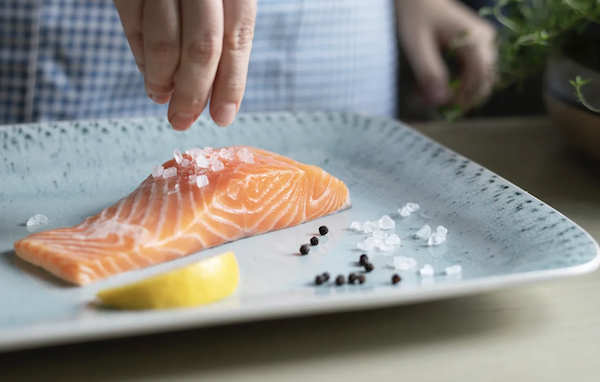
A fish head is one of the symbols of the Rosh Hashanah meal, so why not add a fish dish to the menu? (photo from rawpixel.com)
Soon we will celebrate Rosh Hashanah, for which a fish head is a symbol of leadership (be the head and not the tail) and fertility. This is reason enough, perhaps, to include fish on the holiday dinner or lunch menus. If so, here are a few recipes you could try.
TUNA AIOLI (8 servings)
2 cups mayonnaise 4 large minced garlic cloves 2 tbsp lemon juice 1/2 tsp dry mustard 2 10-ounce packages frozen Italian green beans 4 7-ounce cans drained tuna 2 20-ounce cans drained sliced beets 8 sliced carrots 2 thinly sliced red or white onions
In a bowl, blend mayonnaise with garlic, lemon juice and mustard. Cover and refrigerate.
Cook green beans following package directions.
Arrange tuna, beets, carrots and onions on a serving platter. Serve with mayonnaise-garlic sauce.
FISH AND ARTICHOKE SALAD (6 servings)
1 pound fish of your choice 1 cup pareve chicken soup (or vegetable stock) 1/2 cup dry white wine 1 14-ounce can drained and quartered artichoke hearts 2 tomatoes, cut into eighths 1/2 cup halved black olives 1/4 cup olive oil 2 tbsp fresh lemon juice 1/4 cup chopped fresh parsley salt and pepper to taste a few lettuce leaves 4 chopped green onions
Place fish, soup and wine in a saucepan. Bring to a boil. Turn off heat and let cool.
Place fish in a bowl with artichoke hearts, tomatoes and olives.
In a small bowl, whisk oil, lemon juice, parsley, salt and pepper. Pour over fish and toss to mix.
Cover and refrigerate overnight or at least three hours.
Line a bowl with lettuce leaves. Spoon in fish mixture. Garnish with green onions.
GRILLED SALMON SALAD (8 servings)
8 centre-cut salmon fillets 1/4 cup olive oil 1/4 cup fresh lime juice salt and pepper to taste 8 cups rinsed, dried and coarsely chopped arugula leaves 4 cups halved cherry tomatoes 1/2 cup diced red onion salt and pepper to taste 2 tbsp olive oil 2 tbsp red wine vinegar
Place salmon in a shallow dish. Combine oil, lime juice, salt and pepper and pour over salmon. Marinate in refrigerator 30 minutes, turn and continue marinating 30 minutes more.
Oil a grill. Grill salmon, skin side down, 8-13 minutes, until medium rare.
Meanwhile, combine arugula, tomatoes, red onion, salt, pepper, olive oil and wine vinegar.
Place a salmon fillet in the centre of each dinner plate. Divide the salad equally and place each portion atop a piece of fish.
Sybil Kaplan is a Jerusalem-based journalist and author. She has edited/compiled nine kosher cookbooks and is a food writer for North American Jewish publications.