
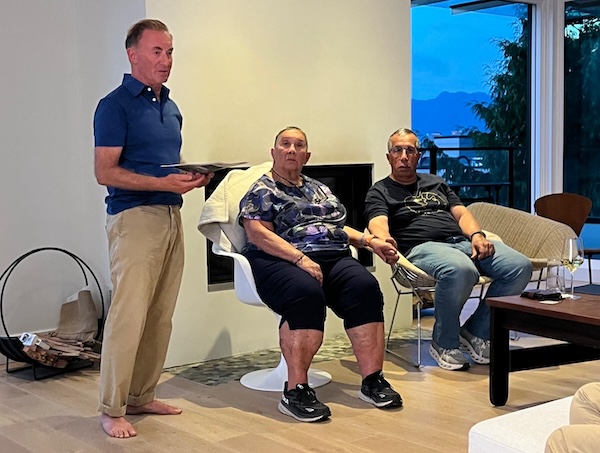
Adam Korbin, regional president, Metro Vancouver, for BGU Canada, left, with Jacqui and Yaron Vital, who visited Vancouver last month. On July 21, they shared the story of the murder of their daughter, Adi Vital-Kaploun, by Hamas terrorists on Oct. 7, 2023. (photo from BGU BC & Alberta)
One family’s tragic experiences during the Oct. 7 terror attacks were shared in an intimate, emotional gathering in a private Vancouver home recently.
Yaron and Jacqui Vital shared the story of the murder of their daughter Adi Vital-Kaploun. Jacqui, an Ottawa native who has lived in Israel for 50 years, and her husband, Yaron, who survived the invasion of Kibbutz Holit, told their stories July 21.
The evening was convened by Ben-Gurion University Canada. Adi studied at the Jacob Blaustein Institutes for Desert Research at BGU’s Sde Boker campus and the university has set up a special scholarship fund in her memory.
For the Simchat Torah holiday in 2023, Yaron Vital joined daughter Adi and her partner, Adani, and their two kids, 4-year-old Negev and 4-month-old Eshel, at their home on Kibbutz Holit. They were joined by another daughter, Ayala, and her family, who live in another kibbutz in the Gaza Envelope area. For the first time since the COVID pandemic, Jacqui was visiting family in Ottawa and watched the confusing news from afar, with mounting alarm.
“We had a nice day on Friday,” Yaron recalled. “Adani and Adi made a nice supper, we played with the kids a little bit and then Ayala left and went back to the kibbutz.”
Because Adi was nursing the baby and would be up in the night, she suggested her father sleep in the nearby guest house.
“It’s an apartment that nobody uses most of the year and it doesn’t seem in such good shape, but it’s a place to sleep,” he said. “In the end, this apartment saved my life.”
At 6:29 a.m., he woke up to “a noise like thunder” and a changed world.
The sky was so bright from rockets that his eyes were seared and he could see the lights for days when he shut his eyes.
Yaron returned to the safe room in the guest house and called Adi, who told him to stay where he was. Adani had left the kibbutz earlier and, when the attacks began, Adi texted him not to return.
Yaron was in the army for 24 years, and served in a special unit in charge of the security along that very border. While the density of rockets overhead was unprecedented, he soon realized how different the scenario was from anything he, or the country, had seen before. Looking out a window, he saw terrorists running throughout the kibbutz. He heard screaming and shooting. From experience, he expected the military to respond almost instantaneously. He had no idea that there were more than 3,000 terrorists already in the country and that Holit was far from the only kibbutz under attack.
The safe room door in the guest house did not have a lock – they are created to protect from rockets and missiles, not from on-the-ground terrorist invasions – and so Yaron rigged up a rope to create a makeshift lock.
The rampaging terrorists skipped the guest house and Yaron had no idea why. Later, in piecing together some of the disparate threads from the day, it emerged that the invaders had detailed maps of the various kibbutzim, clearly based on intelligence from Gazans who had worked at or visited the border-adjacent communities – the maps indicated who lived where, which homes had dogs, where jewelry was kept. Presumably, the terrorists knew the guest house was usually vacant and so didn’t waste their time kicking in the door.
At 12:30 p.m. – six hours after the horrors began – Yaron received a text message from Adi.
“They’re breaking into my house,” she wrote.
“That was the last time she sent me a message,” Yaron said. “I tried to call her back after 10 minutes. She didn’t answer. I heard some shooting from her direction.”
He waited in silence all afternoon. After 11 hours, Yaron heard people in the house. He wouldn’t open the door, knowing it could be a trap. They hollered to see if anyone was in the building.
“I didn’t answer until they came close to the door of the safe room,” he recalled. “They said, ‘Is somebody inside? Is somebody here?’ It seemed like a Hebrew accent. I decided I couldn’t take it anymore, to tell you the truth, so I decided I’m going to answer them.”
Once he was freed, he went with the soldiers to Adi’s house across the street.
“They tried to open the door and it was locked, so I had a feeling maybe there was a chance,” he said. “The commander kicked the door, they jumped inside, disappeared for a few seconds and then they came to me and said, ‘Listen, we saw a dead body in the kitchen.’ When they said that, I lost my … I almost fell down. But, they said right away, ‘Don’t worry, it’s a man.’”
It was evident almost immediately that the body was that of a terrorist. There was no sign of the kids and, while the safe room was a shamble, there was no sign of Adi either. There were hundreds of bullet casings on the floor of the living room.
“I called Adani and I told him that there is nobody in the house. Don’t worry, she’s hiding someplace,” he recalled Adani telling him.
Dead dogs were scattered throughout the kibbutz. Doors to most of the houses were open and Yaron could see bodies inside. Late in the day, he got in his severely damaged car and began to drive home to Jerusalem. On the way, he received news that his grandchildren were safe and comparatively healthy.
Al Jazeera was on site with the terrorists and had footage of the two boys being abducted. Negev had been shot in the foot and a terrorist was bandaging his wound while another terrorist had Eshel on his shoulders and rocked him in a carriage.
In a scene broadcast on Anderson Cooper’s CNN program on Monday, Oct. 9, the terrorists set the boys free right around the Gaza border. The footage showed Negev and Eshel returning with a woman toward the kibbutz. The Vitals believe this was a propaganda move to show the humanity of the terrorists, who were depicted as kindly releasing a mother and her (presumed) children. Around midnight, Adani was reunited with his sons.
After four days battling the terrorists, Holit was finally secured and a special unit came to the kibbutz and started to clear the bodies.
“One of the soldiers bent down and suddenly saw a hand sticking out from under the sofa,” Yaron said. They took a picture of the hand with a wedding ring and that is how the family learned that Adi had not been kidnapped but killed.
It would turn out that she had courageously fended off the terrorists for some time with the gun Adani had in the house – killing one of the terrorists, the body the soldiers discovered in the home. Eventually, though, she was murdered in front of her children. The kids were taken by the terrorists and handed over to a neighbour, who was the woman pictured on CNN.
Jacqui spoke of the unbearable anxiety of not knowing the fate of her daughter.
“I only had three days of not knowing where she was and I couldn’t touch my neck because I was so tense just thinking about what they might be doing to her,” she said. “And there are still 50 families that can’t touch their neck.”
Of their late daughter, Jacqui said: “We know where she is, she’s in a safe place.”
This sentiment has caused some controversy in Israel. On the 10th day after Oct. 7, Adani was on TV saying he was relieved that Adi had been murdered and not kidnapped because, he assumed, death was the preferable alternative. At the time, probably no one imagined that dozens of hostages would still be in captivity in Gaza almost 700 days later.
According to David Berson, executive director of Ben-Gurion University Canada, British Columbia and Alberta, 118 people from the Ben-Gurion University community have been killed on or since Oct. 7, most of them during the 10/7 terror attacks and others in the ensuing war. These include faculty, students and staff.