Skip to content
  • Home
  • Subscribe / donate
  • Events calendar
  • News
    • Local
    • National
    • Israel
    • World
    • עניין בחדשות
      A roundup of news in Canada and further afield, in Hebrew.
  • Opinion
    • From the JI
    • Op-Ed
  • Arts & Culture
    • Performing Arts
    • Music
    • Books
    • Visual Arts
    • TV & Film
  • Life
    • Celebrating the Holidays
    • Travel
    • The Daily Snooze
      Cartoons by Jacob Samuel
    • Mystery Photo
      Help the JI and JMABC fill in the gaps in our archives.
  • Community Links
    • Organizations, Etc.
    • Other News Sources & Blogs
    • Business Directory
  • FAQ
  • JI Chai Celebration
  • JI@88! video

Recent Posts

  • Eby touts government record
  • Keep lighting candles
  • Facing a complex situation
  • Unique interview show a hit
  • See Annie at Gateway
  • Explorations of light
  • Help with the legal aspects
  • Stories create impact
  • Different faiths gather
  • Advocating for girls’ rights
  • An oral song tradition
  • Genealogy tools and tips
  • Jew-hatred is centuries old
  • Aiding medical research
  • Connecting Jews to Judaism
  • Beacon of light in heart of city
  • Drag & Dreidel: A Queer Jewish Hanukkah Celebration
  • An emotional reunion
  • Post-tumble, lights still shine
  • Visit to cradle of Ashkenaz
  • Unique, memorable travels
  • Family memoir a work of art
  • A little holiday romance
  • The Maccabees, old and new
  • My Hanukkah miracle
  • After the rededication … a Hanukkah cartoon
  • Improving the holiday table
  • Vive la différence!
  • Fresh, healthy comfort foods
  • From the archives … Hanukkah
  • תגובתי לכתבה על ישראלים שרצו להגר לקנדה ולא קיבלו אותם עם שטיח אדום
  • Lessons in Mamdani’s win
  • West Van Story at the York
  • Words hold much power
  • Plenty of hopefulness
  • Lessons from past for today

Archives

Follow @JewishIndie
image - The CJN - Visit Us Banner - 300x600 - 101625

Put color in your chag

Put color in your chag

Mix it up this holiday with a colorful orange spice cake. (photo by Barry A. Kaplan)

In honor of Tu b’Shevat on Feb. 3-4, why not try some variety to celebrate the New Year of the Trees? One usually thinks of dates, figs and carob on this holiday, specifically the species of fruits that are listed in the Torah as native to Eretz Yisrael. In Israel today, sometimes we augment that with other in-season fruits, like apples, persimmons, strawberries (though beautiful, they are expensive!) or varieties of delicious citrus. Here are some recipes using oranges.

SYRIAN ORANGE CHICKEN
makes four servings

1 tbsp margarine
1 tbsp oil
1 cut-up chicken
1/2 cup orange juice
1 cup chicken soup
1 1/2 tsp corn starch
1/2 chopped onion
juice of 1/2 lemon
6-9 halved, pitted dates
orange slices

  1. Preheat oven to 350°F. Grease a baking dish.
  2. Heat margarine and oil in a frying pan and brown chicken. Place in a baking dish.
  3. Add orange juice, chicken soup, cornstarch, onion and lemon juice to frying pan and cook, stirring, until sauce thickens. Pour over chicken.
  4. Cover and bake 45 minutes.
  5. Garnish with dates and orange slices, cover and bake at least 15 minutes or until chicken is done. Serve with rice.

ORANGE JUICE SALAD DRESSING
The dressing is good on a salad with lettuce, avocado and grapefruit.

3/4 cup oil
6 tbsp orange juice
1/2 tsp sugar
pinch dry mustard

  1. Combine oil, orange juice, sugar and mustard in a jar.
  2. Shake well.

ORANGE SPICE CAKE

6 seeded, peeled, cut-up small oranges, such as mandarins or tangerines
1/3 cup canola oil
3 eggs
1 cup brown sugar
1/2 tsp ginger
1/4 tsp cinnamon
1 tsp vanilla
1 3/4 cups flour
1 1/2 tsp baking powder
1/2 cup non-dairy creamer

  1. Preheat oven to 350°F. Grease a cake pan, two loaf pans or place mini papers in a mini-muffin pan and spray with vegetable spray.
  2. Place orange pieces, oil, eggs and brown sugar in a mixer or food processor and blend a few seconds.
  3. Add ginger, cinnamon, vanilla, flour, baking powder and non-dairy creamer and blend.
  4. Spoon into baking pans. Bake 25 minutes or until a toothpick inserted in the centre comes out clean.

ORANGE DROP COOKIES
makes three dozen

1 cup sugar
2/3 cup unsalted pareve margarine
2 eggs
1/2 cup orange juice
1 tbsp grated orange peel
2 1/4 cups flour
1/2 tsp baking soda
1/2 cup chopped nuts

  1. Preheat oven to 350°F. Grease cookie sheets.
  2. Cream sugar and margarine with eggs. Stir in orange juice and orange peel.
  3. Add flour, baking soda and nuts and mix well.
  4. Drop by teaspoon onto cookie sheets. Bake 10 minutes or until golden brown.

Sybil Kaplan is a journalist, foreign correspondent, lecturer, food writer and book reviewer who lives in Jerusalem. She also does the restaurant features for janglo.net and leads weekly shuk walks in English in Jerusalem’s Jewish food market.

Format ImagePosted on January 30, 2015January 29, 2015Author Sybil KaplanCategories Celebrating the HolidaysTags New Year of the Trees, seder, Tu b'Shevat
Fruits, nuts, traditions

Fruits, nuts, traditions

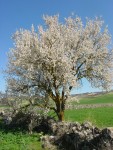
Tu b’Shevat, the New Year of the Trees, coincides with the flowering of the almond tree in Israel. (photo from en.wikipedia.org/wiki/Shevat)

Tu b’Shevat, which falls this year on Feb. 3-4, marks the end of the rainy season in Israel. Buds are beginning to appear on the trees, and the blossoming almond trees, the harbinger of spring, have begun to dot the landscape. So, on the 15th day of the Hebrew month of Shevat, we celebrate the yearly cycle for the growth of trees in Eretz Israel.

According to Jewish mystical tradition, Tu b’Shevat is the day when G-d renews sustenance and the “life-cycle” of the trees, when the sap starts to rise.

There are many customs to remind us of the meaning of this day, including a Tu b’Shevat seder, not unlike the ritual meal we have on Passover.

On Tu b’Shevat, fruit trees were measured for growth in order to calculate the annual tithe to the Temple. Even long after the Temple was destroyed, this seder was a new way to reaffirm the spiritual bond with the land in celebration of the approach of spring and the fruit of the earth.

This ancient tradition was developed in Safed, the seat of kabbalistic studies in the 16th century. Traditionally, we eat nuts and the fruits for which the Torah praises the Land of Israel, including grapes, figs and pomegranates, olives and dates. The table is set with a snowy white tablecloth, candles, fruit and nuts, and the sharing of prayers, readings and songs.

It is traditional to enjoy four cups of wine, like on Passover. Those glasses of wine can be paired with a corresponding fruit and divided into ascending levels of spirituality.

The first cup, therefore, is often white wine, symbolizing winter, accompanied by a fruit that needs a protective covering, such as oranges or almonds.

The second cup is white wine mixed with a small amount of red, signifying spring, the budding of new life. This glass is served with olives, apples, peaches and dates: the outer layer is eaten, yet the heart is protected and has within it the seed of new life.

The third cup is red wine with a small amount of white mixed in. This is the symbol of summer and a perfect world in which nothing is wasted. With this, fruits such as figs, grapes and berries are eaten. These are considered to symbolize the highest level of spiritual openness.

The fourth cup is red wine only, representing fertility and the bounty of the autumnal crops.

What else happens on Tu b’Shevat? Very little religiously, but a lovely ritual has arisen in Israel, one that’s now been adopted all over the Jewish world. It is a popular observance to plant trees, one of the greatest mitzvot we can perform.

Trees have great significance in Judaism. This Tu b’Shevat, however, we are still in a Shmita (jubilee) year in Israel; the land is resting, so no plantings will take place.

Trees hold a special place in Judaism. It is written in Deuteronomy: “When you besiege a city for many days to wage war against it to seize it, don’t destroy its trees….” In the Midrash Shmuel on Pirkei Avot 3:24, it is written that man is like a tree in that his good deeds are his produce, his “fruits,” and his arms and legs the “branches,” which bear these fruits. He is, however, an “upside-down tree,” for his head is rooted in the heavens, nestled in the spiritual soils of the Eternal, and nourished by his connection to his Creator.

At the end of the Hasmonean dynasty, there lived a holy man named Honi, known as the circle drawer, Honi HaMa’agel, and we read his story in Talmud Ta’anit 23a. One day, Honi sees a man planting a carob tree and asks him, “How many years does it take for the carob tree to bear fruit?” The man replies, “Seventy years.” Honi asks, “Do you think you will live another 70 years and reap its fruit?” The man responds, “I am planting the tree not for myself, but for my grandchildren.”

Although the world may not regard Jews as being tied closely to the land, the truth is that Judaism has close ties to agriculture and ecology. The midrash teaches us that man’s life depends on the tree, and we are forbidden to live in a city that has no gardens and trees. They are so important that Rabbi Yohanan Ben-Zakai declared, “If you hold a sapling in your hand and are told, ‘Come look, the Messiah has arrived,’ plant the sapling first and only then go and greet the Messiah.”

Happy Tu b’Shevat!

Dvora Waysman is the author of 13 books, which are available through Amazon, or from the author at [email protected]. Her website is dvorawaysman.com.

Format ImagePosted on January 30, 2015January 17, 2016Author Dvora WaysmanCategories Celebrating the HolidaysTags Israel, Judaism, New Year of the Trees, seder, Tu b'Shevat
מסביב לקולומביה הבריטית

מסביב לקולומביה הבריטית

image - interesting in the news 15 - VHA security, CFHU soldier-students scholarship campaign, naked hiker missing in Coquitlam, Kelowna airport

Format ImagePosted on January 28, 2015January 27, 2015Author Roni RachmaniCategories עניין בחדשותTags airports, antisemitism, Coquitlam, Hebrew University, International Naturist Federation, Kelowna, naked climber, soldier-students, Stéphane Deschênes, Vancouver Hebrew Academy, האוניברסיטה העברית, האקדמיה העברית ונקובר, הפדרציה הבינלאומית לנודיסטים, מילגות לימודים, נגד יהודים, סטפן דאז'ינס, קולונה, קוקויטלם, שדות התעופה
Israel launches campaign to discredit inquiry

Israel launches campaign to discredit inquiry

Palestinian Authority President Mahmoud Abbas at the United Nations General Assembly in September 2014. (photo from UN photo/Amanda Voisard)

The Israeli government has launched a public diplomacy campaign to discredit the legitimacy of the International Criminal Court’s recent decision to start an inquiry into what the Palestinians call Israeli “war crimes” in the disputed territories.

According to ICC prosecutor Fatou Bensouda, the inquiry – which was initiated after a request by the Palestinian Authority – is not a formal investigation, but rather “a process of examining the information available in order to reach a fully informed determination on whether there is a reasonable basis to proceed with an investigation pursuant to the criteria established by the [ICC’s] Rome Statute.”

Palestinian Authority President Mahmoud Abbas recently signed the Rome Statute in order to join the ICC after failing to get a UN Security Council resolution passed that called for Israel’s withdrawal from the disputed territories by 2017.

Israel’s campaign against the ICC inquiry will focus on the fact that the because the charges were filed by the PA, which is not a state, the court has no authority to act. In addition, the campaign will point out the court’s bias against Israel – a country on the frontline of the war against terrorism that makes sure to abide by international law by way of an independent legal system.

The Israeli government decided to launch the public diplomacy campaign at an emergency meeting in response to the ICC decision that was convened by Prime Minister Binyamin Netanyahu. The meeting, which took place at Netanyahu’s office, was attended by Israeli security, legal and diplomatic officials.

The ICC’s decision to launch the inquiry into Israeli actions is “the height of hypocrisy and the opposite of justice,” Netanyahu said on Sunday at the start of this week’s cabinet meeting, two days after the court announced the inquiry.

“During my years of public service, both as UN ambassador and as prime minister, I encountered these kinds of events, but this decision by the [ICC] prosecutor is in a league of its own,” Netanyahu said. “It gives international legitimacy to international terrorism.”

The prime minister said Israel would fight the ICC’s decision with every means it has available, including the enlistment of its allies. Along those lines, Israel is lobbying member states of the ICC to cut funding for the tribunal, Israeli Foreign Minister Avigdor Lieberman said on Sunday. Israel, which like the United States does not belong to the ICC, hopes to dent funding for the court that is drawn from its 122 member states in accordance with the size of member states’ economies, said Lieberman.

“We will demand of our friends in Canada, in Australia and in Germany simply to stop funding it,” Lieberman told Israel Radio.

Read more at jns.org.

Format ImagePosted on January 23, 2015January 23, 2015Author Shlomo Cesana ISRAEL HAYOM/JNS.ORGCategories IsraelTags Binyamin Netanyahu, Fatou Bensouda, ICC, International Criminal Court, Israel, Israeli-Palestinian conflict, Mahmoud Abbas, Palestine
Baird’s visit to Israel, Ramallah

Baird’s visit to Israel, Ramallah

Canada’s Foreign Minister John Baird, left, meets with Israeli Prime Minister Binyamin Netanyahu earlier this week. (photo by Kobi Gideon/GPO)

After a hostile greeting by protesters in the Palestinian Authority capital of Ramallah, who pelted his convoy with shoes and eggs, Canadian Foreign Minister John Baird returned to Jerusalem to meet with Israeli Prime Minister Binyamin Netanyahu, Foreign Minister Avigdor Lieberman and President Reuven Rivlin.

According to reports, Ramallah activists carried signs reading “Baird you are not welcome in Palestine.” Baird has opposed the PA’s bid for war crimes charges against Israel and other moves by the PA at the United Nations. Ottawa has also been vocally supportive of Israel during Stephen Harper’s tenure.

The foreign minister’s visit came on the anniversary of Harper’s tour of the region in 2014. Baird hoped to reaffirm Canada’s commitment to the strategic partnership and agreements forged on that visit. “Canada deeply values its close ties with Israel,” Baird said prior to his trip.

Baird traveled to Ramallah Sunday morning to meet with PA Foreign Minister Riyad al-Maliki. At that meeting, which Baird called “cordial and constructive,” Baird and Maliki discussed Canada’s “desire for a future of peace and prosperity, stability and security for both Palestinians and Israelis.”

Baird said Canada considers itself a “friend” to both Israel and the Palestinian Authority. “As friends, we have candid and frank exchanges on areas where we differ in opinion,” he said, adding that he asked Maliki to “strongly reconsider the consequences of moving forward with any action that may be counterproductive to a negotiated solution with the state of Israel.”

Last week, the PA brought war crimes charges against Israel at the International Criminal Court in The Hague, along with ongoing efforts to seek sanctions at the UN. Baird said these moves, “will not contribute to peace and security in the region.”

As Canadians, said Baird, “we strongly support Israel’s right to defend itself, and we will play our part to defend Israel from international attempts to delegitimize it.”

“Canada believes strongly in a two-state solution between Israel and the Palestinian Authority,” Baird said prior to the trip. “Negotiations provide the only viable path to lasting peace.”

Returning from Ramallah Sunday afternoon, Baird met privately with Lieberman.

Lieberman has earned scorn with his plan to annex Israeli Arab villages to the PA. Under Lieberman’s plan, only those Arab citizens who moved to Israeli-controlled areas and pledged loyalty to the state of Israel would retain their current citizenship. Once considered a contender for prime minister, Lieberman’s chances have been diminished considerably by recent corruption allegations.

The ministers jointly signed four memoranda of understanding and agreements, including a declaration of solidarity and friendship, and a declaration on trade that Baird said aims “to double the value of our [countries’] commercial relationship.”

Baird said that with the rise of worldwide terrorism, including October’s attack on the Parliament buildings in Ottawa, “the relationship between Canada and Israel is stronger than ever been, and getting stronger every day.”

Business development between the two countries will be targeted specifically in the area of defence, security and cyber security, Baird said.

Canadian Ambassador Vivian Bercovici and other official representatives from both countries remained after Baird’s departure for award presentations to the 10 finalists of Grand Challenges Israel (GCI). Inspired by Grand Challenges Canada (GCC), which is led by chief executive officer Peter Singer, who received the Order of Canada in 2011, GCI rewards entrepreneurs for advances in affordable health care for the developing world. Finalists, chosen from more than 100 entries, presented innovations in water purification, disease diagnosis and an affordable wheelchair for children. Worldwide, the Grand Challenges initiative was launched by the Bill and Melinda Gates Foundation in 2003.

Baird’s trip to the region included a stop in Egypt, which he visited prior to the Israel leg of his trip. There, he met with Foreign Minister Sameh Shoukry but failed to ensure the release of Canadian-Egyptian journalist Mohamed Fahmy, convicted for being a member of the Muslim Brotherhood, a group that is now banned in Egypt.

A year ago, on Jan. 20, Harper became the first Canadian prime minister to speak in the Knesset. His remarks about Israel’s right to exist and defend itself received a standing ovation, along with jeers and catcalls from Israeli Arab MKs who walked out in protest. On that visit, Harper pledged millions of dollars in increased support for the PA. Although Harper’s visit was well received by the Israeli media, the Canadian press was critical of Harper’s large delegation and “rigid” pro-Israel stance.

Baird’s Israel agenda originally included stops at the Dome of the Rock and the Al-Aqsa Mosque, both atop the Temple Mount area behind the Western Wall in Jerusalem. No reason was given for the decision to cancel visits there. Harper canceled a similar visit a year ago.

Baird met Netanyahu on Monday afternoon before leaving Israel. He continued to Davos, Switzerland, to attend the 2015 World Economic Forum from Jan. 21-24.

– For more national Jewish news, visit cjnews.com.

Format ImagePosted on January 23, 2015January 21, 2015Author CJN StaffCategories IsraelTags Avigdor Lieberman, Binyamin Netanyahu, Grand Challenges Israel, Israel, John Baird, PA, Palestine, Peter Singer, Reuven Rivlin, Riyad al-Maliki, Sameh Shoukry, Vivian Bercovici

Turkey under scrutiny

Paris terror suspect Hayat Boumedienne’s recent escape from France to Syria has renewed concern about Turkey’s ability and willingness to prevent terrorists from transiting through its territory.

Boumedienne is the romantic partner and alleged accomplice of Amedy Coulibaly, who was shot dead by police after killing four people in a kosher supermarket and shooting a police officer in Paris on Jan. 9. Airport footage shows Boumedienne’s arrival from Madrid to Istanbul on Jan. 2, and Turkish Foreign Minister Mevlüt Çavusoglu said she crossed the border to Syria six days later.

Turkey has been the subject of intense criticism from Western governments and commentators over its perceived lack of effort in stemming the flow of foreign fighters crossing its borders. However, some think this isn’t quite fair.

“I think it’s somewhat of a misplaced criticism,” said Sinan Ülgen, a scholar at Carnegie Europe. Though the Turkish government may have formerly looked the other way at the activities of Islamist groups because of a desire to bring down the Assad regime at any cost, “that policy by and large had changed by April 2014,” according to Ülgen.

At that time, Interior Minister Efkan Ala made an effort to enhance border security, “having realized the risks of getting into that sort of relationship with extremist groups,” said Ülgen. However, researcher Gareth Jenkins says it’s still very easy for foreign fighters to cross through Turkey.

“When you look at the ease with which [terrorists and would-be fighters] are able to go back and forth across the border, there still isn’t a full clampdown,” Jenkins said. “It’s not as easy as it used to be, but it’s still pretty easy.” He said he recently personally witnessed fighters in a Turkish village near the Syrian border. “There were jihadists sitting around waiting to go across.”

With some 40 million tourists visiting Turkey every year, border security is no easy task, but Jenkins says security forces could be doing a lot more. He claimed that difficulty over border security isn’t the only reason for Turkey’s failure at curbing the flow of foreign citizens seeking to join the ranks of ISIS and other groups.

Read more at themedialine.org.

Posted on January 23, 2015January 21, 2015Author Nick Ashdown TMLCategories WorldTags Gareth Jenkins, Hayat Boumedienne, security, Sinan Ülgen, terrorism, Turkey
OK for Shalom home

OK for Shalom home

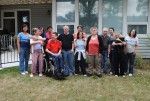
Residents and staff from three of Shalom Residences’ homes in front of the home on Enniskillen Avenue. (photo by Kelsey Halldorson)

A few months ago, Shalom Residences was given the green light from Manitoba Family Services to add a new home in Winnipeg’s South End.

With the vision that people with intellectual disabilities should be full members of the community and that the community is responsible for ensuring that social, residential, religious and cultural opportunities exist to make this possible, a group of parents and other community volunteers founded Shalom Residences as a nonprofit organization in 1978. The first Shalom Residences home opened in 1980.

“Since 1980, Shalom Residences has added five more homes, expanding to provide service to 28 people (22 of whom live in six community residences/group living in single family homes),” said Nancy Hughes, the organization’s executive director since 1991. “These homes have two to five people living together, with staff working in shifts.

“The other six people we serve are in our Supported Independent Living (SIL) program. They each rent their own apartments and have staff support for 10 to 28 hours per week (for budgeting, shopping, meal planning and preparation, housekeeping, etc).”

Currently, all community residences and apartments are located in Winnipeg’s West Kildonan and Garden City areas.

“We’ve always gone about expansion in a careful, gradual way, and future planning includes a home for younger adults in the South End of the city,” said Hughes. “There is a very real need for this within the Jewish and general communities. We’re continuing to lobby our major funder, the [provincial government], to assist us to develop this resource.”

The organization also receives a grant from the Jewish Foundation of Manitoba to hire a part-time Jewish identity coordinator.

Shalom Residences provides Judaic-oriented programs, which includes developing community awareness and increased community acceptance of people with intellectual disabilities as full and equal citizens.

“Although we foster a Jewish milieu, our admission policies are non-sectarian,” noted Hughes. The organization’s ultimate objective is to enable those in its programs to achieve their potential as community members and to become as self-sufficient as possible.

“The people we support have a wide range of abilities and needs, so we offer a higher level of assistance in the community residences and a more independent arrangement in SIL,” said Hughes.

“For the first time, we’re looking in the South End of the city, [and] we have three young people who’ll be funded for this new home,” she said about the residence funding that was recently approved.

The search for a house will take place in River Heights and Crescentwood, and it possibly will include the neighborhoods of Lindenwoods and Charleswood. Once the house is selected, Shalom Residences will buy and renovate it for wheelchair accessibility.

The government will provide ongoing funding for staffing, food and shelter, but Shalom Residences needs to cover the down payment for the house and the initial furnishings. “We could certainly use donations towards some of the costs,” said Hughes.

According to Hughes, this is the first time the government has offered funding for young adults. “We’re very happy to be able to help people leave their family home and start an adult life of their own at a younger age,” she said.

One of the young adults for whom the funding was granted is Micah, one of a pair of twins born with disabilities on the autism spectrum. Micah’s mother, Karla Berbrayer, said, “He has a visual impairment as well as mild cerebral palsy. There is some developmental delay. Although Micah can do his times tables up to the 20 times level, and count to 500 in Hebrew, French and Spanish, he has challenges with daily living skills. My husband and I long ago accepted the fact that Micah cannot be left unattended in the home, and will always require a caregiver.”

The family has been planning for a home for Micah – and has been working with Hughes – for some 10 years, including petitioning the government for the funding, with the stipulation that Micah live in a Jewish setting in the South End with two other individuals close to his age. In their view, Shalom Residences was the only option.

“My husband and I keep a kosher home and observe all the Jewish holidays,” said Berbrayer. “The Jewish religion is a very important aspect of our lives, and we have raised all our children to value their Jewish identity.”

Berbrayer’s husband joined Shalom Residences’ board 20 years ago. He eventually became president and has remained active within the organization.

“We had begun to accept the concept that a new home in the South End for Micah may never happen,” said Berbrayer. “As recently as this fall, I said to my husband, ‘I don’t know that this will ever happen.’”

In November, the couple received the news that the funding for Micah had been approved and that a house would be opened in the South End for him and the two other individuals with whom they asked for him to be housed.

“I burst into tears when the news came,” said Berbrayer. “It was such an unbelievable accomplishment. I felt that I didn’t care how long it would take for the move to transpire, because now I knew that it would happen.”

She expressed gratitude to the government for the decision, and called the new home “a huge step for the organization,” noting that it had been a long time since a new residence had been opened, and that none has been located in the city’s South End.

There is a fundraising dinner for Shalom Residences planned for June. To purchase tickets, for more information or to volunteer, visit shalomresidences.com, email [email protected] or call 1-204-582-7064.


Rebeca Kuropatwa is a freelance writer living in Winnipeg.

Format ImagePosted on January 23, 2015January 21, 2015Author Rebeca KuropatwaCategories NationalTags intellectual disabilities, Karla Berbrayer, Nancy Hughes, Shalom Residences, Supported Independent Living
Barry Sisters recordings now available

Barry Sisters recordings now available

Left to right: Yiddish music icons, Merna and Claire Barry, entertained generations of Jewish Americans with their jazzy versions of Yiddish songs. (photo from rsa.fau.edu)

For more than 40 years, the Bagelman Sisters, later known as the Barry Sisters, were the darlings of Jewish entertainment. Their recordings could be found in almost every Jewish household in the 1950s and ’60s. The younger of the two sisters, Merna, passed away in 1976. The older sister, Claire, died on Nov. 22, 2014, in Hollywood, Fla., at 94.

Who were the Barry Sisters?

On the surface, they were two beautiful girls, dressed in the latest fashion, hair perfectly coiffed, singing with sultry voices that could make your heart leap. But their impact was great.

Born in New York, the two sisters were originally known as the Bagelman Sisters. Many saw them as the Yiddish answer to the popular Andrews Sisters in the 1940s. They combined Jewish folk songs and Yiddish theatre ditties with swing arrangements and perfect harmony. When Clara and Minnie changed their names to Claire and Merna, the Bagelman Sisters became the Barry Sisters. The duo has often been credited with creating Yiddish swing, a music genre that did not exist previously.

The glamorous Barry Sisters were regular guests on Yiddish radio programs like Yiddish Melodies in Swing. They toured with The Ed Sullivan Show to the Soviet Union and performed in Israel in October 1962. The popularity of their catchy and jazzy tunes may have paved the way for the Broadway hit Fiddler on the Roof and the klezmer revival of the late 1970s.

The Judaica Sound Archives at the Recorded Song Archives at Florida Atlantic University has 41 recordings by this dynamic duo of Yiddish music, including: “Abi Gezunt,” “In Meine Oigen Bistie Shain,” “Channah from Havannah,” “Bublitchki,” “Dem Neyem Sher” and many others.

For more Barry Sisters recordings, visit rsa.fau.edu/barry-sisters. Due to copyright concerns, only snippets can be heard on the public website, however, full versions are available to users of the RSA Research Station, rsa.fau.edu.

Niels Falch is a PhD candidate at the University of Groningen in the Netherlands and is currently writing a dissertation on the influence of Jewish music in American popular songs. This article appears courtesy of the Recorded Sound Archives at Florida Atlantic University, rsa.fau.edu.

Format ImagePosted on January 23, 2015January 21, 2015Author Niels FalchCategories MusicTags Bagelman Sisters, Barry Sisters, FAU, Florida Atlantic University, Judaica Sound Archives, Recorded Song Archives, Yiddish radio

Ignorant conspiracies

After the murders in Paris this month, it did not take long for the forces of conspiracy to switch into high gear.

Among those in the anti-Israel movement were people who suggested that the murders had been perpetrated by Israeli agents and that it was a frame up to besmirch Muslims. Greta Berlin, a leader in the Free Gaza movement and one of the most prominent anti-Israel campaigners, posted a statement on her Facebook page shortly after the murders at the French satirical magazine: “Mossad just hit the Paris offices of Charlie Hebdo in a clumsy false flag designed to damage the accord between Palestine and France…. Here’s hoping the French police will be able to tell a well-executed hit by a well-trained Israeli intelligence service and not assume the Muslims would be likely to attack France when France is their friend. Israel did tell France there would be grave consequences if they voted with Palestine. A four-year-old could see who is responsible for this terrible attack.”

Such comments should exclude people like this from legitimate dialogue on the issues, yet the world continues to grant them impunity to spread their theories. And, as perverse and disturbing as the conspiracies from such anti-Israel activists are, there are more absurd and apparently common views expressed on the street in the Paris suburbs where large populations of immigrants from Muslim countries live in economic stagnation. It took an American reporter no time at all to find more fantastical theories; for example, that the attacks were carried out by magical, shape-shifting Jews who morphed themselves into figures resembling Arab terrorists and perpetrated the evil acts.

As extraordinarily outlandish as the latter allegation is, it is no more removed from reality than the former. And both represent a somewhat alarming reality in contemporary discourse. There are conspiracy theories with some traction that say “the Jews” invented ISIS, perpetrated the 9/11 attacks and are in cahoots with the Freemasons to control the media and levers of power. Moowahahaha.

We should be cognizant that these ideas exist and pay attention to the impact they may play in the global dialogue about Israel (and anything else involving Jews). And, we should be vigilant and thankful for the organizations that monitor and condemn these notions. At the same time, we need to maintain perspective. While these ideas may seem widespread, they are generally (though not always) held by the ignorant, the ill-informed and the undereducated. Notably, these ideas seem most prominent in places where democracy has not been permitted to flourish, and autocrats will – and do – exploit these sorts of things for their purposes. Most of the people who carry these poisonous thoughts, however, cannot even exert their influence at the ballot box.

We return to comments by Jonathan Kay when he visited here more than a year ago now. Kay, then the editorial page editor of the National Post and now editor of The Walrus magazine, insisted that these voices have been marginalized. In the halls of power – or even of country clubs and polite society – where antisemitism once held sway – these ideas are dismissed along with the people who espouse them. To subscribe to them is to relegate oneself to the D-list of civil dialogue.

It is important to acknowledge, on the one hand, guttersnipe who purvey ludicrous, hateful ideas and, on the other, the progress that has been made against bigotry among the people who determine policy in our country and among our democratic allies. Outside these circles are all sorts of ideas that are beyond the realm, but in the places where bizarre anti-Jewish conspiracies still hold sway, antisemitism is merely one among a disturbing host of societal ailments.

There is a quote that seems appropriate here, and it is doubly attributed – to the American presidential confidant Bernard Baruch and children’s writer Dr. Seuss. Whichever man originated it, the sentiment applies: “Be who you are and say what you feel, because those who mind don’t matter, and those who matter don’t mind.”

Posted on January 23, 2015January 21, 2015Author The Editorial BoardCategories From the JITags antisemitism, Bernard Baruch, Charlie Hebdo, Dr. Seuss, Greta Berlin, Jonathan Kay, terrorism

Unpacking Lintel’s background

Vancouver’s Pacific Theatre kicked off the new year with Underneath the Lintel, on stage until Jan. 31. Though it seems the well-known Emmy-winning playwright Glen Berger did not intend the bigotry implied by his play, his thematic choices create a serious problem nonetheless. This Lintel comes to Vancouver from Alberta’s Rosebud Theatre. (Spoiler alert: the ending of the play is revealed and discussed below.)

While British, Canadian and American critics have given the play mixed reviews, some have argued that it’s not antisemitic, unlike the story that inspired it. And it’s been a hit with producers, who have given it numerous productions across North America and even a run in London’s West End starring Richard Schiff of West Wing fame.

Berger’s 2001 comedy is a contemporary adaptation of the allegorical medieval Christian myth of the Wandering Jew, a figure that has served for centuries as a symbol of the Jewish people’s rejection of Christianity.

Many readers will be familiar with the story, which tells the tale of a Jewish cobbler in Jerusalem who ignores Jesus’ plea for help on his way to crucifixion. The 13th-century fable tells us that, in response, Jesus cursed the Jew. To paraphrase, Jesus says: “For your failure to demonstrate kindness, you are doomed to wander the earth, without rest, until we meet again.” The cobbler is forced to leave his family and wander the earth, alone and unloved, until the Second Coming. He still wanders today, exhausted (in some versions, wicked) and waiting for Jesus to return.

According to historian Salo Wittmayer Baron, the legend became popular with the audiences for medieval passion plays in which the fable was enacted. “Although, from the outset, everyone realized that [the cobbler] had been a Jerusalemite Jew, he now began to be identified with the unconverted eastern Jew still alive in modern times,” he writes in Social and Religious History of the Jews: Late Middle Ages (vol. 10). The first written record of the fable is from the 13th century; indeed, it becomes the very first mass publication when its German-language version is published in 1602.

Underneath the Lintel follows a Dutch librarian (called Librarian in the program) around the world as he searches for the person who returned a library book that was 113 years overdue. During his international pursuit of the culprit, Librarian tells us, he realizes he may, in fact, be following in the footsteps of the Wandering Jew. He then shares the basics of the medieval fable with the audience (without context or dwelling on the work’s antisemitic history) and reasons that if he has discovered that the Wandering Jew really exists, this also proves that God exists. Librarian is awed and thrilled by that possibility, and the play turns into his search for God. Soon, however, the audience realizes what Librarian does not: he may be the Wandering Jew himself.

The play’s only character is Librarian (a very good Nathan Schmidt). Librarian never judges (a punishing) God’s treatment of the Wandering Jew. In a 2013 essay for American Conservatory Theatre, Berger writes that the Wandering Jew is guilty of a “mistake, a simple mistake.”

This Pacific Theatre production is a very good play, and the story of Librarian is compelling; two features irrelevant to the content of the script. Undoubtedly, the script’s problem is the result of sloppy writing and a somewhat ignorant reading of what the Wandering Jew folktale implies. The playwright seems very naïve.

In a 2013 interview with JWeekly, Berger said, “Up to the 19th century, the Wandering Jew was considered a condemnation of Jews and Judaism, because he wasn’t very nice to Jesus and consequently got punished for it. I think people just know The Wandering Jew as an antisemitic tale in any context.” Including this one? He doesn’t say, but it appears that Berger believes he’s cleansed the fable of its offensiveness. It’s just another cautionary tale now, his script implies, like The Little Mermaid or Pinocchio.

Berger signals a slight shift in the American Conservatory Theatre essay. He writes, “Now, I was quite aware that the myth of The Wandering Jew was originally an antisemitic tale, but the myth had taken on more complex meanings in its 700-odd-year history and I felt, besides, that an artist can always appropriate myths for his own ends.”

This is true. Artists can do whatever they want with whatever they want. What Berger has done here, however, is confirm the conclusion of the original antisemitic folktale. A more “complex meaning” than simple bigotry is tough to imagine.

In this play, the Wandering Jew commits his “crime” while standing “underneath the lintel” of his front door. He watches but ignores the procession of the condemned. When Jesus falls before his door and begs for help, the Jew remains still. In some version of the tale, the Jew strikes Jesus or tells him to hurry. Berger writes in the program’s playwright’s note: “[The Wandering Jew’s] predicament is the predicament of all humanity – he made a mistake, a single mistake ‘underneath the lintel,’ when he put fear and self-interest ahead of compassion. Everyone does this all the time.”

Berger, therefore, reduces the fable to “people make mistakes.” What mistake? Was it a mistake to reject Jesus and Christianity? In whose eyes? Berger allows: “Did the punishment fit the crime? No.” But guilty nonetheless, he implies: there has been a crime. Perhaps Berger thinks the sentence a little long. He never articulates his thoughts on the punishment beyond its failure to fit the transgression.

“I’ve received letters calling Underneath the Lintel antisemitic,” Berger writes. “That said, I’ve also received letters calling the play too ‘pro-Zionist,’ and also ‘anti-Christian,’ for the portrayal of a cruel Christ, I suppose. So go figure.”

In the end, of course, we discover that Librarian might actually be the Wandering Jew and just not know it. On the surface, we learn that the Dutch librarian is also guilty of “a mistake” that has ruined his life. Underneath his own lintel, Librarian rejected the only woman he ever loved. The cost of that mistake is loneliness and an obsessive pursuit of the Wandering Jew that forces him to travel the world. Berger, here, equates Librarian’s mistake with the Jew’s mistake. Librarian rejected a woman; the Jew rejected Jesus. Only one was punished for eternity. Librarian, however, has free will.

It’s difficult to understand why the vast majority of critics do not notice the play’s antisemitism, and why, those who do insist on announcing that it is not antisemitic.

Some audiences will surely argue that the play is not antisemitic but, rather, about antisemitism. Not evident, I believe. Others will compare the retelling of this legend to the problematic Merchant of Venice. But this is a contemporary play, not the revival of a period piece. Some will argue that the play questions God’s fundamental justice: it does not.

Underneath the Lintel was written by an American Jew to entertain and provoke audiences; one might say that The Wandering Jew was written by medieval Christians to entertain and provoke audiences – but, more to the point, to promote hatred and violence. The playwright succeeds in diminishing the true meaning of The Wandering Jew when he equates it, thematically, with a simple story of lost love.

As a final “surprise,” as the play ends, Librarian transforms into a cartoon Jew. He already has a beard and an accent that sounds Yiddish. Now, he dons an old black suit that we’re told is dirty and smelly. The jacket bears the Star of David we’re told Jews were forced to wear in the 15th century. He wears the funnel-shaped cap Jews were forced to wear in the 14th century. He holds a prayer book in one hand and (what appears to be) a candlestick in the other.

Costumed thus, he dances Tevye-style to klezmer music and the play ends. This final image smacks of historic – and overtly – racist portrayals of the Wandering Jew in art. If Berger intended to comment on this image, on this object of scorn, he forgot to do so. The play ends instead with the comic dance of the Jew.

Michael Groberman is a Vancouver freelancer writer.

Posted on January 23, 2015January 21, 2015Author Michael GrobermanCategories Op-EdTags antisemitism, Glen Berger, Salo Wittmayer Baron, The Wandering Jew, Underneath the Lintel1 Comment on Unpacking Lintel’s background

Posts pagination

Previous page Page 1 … Page 586 Page 587 Page 588 … Page 650 Next page
Proudly powered by WordPress