
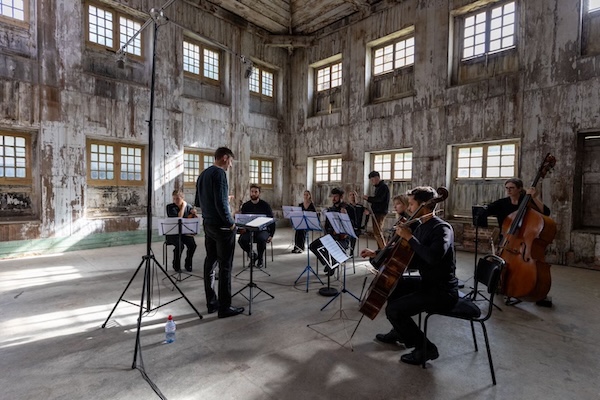
Through a chance conversation with a curator at the Auschwitz Memorial and Museum, conductor and composer Leo Geyer came across musical scores composed by concentration camp prisoners during the Holocaust. June 3 to 7, at London’s Bloomsbury Theatre, the music Geyer documented was played for the first time in 80 years. (photo from Sky Arts)
In 2015, London-based musician and composer Leo Geyer was commissioned to write a tribute honouring British historian Sir Martin Gilbert, who had recently died. Visiting Oświęcim, Poland, to better understand the Holocaust historian’s research, a chance conversation with a curator at the Auschwitz Memorial and Museum led Geyer to a trove of forgotten musical scores composed by prisoners who had been forced to perform in the SS-run orchestras in the Nazi concentration camp, where more than 1.1 million died in gas chambers, mass executions, torture, medical experiments, exhaustion and from starvation, disease and random acts of violence.
The deteriorating and fragile sheets of music, written in pencil, were faded and ripped. Many had burn damage. Intrigued, Geyer devoted nearly a decade of detective work to studying the documents and filling in missing gaps, and the music formed the basis for his doctorate at Oxford University. From June 3 to 7, at London’s Bloomsbury Theatre, the music Geyer documented was played for the first time in 80 years, to commemorate the liberation of Auschwitz in January 1945. The opera ballet included the unfinished scores that Geyer completed and choreography by New York-born choreographer Claudia Schreier.
“The musicians took incredible risks to make brazen acts of rebellion. When good news of the war [of the Allies’ June 6, 1944, D-Day landings] reached the men’s orchestra in Auschwitz I, they performed marches not by German composers but by American composers,” Geyer said in an interview with France 24’s daily broadcast Perspective.
The guards couldn’t distinguish between a Strauss waltz and a John Philip Sousa march.
The musicians “would also weave in melodies from Polish national identity such as St. Mary’s Trumpet Call (a five-note Polish bugle call closely bound to the history of Kraków). We also know of secret performances [that] would take place, which would principally encompass Polish music, but we also know Jewish music was performed as well,” said Geyer.
The story of the orchestras at Auschwitz was popularized by Fania Fénelon, née Fanja Goldstein (1908-1983), a French pianist, composer and cabaret singer whose 1976 memoir Sursis pour l’orchestre, about survival in the women’s orchestra at the Nazi concentration camp, was adapted as the 1980 television film Playing for Time. The orchestra, active from April 1943 to October 1944, consisted of mostly young female Jewish and Slavic prisoners of varying nationalities. The Germans regarded their performances as helpful in the daily running of the camp in so far as they brought solace to those trapped in unimaginable horror. As well, the musicians held a concert every Sunday for the amusement of the SS.
Geyer explained that the SS organized at least six men’s and women’s orchestras at Auschwitz, and perhaps as many as 12. The groups principally played marching music as prisoners trudged to the munitions factories and other industrial sites, where they worked as slave labourers, he explained.
“Musicians had marginally better conditions than other prisoners,” he noted. Nonetheless, he said, “The vast majority of the musicians and composers did not survive the war.” Most of their names are lost. Geyer was able to track down the composer of one unsigned composition by comparing the handwriting to a document found at a conservatory in Warsaw.
Adding poignancy to the performances in London, the musicians played from copies of the original scores.
“We poured our heart and soul into these performances,” said Geyer. “I am neither Jewish nor Romani. But I am human.”
Gil Zohar is a writer and tour guide in Jerusalem.
* * *
A replica of Auschwitz
Due to conservation issues, the Auschwitz Memorial and Museum no longer permits the filming of movies at the historic site. Using advanced spatial scanning technology, the museum employed a team of specialists, led by Maciej Żemojcin, to create a digital replica of the Auschwitz I camp. The project was recognized at the Cannes Film Festival.
Museum spokesperson Bartosz Bartyzel told Euronews Culture that the replica was created “out of the growing interest of directors in the history of the German camp.”
“The Auschwitz Museum has been working with filmmakers for many years – both documentary filmmakers and feature film directors,” he said. “However, due to the conservation protection of the authentic memorial site, it is not possible to shoot feature films [there]. The idea to create a digital replica was born out of the need to respond to the growing interest in the history of the Auschwitz German camp in cinema and the daily experience of dealing with the film industry. This tool offers an opportunity to develop this cooperation in a new, responsible and ethical formula.”
– GZ