Skip to content
  • Home
  • Subscribe / donate
  • Events calendar
  • News
    • Local
    • National
    • Israel
    • World
    • עניין בחדשות
      A roundup of news in Canada and further afield, in Hebrew.
  • Opinion
    • From the JI
    • Op-Ed
  • Arts & Culture
    • Performing Arts
    • Music
    • Books
    • Visual Arts
    • TV & Film
  • Life
    • Celebrating the Holidays
    • Travel
    • The Daily Snooze
      Cartoons by Jacob Samuel
    • Mystery Photo
      Help the JI and JMABC fill in the gaps in our archives.
  • Community Links
    • Organizations, Etc.
    • Other News Sources & Blogs
    • Business Directory
  • FAQ
  • JI Chai Celebration
  • JI@88! video

Recent Posts

  • Eby touts government record
  • Keep lighting candles
  • Facing a complex situation
  • Unique interview show a hit
  • See Annie at Gateway
  • Explorations of light
  • Help with the legal aspects
  • Stories create impact
  • Different faiths gather
  • Advocating for girls’ rights
  • An oral song tradition
  • Genealogy tools and tips
  • Jew-hatred is centuries old
  • Aiding medical research
  • Connecting Jews to Judaism
  • Beacon of light in heart of city
  • Drag & Dreidel: A Queer Jewish Hanukkah Celebration
  • An emotional reunion
  • Post-tumble, lights still shine
  • Visit to cradle of Ashkenaz
  • Unique, memorable travels
  • Family memoir a work of art
  • A little holiday romance
  • The Maccabees, old and new
  • My Hanukkah miracle
  • After the rededication … a Hanukkah cartoon
  • Improving the holiday table
  • Vive la différence!
  • Fresh, healthy comfort foods
  • From the archives … Hanukkah
  • תגובתי לכתבה על ישראלים שרצו להגר לקנדה ולא קיבלו אותם עם שטיח אדום
  • Lessons in Mamdani’s win
  • West Van Story at the York
  • Words hold much power
  • Plenty of hopefulness
  • Lessons from past for today

Archives

Follow @JewishIndie
image - The CJN - Visit Us Banner - 300x600 - 101625

Category: From the JI

Keep lighting candles

We were intrigued to receive notice of the 2026 PuSh International Performing Arts Festival, which takes place in January and February. The festival has been running for more than two decades and bills itself as “a creative hub for dialogue.” 

“The 2026 PuSh festival is an invitation to the culturally fearless – to those ready to step into fresh futurities and the uncharted possibilities of live performance,” said artistic director Gabrielle Martin in the media release that landed in our inbox recently.

Curious words for a festival that last year demonstrated cowardice that redefines the term.

The controversy centred on a play titled The Runner – a one-person offering by non-Jewish playwright Christopher Morris. The story is set in Israel and has as its focus an ultra-Orthodox Jewish ZAKA volunteer who faces an ethical decision: when encountering a wounded Palestinian woman, he opts to save her rather than pursue an Israeli soldier’s body. 

The play had garnered acclaim, having won multiple awards in Canada, and was to be featured at the 2024 PuSh festival. The Belfry Theatre in Victoria had already canceled its planned 2024 run of the show after the theatre was vandalized and a public dialogue was overtaken by protesters.

The scheduled PuSh production was also targeted. Some critics complained that the play centred Jewish experience while marginalizing Palestinian voices and trauma, presumably because depicting an Israeli as a complex moral character was beyond the pale.

One Palestinian artist participating in the festival said he would withdraw his work if The Runner remained in the lineup. Organizers caved, couching their gutlessness in self-adulatory language of prioritizing artists whose perspectives were “underrepresented” given current events.

If the festival was indeed committed to “fearless” exploration, The Runner was an ideal vehicle for that sort of examination. Instead, organizers brought shame upon the arts sector, betraying the very values PuSh specifically and the arts in general are expected to advance.

Keeping up with incidents of hypocrisy these days is a game of Whack-a-Mole, but we cannot overlook the vote by the BC Green Party to adopt a so-called “Anti-Genocide Motion” at their provincial convention. The motion declares that the party will “oppose genocide, apartheid, systemic discrimination and colonial violence – at home and around the world.” 

In supporting the motion, the party’s new leader, Emily Lowan, stated that the Greens consider the recent war in Gaza to constitute “genocide” and “colonial violence.”

The motion and the leader’s full-throated support for it is especially disappointing because, under previous leaders, the BC Greens had resisted the spiral of their federal party into this sort of hyperbolic and ahistoric anti-Zionism.

We could go on. There is literally not the space in this column or in these pages to delineate the myriad causes for Jewish disenchantment these days. This, though, is not justification for despair. History has presented Jews with challenges in the past, put mildly. 

If these developments and their hypocrisy raise your heart rate, consider using that energy as fuel to build something better. The world is troubled right now, for Jews and for others, too, but it is a Jewish tradition – especially at this moment in the calendar – to light a candle rather than to curse the darkness. 

If you are expending energy complaining to your friends about these events, consider more active ways to effect positive changes. For example, you can contact the Green Party and tell them you are affronted by their adoption of a resolution that debases the term “genocide,” misrepresents events globally and foments intercultural division at home. Contact the PuSH festival and their sponsors to tell them you haven’t forgotten their illiberal folding to coercion. Support arts institutions that continue to host and produce Israeli and Jewish art and artists, and our own community arts and culture organizations, which have faced additional challenges over the last two-plus years. Whenever you are angered or disappointed, remember that action is the antidote to helplessness and hopelessness. Just one candle can illuminate the darkness and bring hope and inspire change. 
Posted on December 5, 2025December 3, 2025Author The Editorial BoardCategories From the JITags antisemitism, arts and culture, BC Green Party, Hanukkah, politics, PuSh Festival, PuSh International Performing Arts Festival
From the archives … Hanukkah

From the archives … Hanukkah

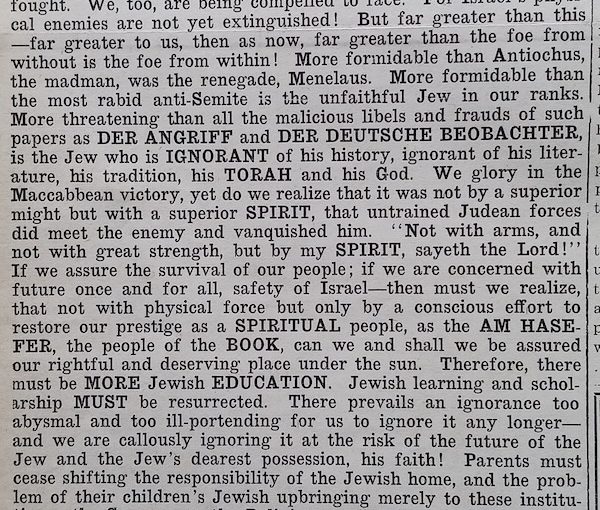
The editorial in the Dec. 8, 1939, issue of the Jewish Western Bulletin.

We’ve come a long way in many ways, though some readers may disagree. I read, kind of in horror, the newspaper’s Dec. 8, 1939, editorial in which the lesson drawn from Hanukkah was that, “More formidable than the most rabid anti-Semite is the unfaithful Jew in our ranks. More threatening than all the malicious libels and frauds of such papers as DER ANGRIFF and DER DEUTSCHE BEOBACHTER, is the Jew who is IGNORANT of his history, ignorant of his literature, his tradition, his TORAH and his God.”

I can appreciate the Maccabean victory “was not by a superior might but with a superior SPIRIT, that untrained Judean forces did meet the enemy and vanquished him.” I agree that Jewish education is vital to Jewish continuity, but yikes. I’m not sure all the “yelling” capital letters encourage the message that: “There must be a closer alliance, a sense of closer affinity, a warmer consciousness of brotherhood between Jew and Jew and between the individual Jew and Jewry at large if we are to succeed – nay, if we are to insure our future as a people!”

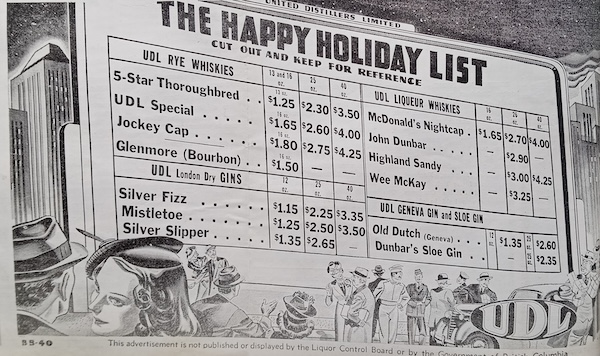
I am also always surprised at how much of the advertising in the early years of the Jewish Western Bulletin was for alcohol. As but one example, given the time of year, is the Dec. 24, 1941, ad from United Distillers Ltd., “The Happy Holiday List” that readers are asked to “cut out and keep for reference,” which I guess I’ve done, though I don’t think any of the brands still exist.

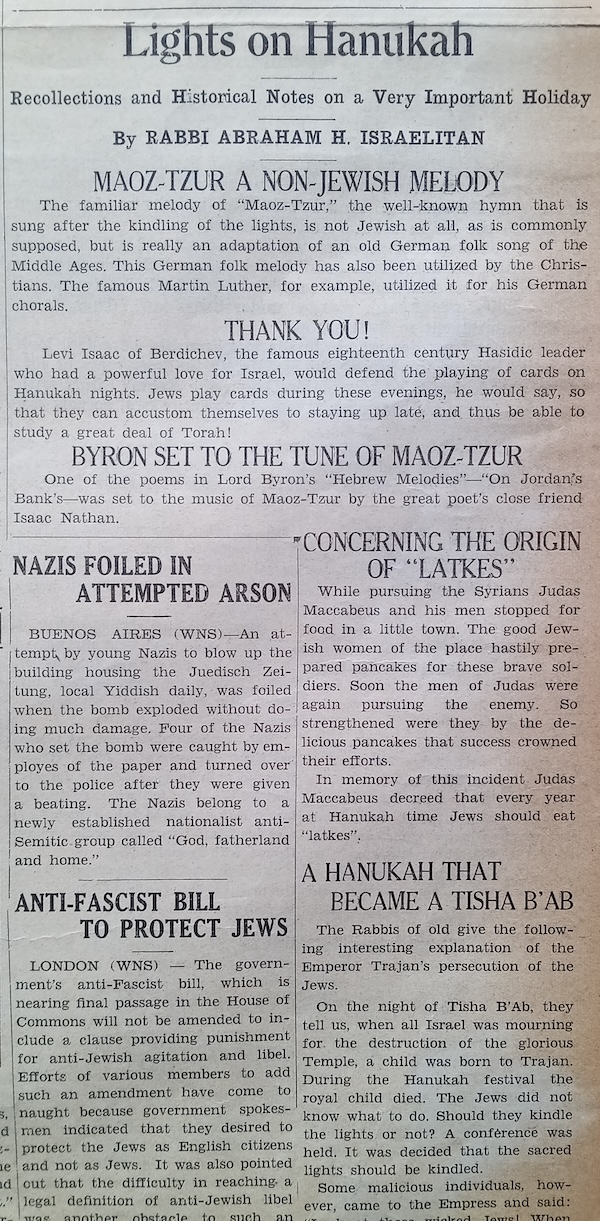
I did enjoy some of the Hanukkah trivia that made the front cover of the Dec. 11, 1936, paper, though it was a jarring juxtaposition with the world news. As it happens, the first item, on the melody of the traditional Hanukkah song “Maoz Tzur,” mentions Martin Luther, as does the article on the cemetery in the German City of Worms that is featured in this week’s issue – on this very page, in fact – which discusses briefly Luther’s legacy.

In his “Lights on Hanukah” article, Rabbi Abraham H. Israelitan points out: “The familiar melody of ‘Maoz-Tzur,’ the well-known hymn that is sung after the kindling of the lights, is not Jewish at all, as is commonly supposed, but is really an adaptation of an old German folk song of the Middle Ages. This German folk melody has also been utilized by the Christians. The famous Martin Luther, for example, utilized it for his German chorals.”

The rabbi also notes, “One of the poems in Lord Byron’s ‘Hebrew Melodies’ – ‘On Jordans Bank’s’ [sic] – was set to the music of Maoz-Tzur by the great poet’s close friend Isaac Nathan.” He goes on to reveal “the origin of latkes,” and a few more of what we now call “fun facts.” Israelitan was not a local rabbi. His article was distributed by Seven Arts Feature Syndicate, which, according to Google, was an American group that provided content to Jewish papers from the 1920s through the 1960s.

Holiday parties, concerts, menorah lightings and more have always been promoted or covered in the newspaper, of course. Almost every Hanukkah issue has included recipes, gift ideas, personal holiday stories. And pretty much every Hanukkah-themed editorial aims to point out what the Maccabees can teach us today or what light we can shine to diminish the darkness in the world – though we do it a little less harshly than the editors of 80, 90 years ago, I think. Most certainly, we do it with fewer capital letters. 

image - An adl in the Dec. 24, 1941, issue of the Jewish Western Bulletin
An ad in the Dec. 24, 1941, issue of the Jewish Western Bulletin.
image - An article on Hanukkah trivia in the Jewish Western Bulletin Dec. 11, 1936
An article on Hanukkah trivia in the Jewish Western Bulletin Dec. 11, 1936.
Posted on December 5, 2025December 4, 2025Author Cynthia RamsayCategories From the JITags archives, editorials, fun facts, Hanukkah, history, Maoz Tzur, trivia

Words hold much power

At an event hosted by the National Council of Canadian Muslims on Nov. 1, Toronto’s Mayor Olivia Chow said, “the genocide in Gaza impacts us all.” 

Four days later, protesters attacked a group of Jewish students from Toronto Metropolitan University at an event featuring a speaker who served in the Israel Defence Forces during the recent Gaza war.

Is this cause and effect? Did Chow’s words give a kind of permission for anti-Israel activists to act out violently?

Human nature doesn’t work so neatly. Suggesting one directly led to the other is both unprovable and probably specious.

Both of these incidents, however, are part of a larger zeitgeist.

For (at least) two years, Israel has been accused of monstrous barbarities. Accusations against the Jewish state include deliberate starvation, ethnic cleansing, intentional mass killings, wanton destruction of infrastructure and other assorted war crimes.

There are legitimate debates around the definitions of terms and whether or how they apply to recent events in Gaza. However, public discussions, as Chow demonstrated, rarely reflect these nuances.

As a society, we now widely accept that incendiary language can lead to incendiary actions. In discussions around immigration levels, for example, responsible public figures generally engage in discourse that does not demonize migrants or new Canadians. Concerns have been raised in recent years around the tenor of discussion around transgender issues, with advocates warning that some of the language can exacerbate emotional isolation, especially in transgender youth, and can lead to suicide ideation. Words, it is widely accepted, can have tangible, indelible impacts.

This thoughtfulness seems nowhere to be found when Jews and allies warn that the provocative language against the Jewish state is having serious impacts on Jews in Canada.

While cause and effect are rarely provable, correlations can be clearer. Over the past two years, combustible rhetoric against Israel has coincided with an unprecedented spike in antisemitic acts against Jewish institutions and people. One would think, under the circumstances, that reasonable people might see the potential that one is at least somewhat related to the other.

Raise this possibility, though, and you can expect to be met with assertions that “Zionists” are trying to silence criticism of Israel or that there is a “chill” on discussion of urgent and legitimate international matters.

This is an admirable defence of free speech. It is interesting, though, that concepts of almost unfettered free expression seem to be the redoubt of Israel critics who accept limitations on civil discourse in a vast range of other topic areas.

Is it a coincidence, also, that the very concept of “Zionists” controlling what other people are permitted to think and say about Israel dovetails with traditional antisemitic concepts of Jewish power and control?

What everyone should be able to accept – because the evidence is plain – is that there is a parallel between the intensity of rhetoric against Israel and increasing attacks on Jews in Canada (and elsewhere).

Toronto’s mayor is just one of many Canadian leaders who should know better than to nonchalantly toss around accusations, understanding that the pitch of condemnation against Israel is having concrete impacts on Jews in Canada.

Anyone with a public platform should behave in ways that recognize the intended and potentially unintended consequences of their words. A mayor of a Canadian city, for example, should know that her words will have limited effect on the lives of Palestinians, but plenty of impacts here at home.

In a diverse country like Canada, where inclusivity is considered a core value, people in positions of respect and power have a duty to act responsibly, to promote unity and avoid phrases that might inflame community tensions. 

Did Chow’s words directly lead to the violent attack on Jewish students this month? Almost certainly not. 

But they contributed to an environment already aggravated with tension and peril.

Format ImagePosted on November 21, 2025November 20, 2025Author The Editorial BoardCategories From the JITags antisemitism, language, Olivia Chow
From the archives … books

From the archives … books

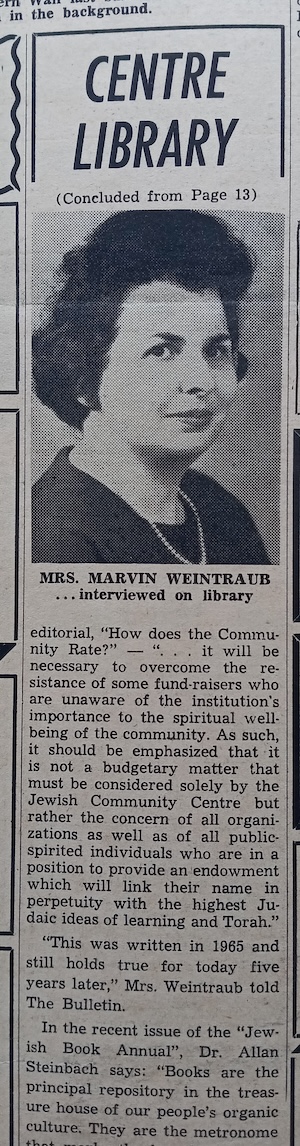
In honour of Jewish Book Month, which runs Nov. 13 to Dec. 13, I’m highlighting a short article that appeared in the Independent’s predecessor, the Jewish Western Bulletin, on Dec. 18, 1970.

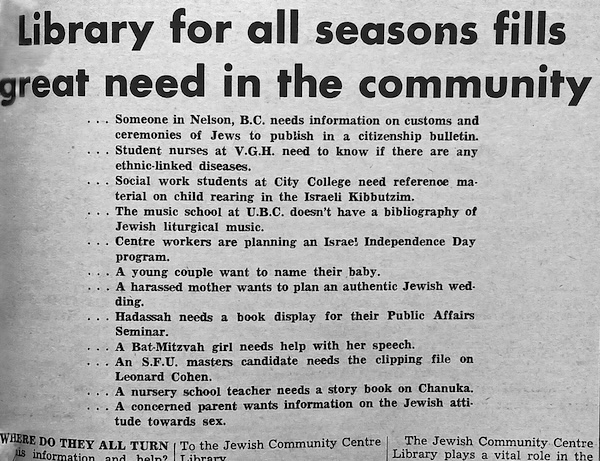
image - Rita Weintraub photo in the article on the JCC Library from the Jewish Western Bulletin, on Dec. 18, 1970 The focus on the Jewish Community Centre Library, now called the Isaac Waldman Jewish Public Library, stressed the “vital role” the library plays “in the life of the Vancouver Jewish community” and how it serves “the community at large in a very meaningful and important way. At any time, one can pass by and see it being used for recreational reading, browsing or study.”

The article notes how a visiting professor who stopped in at the library remarked “how thoroughly cross-referenced it was.” 

“Mrs. Marvin Weintraub, hardworking and dedicated volunteer librarian,” aka Rita Weintraub, is interviewed for the story. Many in our community will have known Rita, who died in 2020. The library she was instrumental in building was a lifelong passion. In the article, she refers to the library as important for “the spiritual well-bring of the community.” As such, she said, it should be “the concern of all organizations as well as of all public-spirited individuals who are in a position to provide an endowment which will link their name in perpetuity with the highest Judaic ideas of learning and Torah.”

Posted on November 21, 2025November 20, 2025Author Cynthia RamsayCategories From the JITags history, Isaac Waldman Jewish Public Library, Jewish journalism, Jewish Western Bulletin, Rita Weintraub

A better future possible

This feels like a turning point. Few people who observe international affairs, especially in the Middle East, would doubt that the conclusion of the two-year-long war means a significant change in the dynamics of the region.

It is an understatement to say that wars cause upheaval. The result of any war is always catastrophic death and destruction. But wars also, by definition, upend status quos. 

The First World War decisively ended the age of empires. The Second World War ushered in, among much else, a new world order including the concept of universal human rights. 

Every war, among its other consequences, is like throwing a deck of cards in the air. What emerges in the aftermath is to some extent beyond the control of any of the belligerents, including the victors (such as there are ever true victors in war). 

In Israeli history, it has sometimes seemed as though a war ends and things return to the status quo ante. Israeli-Arab wars have ended before with little or no decisive change in the broader context of conflict. New wars, sadly, have always erupted. Perhaps the end of the Gaza war will usher in a time of changed dynamics or maybe the region will revert to its perpetual bottom line of Zionists-versus-anti-Zionists and little will change. The eight-decade battle over Israel’s right to exist is unlikely to be conclusively settled, whether or not the current ceasefire holds.

This feels different, though, in many ways. 

The global engagement with this particular conflict – the diplomatic condemnations, the isolation of Israel, the worldwide street protests, the systematic boycotts of Israelis and Jews, the raging antisemitism that paralleled it – set this war apart from others of the past. One thing almost all Jews are probably watching closely is whether the easing of military tensions in the Middle East leads to an easing of antisemitic tensions worldwide. Many of us hold our breath awaiting that verdict.

The US administration plays a distinct wild card. It helped broker the ceasefire, but also has floated some provocative ideas of how to rebuild Gaza.

The talk about rebuilding Gaza, to which some European powers have committed and to which Arab states have given at least lip-service, is a physical necessity. As formidable as that reconstruction process will be, a moral and political rebuilding will be far more daunting. “De-Hamas-ification,” to update a term from a previous war, is a stated objective of Israel and its supporters. But, as some commentators have noted, Hamas may be as much a symptom of an extremist intolerance in elements of Palestinian society as a cause. This is likely particularly true without broad and sustained supports for Palestinian voices and aspirations that are anti-authoritarian or desiring of coexistence or peace with Israel. Militaries can be defeated perhaps more easily than some of the tenacious ideas that they represent. 

Additionally, it will be fascinating to see whether the world, having made Gaza the almost singular focus of international affairs for the past two years, will now take any responsibility for ensuring the safety and prosperity of the Palestinian people, or whether we will collectively abandon them again until the next catastrophe reawakens our sense of humanitarianism.

Despite the Madison Avenue mantra, “new” does not always mean “improved.” Sometimes, things can change for the worse. But this does seem like a moment of opportunity. 

On the one hand, it has become clear that “From the river to the sea …” is not a practical strategy. On the other, for those who seek peace, we have understood that we are not powerless witnesses to history. Each of us, in our way, has influence. Many erstwhile apolitical people have been motivated to action, to engage in dialogue across social and political boundaries, and to be part of the efforts to bring about a better life for all sides.

Now that the immediate war is over, we should hope coming together is possible among those of differing perspectives to advance a future of mutual benefit. What we do now, as individuals, as countries, as Jews, as humans, and in whatever context we act and whatever forms our actions take, can have a powerful impact on what happens next. 

Posted on November 7, 2025November 6, 2025Author The Editorial BoardCategories From the JITags change, conflict, Gaza, Israel, Palestine, peace, politics, rebuilding Gaza, war

From the archives … editorials

Almost every year that the Jewish Independent has entered the American Jewish Press Association’s Simon Rockower Awards for Excellence in Jewish Journalism competition, the paper has been recognized for its editorials. We have won for other articles, too, in several different categories, but have taken away the most honours for our editorials. This year, for instance, we took first and second place! (See jewishindependent.ca/ji-editorials-win-twice.)

The JI’s editorial board, Pat Johnson, Basya Laye and I, don’t always agree initially on what the editorial’s stance will be. Our back-and-forths, exchanging our different views and coming to a consensus, is one of my favourite parts of running the paper. It’s a key reason, I believe, that the editorials have been so award-winning.

Another reason is that the three of us have read and worked on the Jewish Independent for so many years, and we’ve been part of this community for so many years. We are grateful for those on whose shoulders we stand. The wisdom of previous generations, and that of our own generation, inspires how we look at what’s happening here and elsewhere in the world.

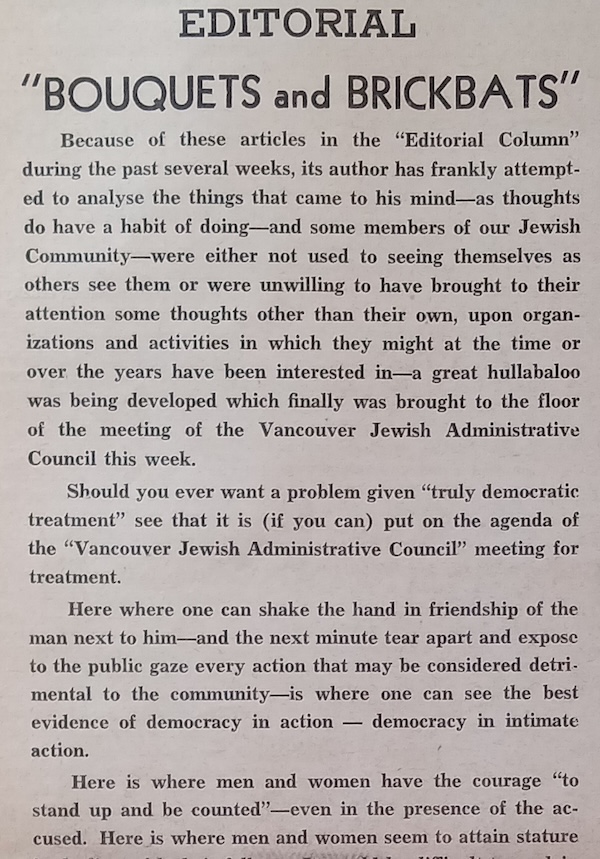
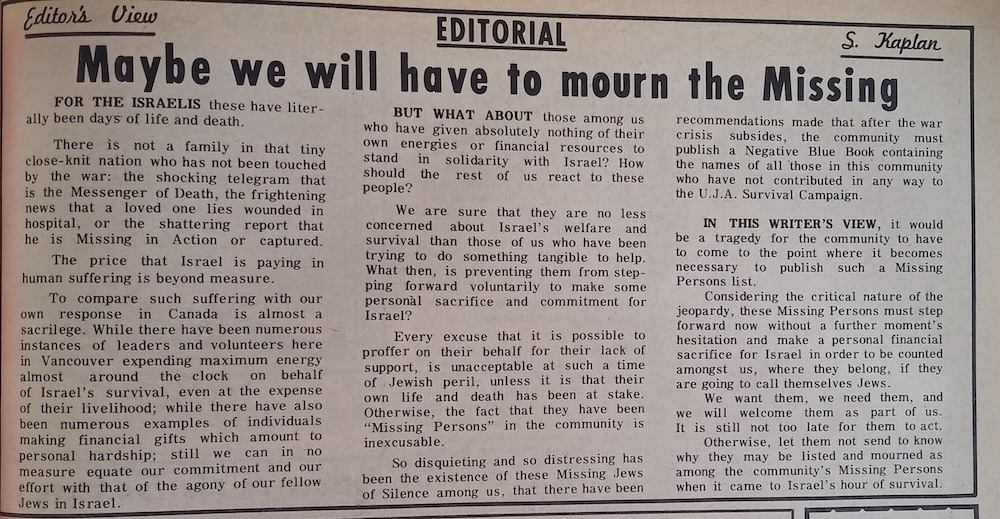
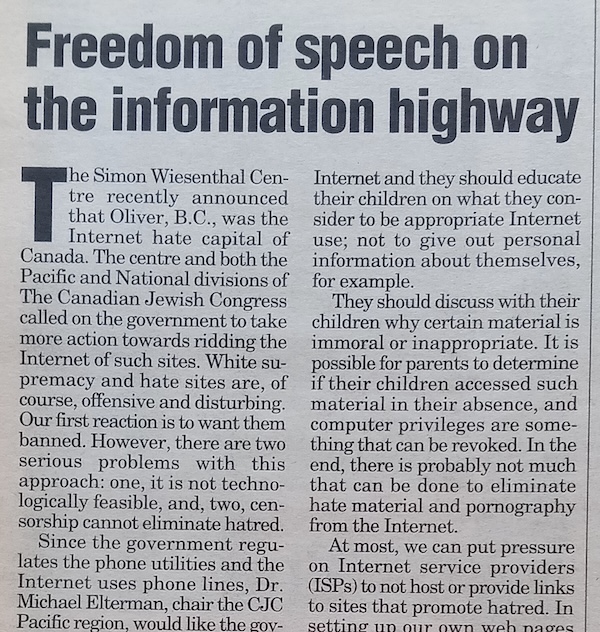
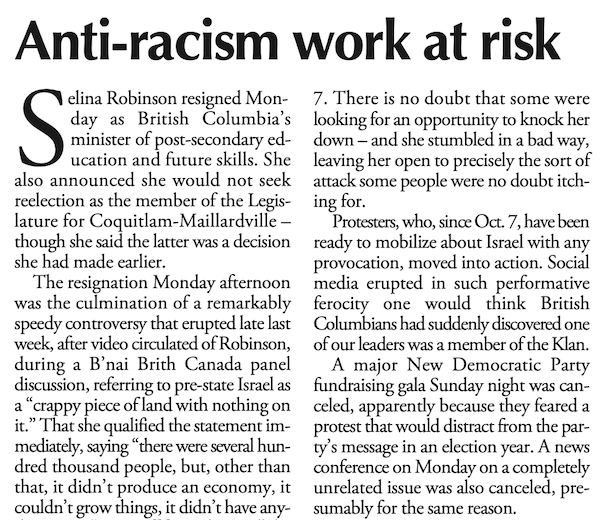
As I looked through the JI archives, I came across the first editorial I wrote for the paper, when it was still called the Jewish Western Bulletin, and before Pat, Basya and I became a team. I also clipped out just some of the thousands of editorials that have been written over the years. There are so many recurring themes, including communal and democratic responsibilities and the importance of free speech. The editorials variously try to calm, cajole, educate or empower readers. 

image - April 13, 1945, editorial in JWB
April 13, 1945: The paper’s editorials were brought under community review. Associate editor Goodman Florence describes the meeting that took place and comes to the conclusion that, “He who aspires to express himself must expect to receive both ‘bouquets and brick-bats’ – and if he is intelligent he will use them both.”
image - Oct. 26, 1973, editorial in JWB
Oct. 26, 1973: Jewish Western Bulletin editor Sam Kaplan calls out community members who’ve not contributed funds to Israel in the wake of the Yom Kippur War. The editorial floats the idea of publishing a list of these “Missing Jews of Silence.”
Feb. 6, 1998, editorial in the JWB
Feb. 6, 1998: My first editorial for the paper argued for limited  regulation of the internet, concluding that state censorship is more dangerous than free speech, including hate speech.
image - The JI editorial board’s first place Rockower Award winners from 2024
The JI editorial board’s first place Rockower Award winners from 2024 – and our many other missives – can be read at jewishindependent.ca.
Posted on November 7, 2025November 6, 2025Author Cynthia RamsayCategories From the JITags AJPA, American Jewish Press Association, editorials, history, Jewish Independent, Jewish Western Bulletin, journalism, Rockower Awards

Antisemitism a problem

The overwhelming joy of seeing the remaining hostages reunited with their loved ones, and Israelis and Jews heaving a sigh of relief after two excruciating years, is tempered with the sadness of all that was lost on and since Oct. 7, 2023. The entirely reasonable fear, also, is that this eight-decade conflict is not over. With the days-old ceasefire already fraying, it is not clear that even the immediate conflict is decisively ended.

For Jews in the diaspora, the past two years have seen two related but distinct conflicts. The war in the Middle East, with the fate of the hostages as well as the loss of Palestinian and Israeli lives, has been a constant source of pain. The paroxysm of antisemitism worldwide has been a parallel phenomenon.

We are careful to note that the phenomenon of antisemitism is parallel to the war in Gaza, not caused by it. The blame for antisemitism must always be placed where it belongs – on antisemites. To justify it as being a consequence of international affairs is to excuse the perpetrators and avoid the problem. Even so, it is naïve to ignore the parallel – for decades, every time violence flares between Israelis and Palestinians, trouble increases for Jews worldwide.

Assuming that the war is over, we will see whether the antisemitism we have witnessed and experienced – the violence against Jews, the attacks on Jewish institutions, the loss of jobs, the end of friendships, the graffiti, vandalism, and tsunami of online and verbal hatred and conspiratorial speculation (and even unintended offence) – abate. Even if it does subside, the underlying issue remains. Antisemitism in Canada is a Canadian problem. To accept that it ebbs and flows with international news is not an acceptable approach for people who claim to oppose racism and advance inclusion.

Two interesting approaches – and doubtlessly scores more that have received less publicity – take aim at the issue. They come from organizations with significantly different views and propose significantly different responses. This diversity is understandable, in part because antisemitism manifests in diverse ways and so requires diverse responses. This also points to a larger problem: antisemitism is so diffuse and varied, and so historically enduring, that we can disagree on its very nature, its manifestations and causes, let alone how to confront and overcome it. If anyone had the magic solution, we wouldn’t be having this discussion three millennia on.

The latest intervention is a report by the Nexus Project, a US-based nonprofit focused on combating antisemitism while protecting democratic norms like free speech and civil rights. The Shofar Report: A Call to Defend Democracy and Confront Antisemitism contends the best way to combat antisemitism is to strengthen the values of American society (and other Western societies). It argues that Jewish safety and security and American (or, we might extrapolate, Western democratic) institutions are inseparable. Put succinctly, their approach rests on the conventional wisdom that the very societies where antisemitism flourishes are endangered in existential ways. As such, antisemitism is a kind of canary in the coal mine of societal erosion.

The report has several calls to action, including expanding education around the Holocaust, media literacy and diverse Jewish contributions to society; strengthening civil rights enforcement; countering disinformation and conspiracy theories; preserving academic freedom; building cross-community coalitions; and so forth. It critiques antisemitism on the left and right of the political spectrum. While these are not fresh ideas, they are compiled and contextualized here within the apparent erosion of American democracy. If these approaches have not seemed to work, a response might be that we have not been doing them forcefully enough or with enough resolve. With a rapidly changing landscape, might focused attention and some new tactics yield better results?

The Heritage Foundation has a rather more assertive approach. The foundation is perhaps best known in this era as the authors of Project 2025, which serves as a policy map for the current American administration.

Project Esther: A National Strategy to Combat Antisemitism, which was released a year ago, rests on the assumption that antisemitism in the United States (and, again, to extrapolate, in the West) is not an incidental, populist phenomenon, but a deliberately fomented strategy of a coordinated “Hamas Support Network.” The strategy of this report is to put pressure across academic, social, legal, financial and religious spheres to identify and isolate forces they see as perpetrators, supporters or fence-sitters. Their aim is to dismantle the “pro-Palestinian” movement as it is currently constituted, including associated liberal and progressive organizations. To that end, they focus exclusively on left-wing antisemitism. They recommend a combative strategy based on existing and new counter-terrorism and hate-crime laws, investigations and litigation.

We may agree with aspects of one approach more than the other, or take nuggets from each and a thousand other tactics. The solution to antisemitism’s rise, if there is one, will probably come from some synthesis of strategies: building bridges, fighting for democracy, and holding individuals and institutions accountable for their failures and fomentation. The most important thing is to be engaged in the struggle and not to assume that, if an overseas conflict is resolved, the domestic problem will be solved. That would be a form of denial and, while we can disagree over the potential resolutions, we must be unanimous in recognizing the painful realities of the problem. 

Posted on October 24, 2025October 23, 2025Author The Editorial BoardCategories From the JITags antisemitism, foreign affairs, Gaza, Heritage Foundation, Israel, Israel-Hamas war, Nexus Project, policy, Project Esther, The Shofar Report
From the archives … a coin, etc.

From the archives … a coin, etc.

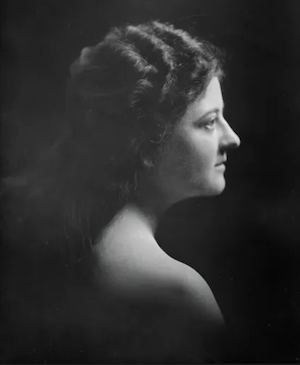
My latest trip down a rabbit hole was inspired by this issue’s theme of Finance & Law. One of the first news items that caught my eye was “Model for U.S. Coin Revealed as a Jewess at Marriage.” The two-paragraph story appeared in the July 24, 1930, copy of one of the Jewish Independent’s predecessors, the Jewish Centre News.

“Through her marriage it was revealed that Miss Doris Doscher, whose face adorns the new twenty-five cent pieces issued by the National Treasury, is a Jewess. She was married yesterday to Dr. H. William Baum at the Jewish Institute of Religion,” reads the article.

“Miss Doscher was selected several years ago by the government representatives as the model for the new twenty-five cent pieces because she characterized ‘the highest type of American Womanhood.’”

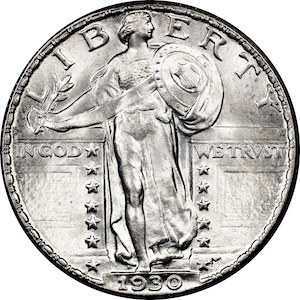
Doscher, who lived from 1882 to 1970, was an actress (in silent films!) and model. Her main claim to fame movie-wise seems to have been the role of Eve in 1918’s The Birth of a Race. Her most famous modeling ventures were for the Standing Liberty Quarter (in circulation 1916-1930), designed by Hermon Atkins MacNeil, and for the Pulitzer Fountain of Abundance by Karl Bitter (and Thomas Hastings, according to nycgovparks.org), which was dedicated in 2016, having been completed by Isidore Konti and Karl Gruppe after Bitter died in 1915. The fountain is located at Grand Army Plaza in Manhattan.

From the late 1920s, Doscher worked as a newspaper columnist and radio broadcaster, even having her own health and beauty column for a time; she also lectured on the topic. But, back to the Standing Liberty Quarter, which was controversial for a couple of reasons.

image - A 1918 print of Doris Doscher, horizontally flipped for comparison to the Standing Liberty Quarter, for which she may have been the model
A 1918 print of Doris Doscher, horizontally flipped for comparison to the Standing Liberty Quarter, for which she may have been the model. (photo from mediastorehouse.com)
image - Standing Liberty Quarter, 1930
The Standing Liberty Quarter, 1930.

The first iteration of Liberty was quite risqué, with her right breast exposed, which apparently appalled the women’s movement of the day, as well as clergy and others. According to edmontoncoinclub.com, “The initial production run of 52,000 pieces had made their way through the Treasury system by January 1917; by then, the production of the ‘Type 1’ 1917 issue was already in full-swing … but by early 1917 clearly something had to be done. Hermon MacNeil was obliged to modify his design, which he strenuously objected to [an article on uscoinnews.com asserts that MacNeil never authorized the design change], and the reasons that were given to him by the mint were everything from poor striking characteristics, relief problems, die wear, coin wear, anything else but that exposed breast. The dies were modified in time for the 1918 strike (known as ‘Type 2’), and it featured a now ‘clad-to-the-neck’ in chain-mail Liberty.” Other changes were made for that casting and there were later revisions. 

“The last run of the Standing Liberty Quarter took place in 1930, with only Philadelphia and San Francisco minting them. None were made in 1931 or 1932, possibly reflecting an oversupply because of the Great Depression, which had decimated the world economy in 1929,” notes the article on edmontoncoinclub.com.

The second controversy – which is still unresolved – arose after Doscher died. In 1972, another actress and model, Irene MacDowell, claimed to have been MacNeil’s model. According to various reports, her husband was friends with MacNeil and would not have approved of her modeling for the sculptor, hence, the secrecy. Another rumour is that MacNeil’s wife considered MacDowell a threat to her marriage, and so the sculptor kept her identity hidden.

It may never be known whether MacDowell or Doscher was the real model for the Standing Liberty Quarter, but Doscher was publicly credited, becoming known as known as “the girl on the Quarter.” And the moniker stuck. As noted on a memorial site for MacNeil (hermonatkinsmacneil.com), “100 years after the birth of Hermon MacNeil and fifty years after the Standing Liberty Quarter was minted, Doris Doscher Baum appeared on the TV quiz show I’ve Got a Secret on April 4, 1966.” The video is on YouTube.

There’s even more on this whole topic – including the reason the Standing Liberty coin was made. According to a blog on greatamericancoincompany.com, “When Robert W. Woolley took office as Mint director in April 1915, he asked [Philadelphia Mint superintendent Adam] Joyce to have [Mint chief engraver Charles] Barber submit some new designs for the dime, quarter and half dollar. It seems Woolley misinterpreted a memo from the assistant treasury secretary stating that coin designs could be changed after 25 years. Woolley took it to mean they must be changed and set the redesign wheels in motion.”

Barber’s suggested designs did not impress, and so a few sculptors were asked to make a submission, and MacNeil’s won. In the end, the blog notes, more than 214 million MacNeil quarters were made.

I could have spent as many hours exploring the other clippings I picked for this issue’s theme. I settled on a group that, to me, shows the paper’s diversity, as well as how technology and societal attitudes change over the years. 

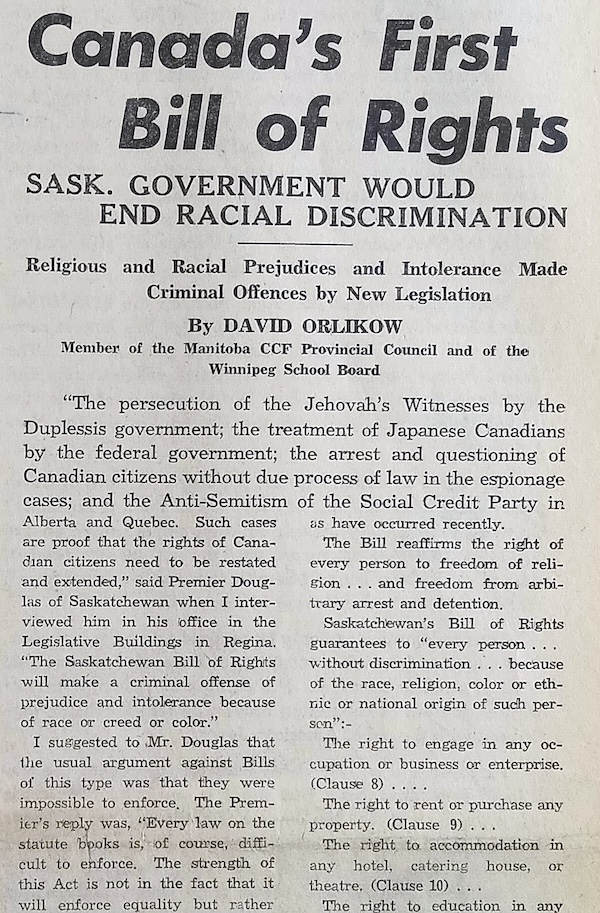
image - April 4, 1947: In an article by Winnipeg Jewish community member David Orlikow, Saskatchewan’s then-premier Tommy Douglas talks about the Bill of Rights his province was introducing  – the first such bill in Canada. Orlikow would have a 43-year political career, including 26 years as an MP (1962-1988)
April 4, 1947: In an article by Winnipeg Jewish community member David Orlikow, Saskatchewan’s then-premier Tommy Douglas talks about the Bill of Rights his province was introducing  – the first such bill in Canada. Orlikow would have a 43-year political career, including 26 years as an MP (1962-1988).
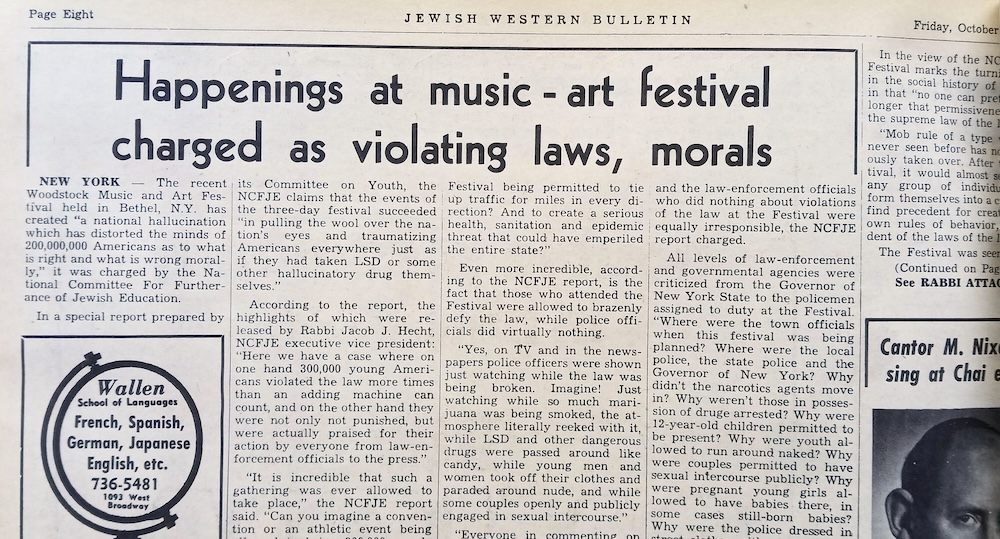
imaeg - Oct. 17, 1969: An organization called the National Committee for Furtherance of Jewish Education was appalled, to say the least, by the goings-on at the Woodstock Music and Arts Festival, which, it contended, created “a national hallucination which has distorted the minds of 200,000,000 Americans as to what is wrong morally"
Oct. 17, 1969: An organization called the National Committee for Furtherance of Jewish Education was appalled, to say the least, by the goings-on at the Woodstock Music and Arts Festival, which, it contended, created “a national hallucination which has distorted the minds of 200,000,000 Americans as to what is wrong morally.”

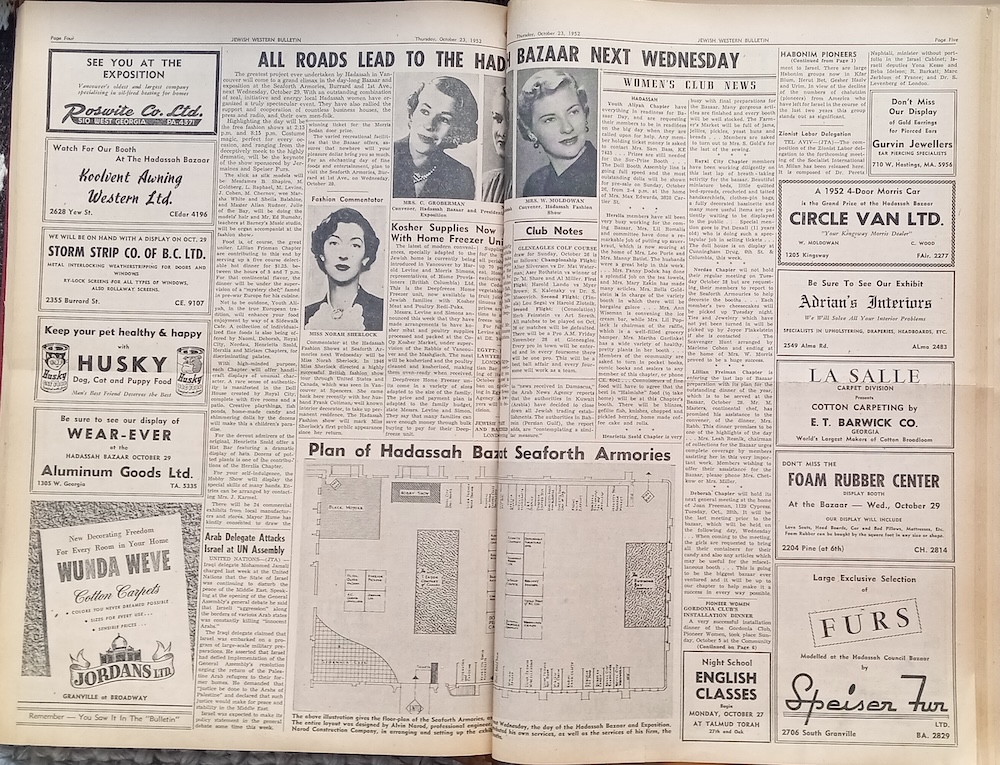
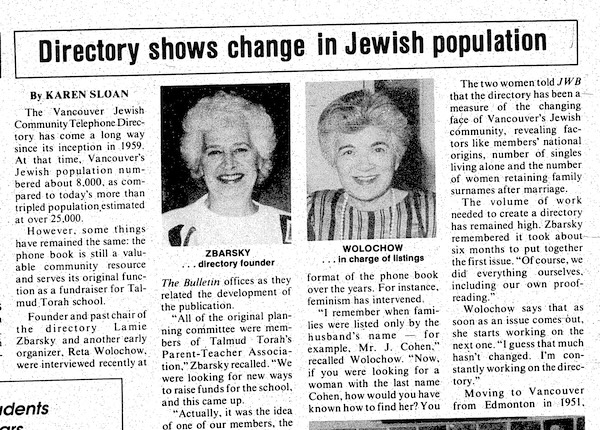
image 1 - Community organizations need to fundraise, of course. A couple of the longest-running initiatives were the Hadassah Bazaar, which may have started in 1933 as a small affair at the JCC that graduated to Seaforth Armories in 1952, though the 1952 bazaar is generally counted as the first one and the 2007 event at the Hellenic Community Centre as the last; and the community phone directory, a fundraiser for Vancouver Talmud Torah that ran from 1959 to 2013-14.

image 2 - Community organizations need to fundraise, of course. A couple of the longest-running initiatives were the Hadassah Bazaar, which may have started in 1933 as a small affair at the JCC that graduated to Seaforth Armories in 1952, though the 1952 bazaar is generally counted as the first one and the 2007 event at the Hellenic Community Centre as the last; and the community phone directory, a fundraiser for Vancouver Talmud Torah that ran from 1959 to 2013-14.
Community organizations need to fundraise, of course. A couple of the longest-running initiatives were the Hadassah Bazaar, which may have started in 1933 as a small affair at the JCC that graduated to Seaforth Armories in 1952, though the 1952 bazaar is generally counted as the first one and the 2007 event at the Hellenic Community Centre as the last; and the community phone directory, a fundraiser for Vancouver Talmud Torah that ran from 1959 to 2013-14.


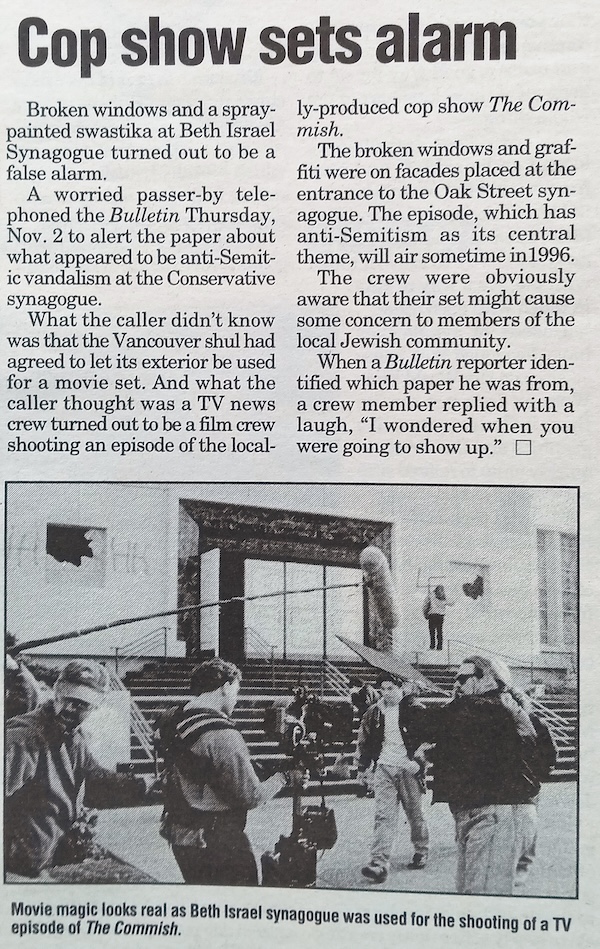
image - Nov. 17, 1995: Antisemitic graffiti on Beth Israel Synagogue concerned a passerby, but it was a “false alarm.” BI had agreed for its exterior to be used for “an episode of the locally-produced cop show The Commish.”
Nov. 17, 1995: Antisemitic graffiti on Beth Israel Synagogue concerned a passerby, but it was a “false alarm.” BI had agreed for its exterior to be used for “an episode of the locally-produced cop show The Commish.”
Format ImagePosted on October 24, 2025October 23, 2025Author Cynthia RamsayCategories From the JITags coins, finance, history, Jewish Centre News, Jewish Western Bulletin, law, ytttttttttt

When approaches differ

News of a possible breakthrough that could lead to the end of the war between Israel and Hamas is encouraging, but there is effectively no happy ending to this situation. Nothing can return the lives lost or undo the horrors of the past two years. Even if it ends tomorrow, the tragedy of this war will go down as one of the saddest, most protracted chapters in a heartbreaking history.

The international repercussions have been less lethal but will have permanent implications for, among other things, the stability and well-being of Jewish communities in the diaspora. Global antisemitism has reached unimagined heights. And, globally, Jewish people and organizations are at odds over how to proceed.

For many months, voices in Israel, among Jews worldwide and in our own local community have been divided over, among other things, whether Israel should unilaterally end the war, pursue it to the stated end of eliminating Hamas or, depending on the perspective, something on a spectrum between these views. Some are calling for an Israeli or international occupation of Gaza. 

Here in British Columbia, weekly solidarity rallies at Vancouver City Hall have continued, sometimes with small numbers, and featuring a diversity of voices. Other rallies, including marches across the Burrard Street Bridge and, this week, a community commemoration of the second anniversary of 10/7, have brought together overlapping and different participants.

It is sometimes hard for human beings, especially those deeply determined to do the right thing, to accept that there can be legitimate but differing opinions on the best way forward. We should be able to agree on this: no one can predict the future or know for certain what is best for the people of that region (or for Jews worldwide). We may disagree on fundamentals, such as whether a two-state solution remains a viable possibility or whether, at the other end of opinion, the West Bank and Gaza should be absorbed into an enlarged state of Israel (a perspective still generally viewed as extremist), or whether some kind of federated one-state system might integrate both peoples’ needs and futures. If we disagree on the end goal, we will almost certainly find fault with the other side’s means of reaching it.

Stuck as we may be in what seems an ideological, moral, political, strategic and theological disagreement, it is easy to view others, even those in our own community, as adversaries – this certainly is reflected in some of the messages we have received in recent days. On the one hand, we received an open letter to community rabbis ostensibly reminding them what Jewish morality entails, and, on a different hand, we received messages declaiming those in our community who call for a ceasefire as being in cahoots with nefarious groups, including one proscribed by the federal government as a terrorist entity. Both missives encourage community members to call out those who do not agree with their approach.

The passions ignited around this topic are understandable. These are existential issues faced by our people and our homeland. With no universally agreed-upon ends or means, division is inevitable. We should, though, keep in mind that, while it is our obligation to pursue justice, that pursuit includes minimizing harm in our own community. We should be guided by the understanding that our actions will have greater impacts on our people’s well-being here at home than on events halfway around the world. 

While it may be difficult in the moment of discord to see the sincerity and humanity of those we see as our opponents, there is a commonality at play. Believe it or not, the people in our community most vehemently hostile toward your outlook are convinced, as you are, that they are acting in the best interests of the Jewish people, and, in most circumstances, the best interests of our homeland.

Human affairs are an art, not a science. There are – surprise! – no right answers, only opinions and presumptions. As convinced as we may be otherwise, not one of us can conclusively know for certain the best avenue to pursue to bring about the future we dream of. 

At a minimum, let us presume we are all committed to a future of peace, justice and security. What that looks like, and how we get there, will differ.

Let us further presume the best intentions in others and celebrate our shared desire for positive outcomes and the impassioned commitment even of those with whom we disagree. 

Posted on October 10, 2025October 8, 2025Author The Editorial BoardCategories From the JITags community, diversity, hostages, Israel, Israel-Hamas war, peace, politics
From the archives … social life

From the archives … social life

Oct. 10, 1935: This week, 90 years ago, community members were coming and going from the city. There was a Folk Song and Dance Festival and Arts and Crafts Exhibition coming up. Beth Israel, Young Judaea, AZA, BB Junior Auxiliary, Junior Council and Sub-Junior Council all had meetings and other events. China Seas and Page Miss Glory were screening at the Capitol Orpheum and Heart’s Desire was playing at the Strand.

The Jewish Western Bulletin / Jewish Independent has always covered the arts and culture scene. Amid the harder-hitting news, there have been society and social notes columns, social and club news sections, synagogue calendars, event listings, notices and advertisements, as well as articles promoting, reviewing or otherwise profiling various creatives (including community organizers) or their creations/events.

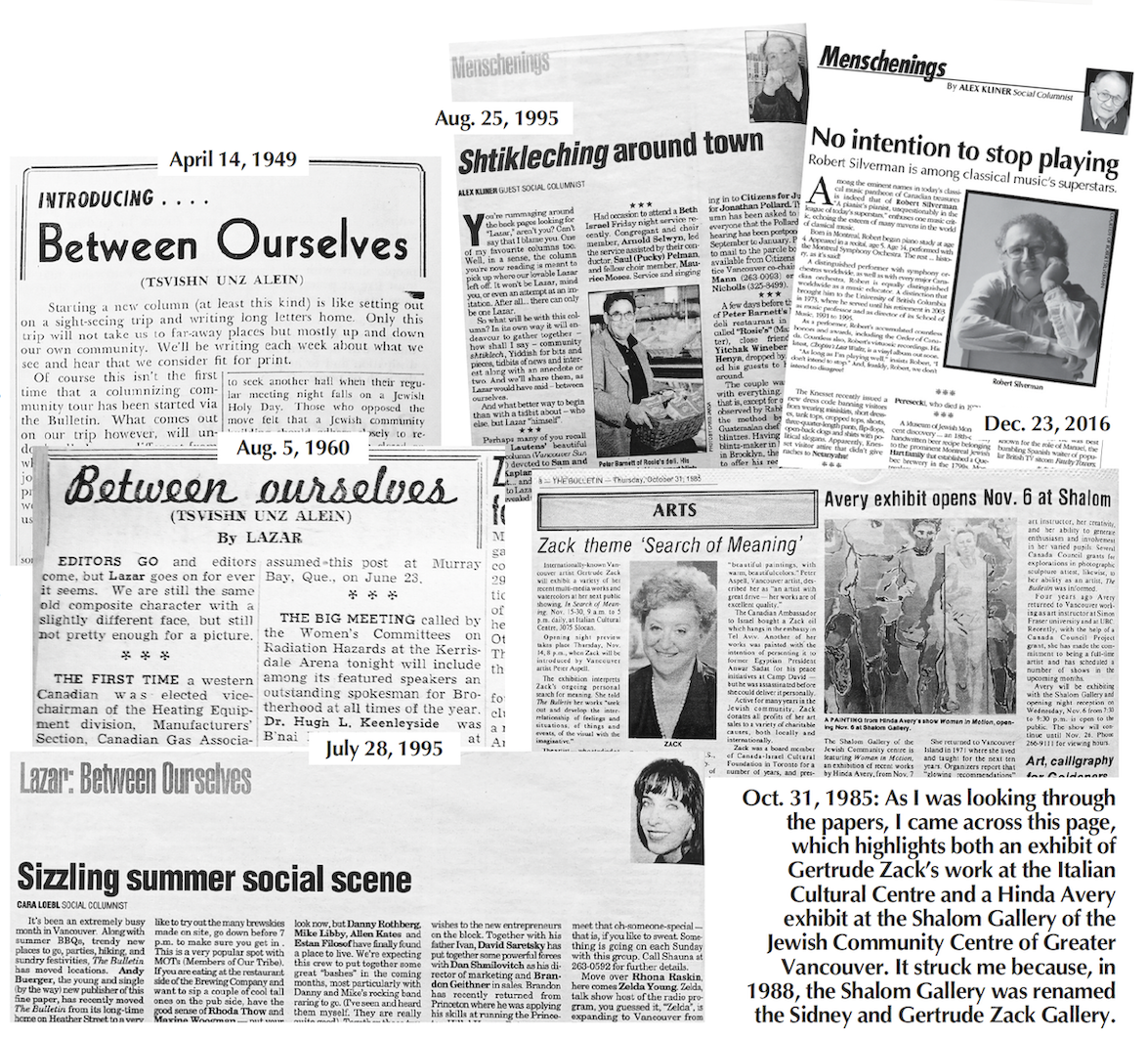
One of the longest-lasting social columns is Between Ourselves (Tsvishn Unz Alein) by Lazar, which started on April 14, 1949, when the JWB was run by the Vancouver Jewish Administrative Organization (akin to our Jewish Federation of Greater Vancouver) and Abraham Arnold was managing editor. When Sam and Mona Kaplan took over the paper in 1960, Mona Kaplan penned her first Between Ourselves (Tsvishn Unz Alein) by Lazar columns, in the Aug. 5 issue of that year, and she continued to be “Lazar” until the paper again sort of changed hands in mid-1995. While the Kaplans still owned the JWB, it came under new management, as they were beginning their retirement journey. At first, the new publisher, Andrew Buerger, kept the Lazar column – minus its Yiddish flavour – but editor Ariela Friedmann bid “Farewell to Lazar” (then written by Cara Loebl) a couple of months’ later, on Aug. 18, 1995.

Its replacement was Menschenings, which, Friedmann noted, would “give voice to all ages and aspects of the community, from social news, to what’s new, who’s new, some schmoozing, a bit of this and that.” 

Initially, the column was alternately written by two different writers, Jacqui Roitman and Alex Kliner, both of whom had experience in theatre and film. As many readers will know, Alex became the sole face of Menschenings, continuing through the Kaplans’ sale of the paper in mid-1999 to Kyle Berger, Pat Johnson and me. From his first column to his last, in 2016, when he retired, Alex’s writing was infused with Yiddish, having a heimishe (homey and familiar) quality like Lazar’s, meaning that Between Ourselves/Menschenings lasted some 67 years. 

image - Between Ourselves/Menschenings history in newspaper clippings

Format ImagePosted on October 10, 2025October 8, 2025Author Cynthia RamsayCategories From the JITags Abraham Arnold, Alex Kliner, Cara Loebl, history, Jacqui Roitman, Lazar, lifestyle, Mona Kaplan

Posts pagination

Page 1 Page 2 … Page 47 Next page
Proudly powered by WordPress